Key points
- Skate helmets sold in Europe are tested to EN 1078. ASTM F1492 is the US standard for skateboarding and requires protection against more than one moderate impact. CPSC is the US standard for bicycle helmets. Without a standards certification sticker inside the helmet, it is not a certified helmet.
- A helmet only protects you if it fits: measure your head circumference, put it on level and fasten the chin strap. A helmet with EPS foam must be replaced after a hard impact, even if there is no visible damage.
- Knee pads, elbow pads and wrist guards are tested in Europe to EN 14120: Level 1 for normal roller sports, Level 2 for acrobatic roller sports. The A, B or C range on the label is determined by body weight.
- For beginners, a helmet, wrist guards and knee pads are most important. Knee pads with hard caps are essential in ramps, and a fullface helmet and slide gloves for downhill.
- Measure pads on your body, not by clothing size: knee pads are usually measured around the thigh above the knee, elbow pads around the upper arm and wrist guards around the hand. The sizing chart for the model determines the fit.
- Vulc soles provide more board feel, cupsoles more cushioning and support. Suede withstands griptape the longest, and shoe glue on the seams extends a shoe's life.
#Principle
Falling is part of skating, even for professionals. Protective equipment can lessen the consequences of a fall, but it cannot prevent the fall or every injury. No helmet can reliably rule out a concussion. The US Consumer Product Safety Commission (CPSC) explicitly states that no type of helmet has been proven to prevent concussions. Nevertheless, the helmet is the most important piece of equipment because head injuries can have the most serious consequences.
Knee, elbow and wrist protectors are designed to reduce bruises, abrasions and cuts. TSG states in the instructions for its skate protectors that they cannot significantly lessen serious injuries such as fractures under very high forces and offer only limited protection in falls at speeds above 13 km/h. Pads therefore make learning more comfortable and take the sting out of many falls, but they do not make you invulnerable.
In Switzerland, helmets are not mandatory for skateboarding. Whether and what you wear is up to you. Nevertheless, the BFU recommends a well-fitting helmet as well as knee, elbow and wrist pads (more under Switzerland: what the BFU recommends). We strongly recommend helmets and pads for children, beginners and anyone riding ramps. Many skateparks and courses require them in their rules.
- Helmet in Europe
- EN 1078, with CE mark
- Helmet USA, skateboard
- ASTM F1492, for more than one moderate impact
- Helmet USA, bicycle
- CPSC 16 CFR 1203
- Helmet downhill
- Fullface, e.g. additionally tested to ASTM F1952
- Knee, elbow, wrist
- EN 14120, Level 1 or Level 2, area A, B or C
- Order of importance for beginners
- Helmet, wrist guards, knee pads, elbow pads
#Helmet: construction types
Every helmet has two jobs: a shell distributes the impact over a larger area and allows the head to slide over the ground, while foam underneath absorbs the energy. How the shell and foam are constructed determines whether a helmet is intended for one hard impact or several lighter ones.
| Construction type | Construction | Behavior on impact | Typical for |
|---|---|---|---|
| Hard shell with EPS | Separate plastic shell, usually ABS, over a core of rigid EPS foam (expanded polystyrene), with comfort padding inside. | The EPS foam is partially crushed on impact, absorbing the energy. It is designed for one moderate to hard impact and does not recover afterward. | Classic round skate helmets with a bicycle standard (EN 1078 or CPSC), for example Pro-Tec Classic Certified, Triple 8 THE Certified Sweatsaver or TSG Evolution. |
| In-mold | Thin polycarbonate outer skin fused directly to the EPS foam. | As with the EPS helmet: one hard impact, then replace it. Lighter and often better ventilated, but the thin skin is more susceptible to scratches and dents. | Bicycle helmets, also some combination skate and bicycle helmets. |
| Soft foam for multiple impacts | Hard shell over a softer, resilient foam. | Intended to withstand several lighter impacts, such as those that occur while skating in a session. It is not necessarily as effective as EPS against a very hard impact. | Helmets meeting ASTM F1492 and helmets without a bicycle standard. Only the sticker states whether and to which standard such a helmet has been tested. |
| Fullface | Hard shell with EPS and a fixed chin bar that protects the chin and face. | Like an EPS helmet, but covers significantly more area. | Downhill and fast longboarding. |
Pro-Tec describes the Classic Certified as a continuation of its first helmet model, with an EPS core added for hard impacts. Triple 8 calls THE Certified Sweatsaver "dual certified": tested to the US bicycle standard CPSC and to ASTM F1492 for skateboarding. TSG also states that it uses EPS and not EPP, a foam marketed as resistant to multiple impacts.
Half shell, low-cut or fullface
- Round, smooth shell that covers the forehead, crown, sides and back of the head.
- The round shape slides well over the ground during a fall.
- Few, small ventilation holes, so it is warmer than a bicycle helmet in summer.
- Some models extend lower at the back and temples and cover more of the back of the head.
- Fixed chin bar, protects the chin, teeth and face.
- Often with a visor and cheek pads for adjustment.
- Heavier and warmer, restricted downward field of vision.
- According to the manufacturer, the TSG Pass is intended only for downhill skateboarding and is tested to ASTM F1952 and CPSC in addition to EN 1078.
#Helmet: EN 1078, ASTM F1492 and CPSC standards
A standard specifies how a helmet is tested: how much energy acts on impact against different anvils, how much the test head may decelerate at most, which area of the head the helmet must cover and how much the chin strap can withstand. The standard designation appears on a sticker or printed marking inside the helmet or on the strap. If it is missing, the helmet has not been tested. Do not rely on names, appearance or packaging.
| EN 1078 | ASTM F1492 | CPSC (16 CFR 1203) | |
|---|---|---|---|
| Origin | Europe, harmonized standard under the PPE Regulation | USA, voluntary standard | USA, legally required for bicycle helmets |
| Intended for | Bicycling, skateboarding and roller skating | Skateboarding, longboarding, aggressive roller skating and inline skating | Bicycling, scooter riding |
| Type of impacts | One hard impact per test site | More than one moderate impact, but only a limited number | One hard impact per test site |
| Deceleration limit | 250 g | not quantified in our sources | 300 g |
| Impact energy according to TSG | 89 J on a flat anvil, 65 J on an edge anvil | not quantified in our sources | 98 J on a flat anvil, 58 J on edge and hemispherical anvils |
| Coverage | according to TSG, a larger area than CPSC | not quantified in our sources | according to TSG, a smaller area than EN 1078 |
| Other tests | Field of vision, straps and buckle, heat, cold, UV aging | not described in our sources | Roll-off test, chin strap, heat, cold, wet conditions |
g denotes the multiple of gravitational acceleration measured at the test head. The lower the limit, the stricter the requirement at the same energy. The values for EN 1078 and CPSC come from TSG, the characterization of ASTM F1492 from the CPSC.
What the differences mean in practice
- EN 1078 is the standard you will find on practically every skate and bicycle helmet in Switzerland and the EU. It expressly covers skateboarding. Together with the CE mark, it shows that the helmet was examined as personal protective equipment under Regulation (EU) 2016/425 by a notified testing body.
- ASTM F1492 was developed for what is typical when skating: many smaller falls in a session. The helmet must withstand more than one moderate impact, but protects against only a limited number. The CPSC lists this standard for skateboarding, longboarding and aggressive roller skating and inline skating.
- CPSC tests a single, hard impact with more energy, as can occur when bicycling in traffic. A helmet that carries only CPSC certification is a bicycle helmet.
- “Dual certified” usually means CPSC and ASTM F1492 together for US brands. In Europe, many skate helmets are sold with EN 1078 and additionally one or both US standards. Such a helmet is suitable if you skate and ride a bicycle with the same helmet.
- A full-face helmet for downhill may also be tested to ASTM F1952. This is the US standard for downhill mountain bike helmets, it tests the chin bar, among other things.
- Some models are certified only in certain sizes or variants. Pro-Tec and Triple 8 offer helmets that look the same with and without the designation “Certified”. Read the sticker inside the helmet you buy.
#Helmet: MIPS and other rotational systems
In most falls, the head hits at an angle rather than straight on. This not only slows it down but also sets it rotating. This rotation is considered a common cause of concussions and more severe brain injuries. Rotational systems are intended to reduce this rotational motion.
- MIPS is a thin, low-friction layer inside the helmet. During an angled impact, it moves slightly relative to the helmet and is intended to divert some of the rotational forces away from the head.
- Other manufacturers address the same issue with their own systems, the BFU cites ODS and Wavecel as examples alongside MIPS. All have a layer or structure that can move on impact.
- In 2024, the BFU tested bicycle helmets with and without rotational damping in a laboratory. Helmets with such systems provided better protection against brain injuries, so the BFU recommends them for bicycle helmets. It did not test skate helmets in this study.
- A rotational system does not replace a standard. The helmet must still be tested to EN 1078 and fit correctly.
- MIPS itself points out that no helmet protects against all injuries.
Whether a helmet has a rotational system is stated in the product description, for Pro-Tec, for example, in the model name with the addition “with MIPS”. If you are looking for a helmet that you will also use for bicycling, a model with EN 1078 and rotational damping is worth considering.
#Helmet: measuring size and checking fit
- Measure head circumference
Place a soft measuring tape horizontally around your head, about 2.5 cm above your eyebrows, just above your ears and over the widest part at the back of your head. The measurement in centimeters is your helmet size. Measure two or three times and use the largest measurement.
- Use the model's size chart
Each brand and often each model has its own chart. An M is not the same everywhere, as the chart below shows. If you are between two sizes, try both. Triple 8 and 187 Killer Pads recommend the larger size in this case, as does Pro-Tec if your measurement is at the upper end of a size. According to the product description, Triple 8 includes two sets of Sweatsaver pads with THE Certified Sweatsaver, allowing you to fine-tune the fit. TSG also supplies pads in two thicknesses with its half-shell helmets.
- Putting it on
The helmet sits level, not pushed back onto the back of your head or pulled down low over your forehead. According to the BFU, the front edge sits about two finger widths above the bridge of your nose and protects your forehead.
- Shake test
With the chin strap unfastened, shake your head and nod. The helmet stays in place without pressing on your head. If you move it forward, backward or sideways by hand, the skin on your forehead moves with it. If the helmet has an adjustment dial at the back of your head, adjust it now so that nothing wobbles.
- Adjust the straps
The side straps meet just below the ear and are equally tight. The chin strap is fastened and adjusted so that one or two fingers still fit between the strap and your chin.
- Roll-off test
With the strap fastened, try to roll the helmet off from back to front over your forehead. If you can do this, the helmet is too large or the strap is too loose.
| Model | Size | Head circumference |
|---|---|---|
| Pro-Tec Classic Certified | XS | 52 to 54 cm |
| Pro-Tec Classic Certified | S | 54 to 56 cm |
| Pro-Tec Classic Certified | M | 56 to 58 cm |
| Pro-Tec Classic Certified | L | 58 to 60 cm |
| Pro-Tec Classic Certified | XL | 60 to 62 cm |
| Triple 8 THE Certified Sweatsaver | XS/S | 51 to 54 cm |
| Triple 8 THE Certified Sweatsaver | S/M | 53 to 57 cm |
| Triple 8 THE Certified Sweatsaver | L/XL | 57 to 60 cm |
| Triple 8 THE Certified Sweatsaver | XL/XXL | 60 to 63 cm |
| Triple 8 Lil 8 (children) | one size | 46 to 52 cm |
| Triple 8 Little Tricky (children) | one size | 50 to 56 cm |
| TSG Evolution | XXS/XS | 52 to 54 cm |
| TSG Evolution | S/M | 54 to 56 cm |
| TSG Evolution | L/XL | 57 to 59 cm |
| TSG Evolution | XXL | 59 to 61 cm |
Manufacturer size charts as of November 2026. The size designations are not comparable: a Pro-Tec S for the Classic Certified starts at 54 cm, a Triple 8 S/M at 53 cm. If your measurement is at the upper end of a size, Pro-Tec recommends the next size up. Always use the chart for the model you are buying.
#Helmet: when to replace it
- After a hard impact to the head, if your helmet has rigid EPS foam. The foam has deformed at the point of impact and no longer absorbs impact there. According to the CPSC and TSG, this also applies if no damage is visible from the outside.
- For a multiple-impact helmet, as soon as the shell or foam is visibly damaged, for example with cracks or permanent dents, or when the manufacturer specifies.
- If the shell has cracks, is separating from the foam, or is faded and brittle.
- If the foam shows dents, cracks, impressions or compressed areas.
- If straps are frayed, the buckle does not fasten properly, or padding is missing.
- After exposure to heat: TSG states that helmets are damaged above 65 °C and that a car or bag can reach this temperature on hot days. Heat damage appears as blistered, uneven areas.
- After the manufacturer's specified period. TSG recommends replacement every 3 to 5 years under normal use and no later than 6 years after the date of manufacture on the label. If no period is specified, the CPSC gives a guideline of 5 to 10 years from purchase, depending on use, care and storage.
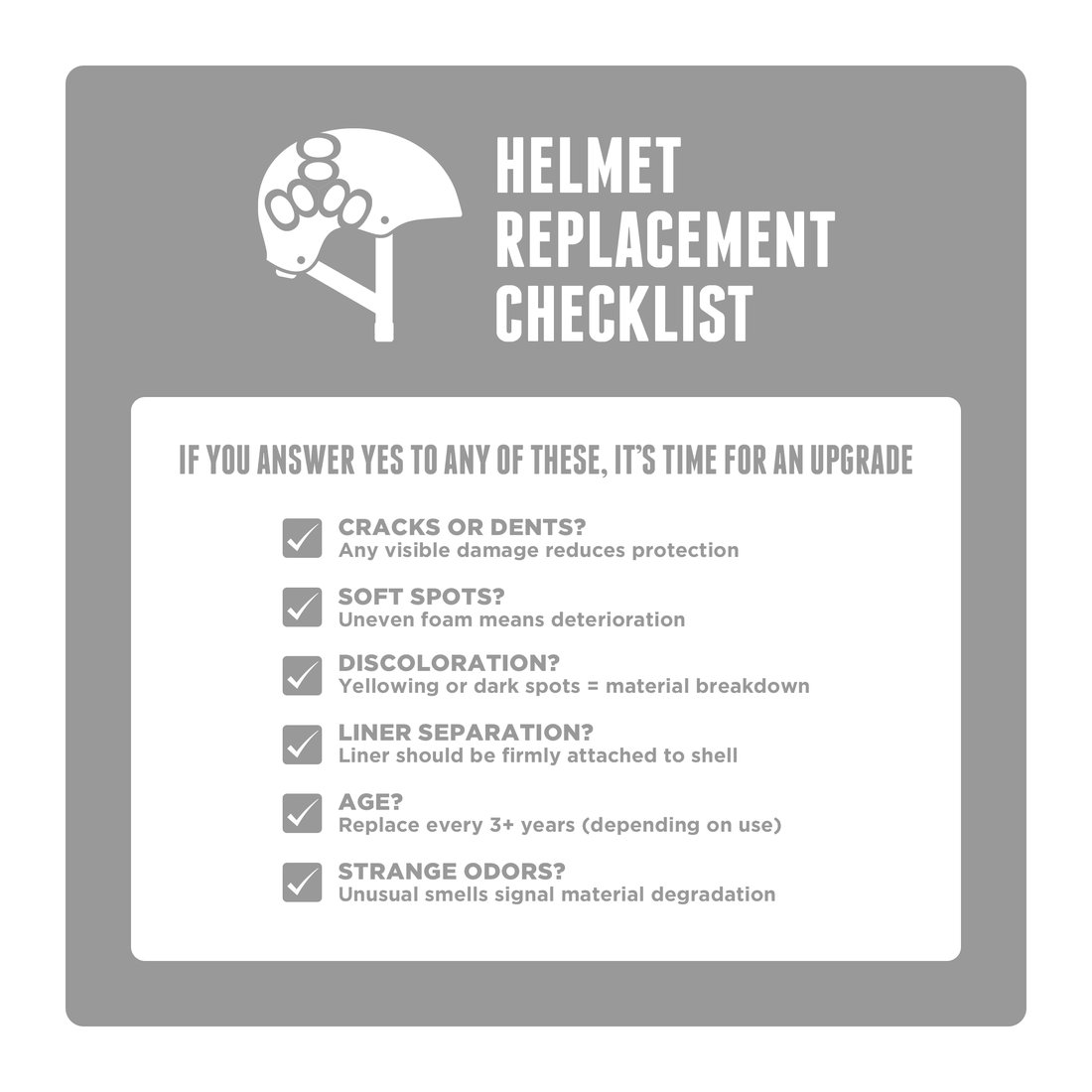
Store the helmet in a dry, cool place, not in direct sunlight or in a hot car. Let it air-dry after every session. Clean the shell only with a soft, damp cloth, cold water and mild soap. On most models, the padding can be removed and washed by hand. Follow the manufacturer's care instructions.
#Protective gear: overview, EN 14120 standard and CE mark
Protective pads for roller sports are tested in Europe according to EN 14120. The standard applies to wrist, palm, knee and elbow guards for skateboarding, roller skating, inline skating and scooters. Shock absorption, abrasion resistance, fit and comfort are tested. The CE mark shows that the protective pad complies with Regulation (EU) 2016/425 as personal protective equipment. For TSG skate protective gear, for example, a notified body has carried out an EU type examination, and its name and number are listed in the instructions.
| Information | Meaning |
|---|---|
| Level 1 | For normal roller sports: learning to ride, cruising, street and small ramps. |
| Level 2 | For acrobatic roller sports with higher demands: ramps, bowl, vert, jumps. |
| Category A | For people weighing up to 25 kg. |
| Category B | For people weighing over 25 kg up to 50 kg. |
| Category C | For people weighing over 50 kg. |
| Body part | A symbol shows whether it is a knee pad, elbow pad or wrist guard. |
| LEFT or RIGHT | On guards sold as a pair, the side is indicated on a sewn-in label. |
Each manufacturer determines which letter size falls into which category. At TSG, TXXS and XXS fall into category A, XS into category B and S through XL into category C. The label must not be removed. The examples for Level 1 and Level 2 in the table are our own classification.
| Guard | Construction | Purpose | More information |
|---|---|---|---|
| Wrist guard | Cuff with a plastic splint on the palm, often also on the back of the hand. | When you fall forward, you reflexively put your hands out to break your fall. The splint distributes the impact and allows the hand to slide over the ground. | Wrist guard section |
| Slide gloves | Glove with replaceable plastic pucks on the palm and fingers. | For longboarding: the hand rests on the ground while sliding. | Slide gloves section |
| Knee pads | Padding in a slip-on design or with a hard plastic cap and hook-and-loop straps. | On a ramp, you slide on the cap when you fall (knee slide). On the street, they cushion the impact. | Knee pads section |
| Elbow pads | Like knee pads, but smaller. | Protect against falls to the side and backward. | Elbow pads section |
| Crash pants | Tight-fitting pants with padding at the hips, tailbone and often the thighs. | Cushion falls onto the hips and buttocks, which are common when learning and in transition. | Crash pants section |
#Wrist guards
When you fall forward, you put your hands out. Your full weight lands on the heel of your hand, and your wrist bends backward. A wrist guard is intended to address both: the splint distributes the impact and slides over the ground instead of the skin catching on the asphalt. That makes it one of the most important guards for beginners.
Construction
- Lower splint (palmar splint): plastic splint under the palm, running from the heel of the hand toward the forearm. It is the most important part and should sit in the center of the heel of the hand.
- Upper splint (dorsal splint): splint on the back of the hand. Together with the lower splint, it keeps the joint more stable in both directions. Not every model has one.
- Slide plate: hard, smooth surface on the outside of the heel of the hand, often part of the lower splint. It allows the hand to slide and protects against abrasions.
- Cuff: fabric or neoprene with a thumb hole, fastened with two or three hook-and-loop straps. The fingers remain free.
- Prevent or significantly reduce abrasions and bruises on the heel of the hand.
- Distribute the impact over a larger area.
- Allow the hand to slide over the ground instead of stopping abruptly.
- Help beginners overcome the fear of falling forward.
- They do not prevent every fracture. A very hard fall can also transfer the force farther up into the forearm.
- The splint makes it harder to grip the board during grabs and to pick it up.
- If fastened too loosely, they slip out of place during a fall and provide little protection.
- They are no substitute for practicing how to fall properly.
To determine your size, measure the circumference of your hand at palm level. TSG calls this measurement «palm». At Triple 8 and 187 Killer Pads, the measurements are given in inches. The guard should fit snugly without constricting your fingers.
#Slide gloves for longboarding
Slide gloves are a category of their own and are not a substitute for wrist guards. When longboarding, you put one or both hands on the asphalt for slides and to brake. To let your hand slide instead of getting scraped, hard plastic discs called pucks are attached to the palm and often to the fingertips.
- Pucks: usually made of UHMW, a highly abrasion-resistant polyethylene. They wear down and can be replaced on many models, often using hook-and-loop fasteners.
- Glove: durable material such as leather, suede or fabric with Kevlar. For example, Landyachtz makes the Bling Hands Slide Glove from a blend of Kevlar, nylon and suede, with double stitching at wear points.
- Fit: tight enough to keep the puck from shifting, with a closure at the wrist.
- Limitations: A slide glove generally has no splint to support the wrist. It protects against abrasion, not against the wrist bending. The label states whether a model has been tested to a standard.
For more on board types, see Longboard. For downhill, a full-face helmet goes with the gloves, see Helmet: types.
#Knee pads
Knee pads have the widest selection of any protective pad, because knees are used differently in each discipline. In street, you are more likely to fall onto your knee and roll out of the fall. In a ramp, you deliberately drop onto your knees and slide down the transition. These require different designs.
- A neoprene or fabric sleeve with a sewn-in foam pad, often with a thin, flexible outer layer.
- Slim, flexible, fits under pants.
- Stays in place through its snug fit, some models also have hook-and-loop straps.
- Cushions impacts, but does not slide as well on concrete as a hard cap.
- Thick, multilayer padding with a hard, replaceable plastic cap at the front.
- Made for sliding down the ramp on the cap.
- Fastened with wide hook-and-loop straps at the top and bottom, often with an inner pull-on sleeve.
- Warmer and bulkier, difficult to wear under tight pants.
Knee slide: why the hard cap matters
If you lose control in a ramp, you jump off the board, turn toward the ramp and drop onto your knees. With your upper body upright, you slide down the transition on the caps until you are standing in the flat. This is the knee slide. It only works if the cap is hard and smooth and the pad does not twist while sliding. A soft cap slows you down on the concrete, and the momentum goes into your knees. Practice knee slides first from a standing position halfway up the ramp, before you need them.
Padding thickness and closure
| Feature | Options | What to look for |
|---|---|---|
| Padding thickness | From slim street pads to thick vert pads with multiple layers of foam | The higher the ramps and the more often you fall onto your knees, the thicker the padding should be. The standard does not prescribe a specific number of millimeters, it tests the effectiveness. |
| Pull-on | Sleeve pulled over the foot and lower leg | Fits most securely, but must be pulled on before putting on shoes. |
| Hook-and-loop | Open pad with straps above and below the knee | Can be put on and taken off with shoes on. Straps should be tight, but without constricting. |
| Butterfly or Open Back | Pad opens completely at the back, padding is placed at the front and fastened at the back | Convenient with shoes and pants, the fit depends heavily on fastening it correctly. Example: Pro-Tec Street Knee Open Back. |
| Combination | Inner sleeve plus outer hook-and-loop straps | Typical of vert pads, holds best when sliding. |
Recaps: replaceable caps
On park and vert pads, the cap wears down with every knee slide. So that you do not have to replace the entire pad, the caps can be swapped on many models. 187 Killer Pads calls them ReCaps and offers them in several sizes to match the pad size. Pro-Tec has replacement caps for the Vert Knee. Replace the cap before it is worn through or has cracks, and choose the size the manufacturer specifies for your model.
#Elbow pads
Elbows hit the ground mainly during falls to the side and backward, and also when slipping on the transition in a ramp. Elbow pads are built like knee pads, only smaller: as slim slip-on pads or with a hard cap and hook-and-loop straps for park and vert.
- TSG measures the lower upper arm just above the elbow.
- Elbow pads tend to slip down on narrow arms. A model with two straps or a snug slip-on pad stays in place better.
- For children and beginners, they are part of every pad set. For bowl and vert, we recommend models with a hard cap.
- In street, many advanced skaters no longer wear elbow pads. If you often fall backward, slim models worn under a sweater can help.
#Crash pants and hip protection
When learning, on flat ground and in transition, you often fall on your hips, buttocks and tailbone. Crash pants are tight-fitting underwear or shorts with padding sewn in at these points. They are worn under your regular pants.
- Padding at the hip bones, buttocks and tailbone. Some models also pad the outer thighs.
- At SKATE.CH, for example, Triple 8 Bumsaver and Pro-Tec Impact Shorts. For the upper body, there are padded shirts such as the Triple 8 Bashguard Padded Top.
- They should fit snugly so that the padding stays in the right place during a fall.
- Particularly useful when returning after a long break, for adults who are new to skating, and for longboarding.
#Ankle protection and mouthguards
Ankle protection: The most common blow to the ankle comes from your own board, for example when it spins during a flip trick. Mid- and high-top shoes with a padded upper are particularly helpful against this (see Skate shoes: Low, Mid or High). There are also thin neoprene ankle guards with padding that are worn under the sock. They provide little support against rolling your ankle.
Mouthguards: Mouthguards are not widely used in skating. If you skate bowl and vert a lot or have fallen on your chin before, you can wear a sports mouthguard like those commonly used in combat and team sports. For downhill, a full-face helmet with a chin bar protects the chin and teeth much better.
#Protective gear: measuring for sizes
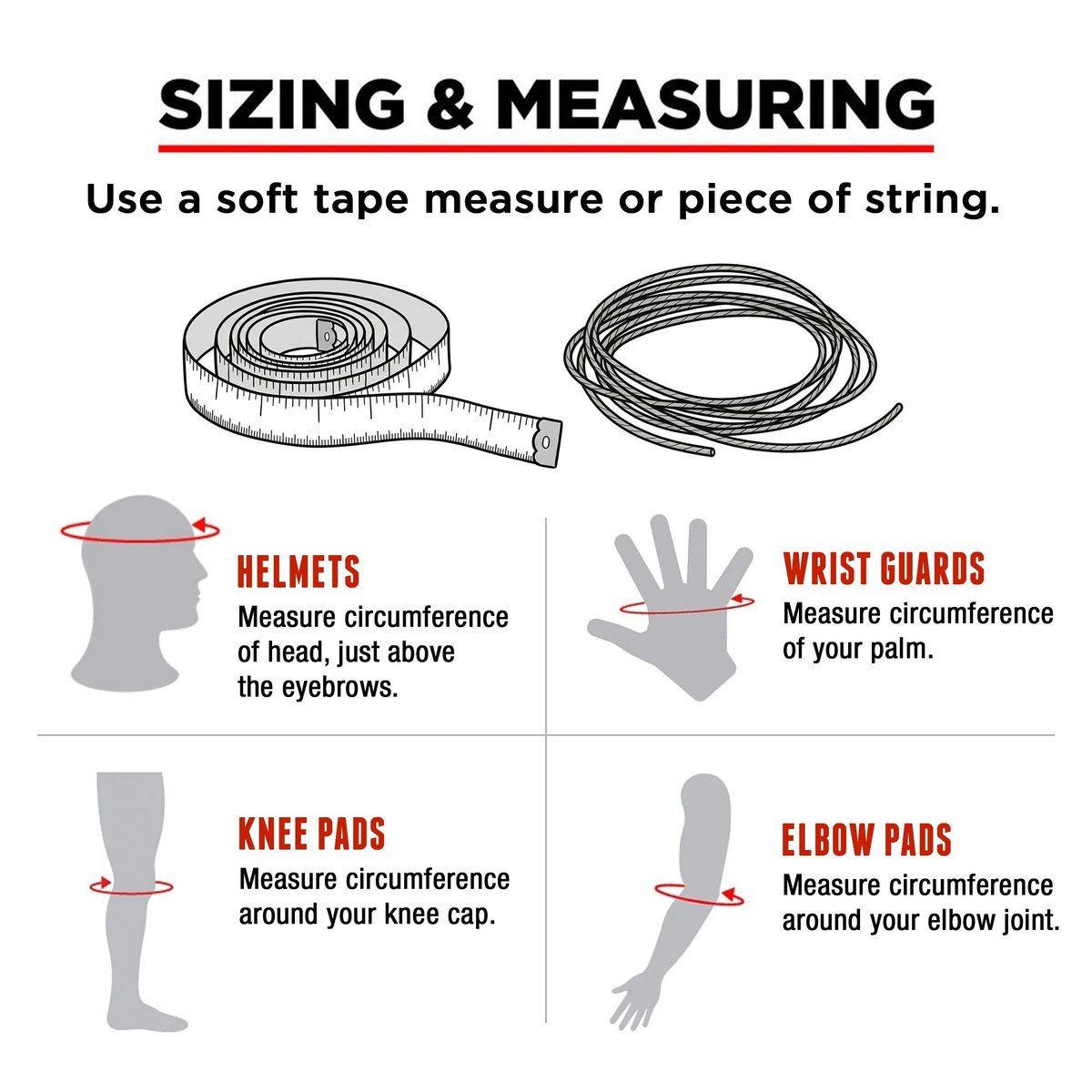
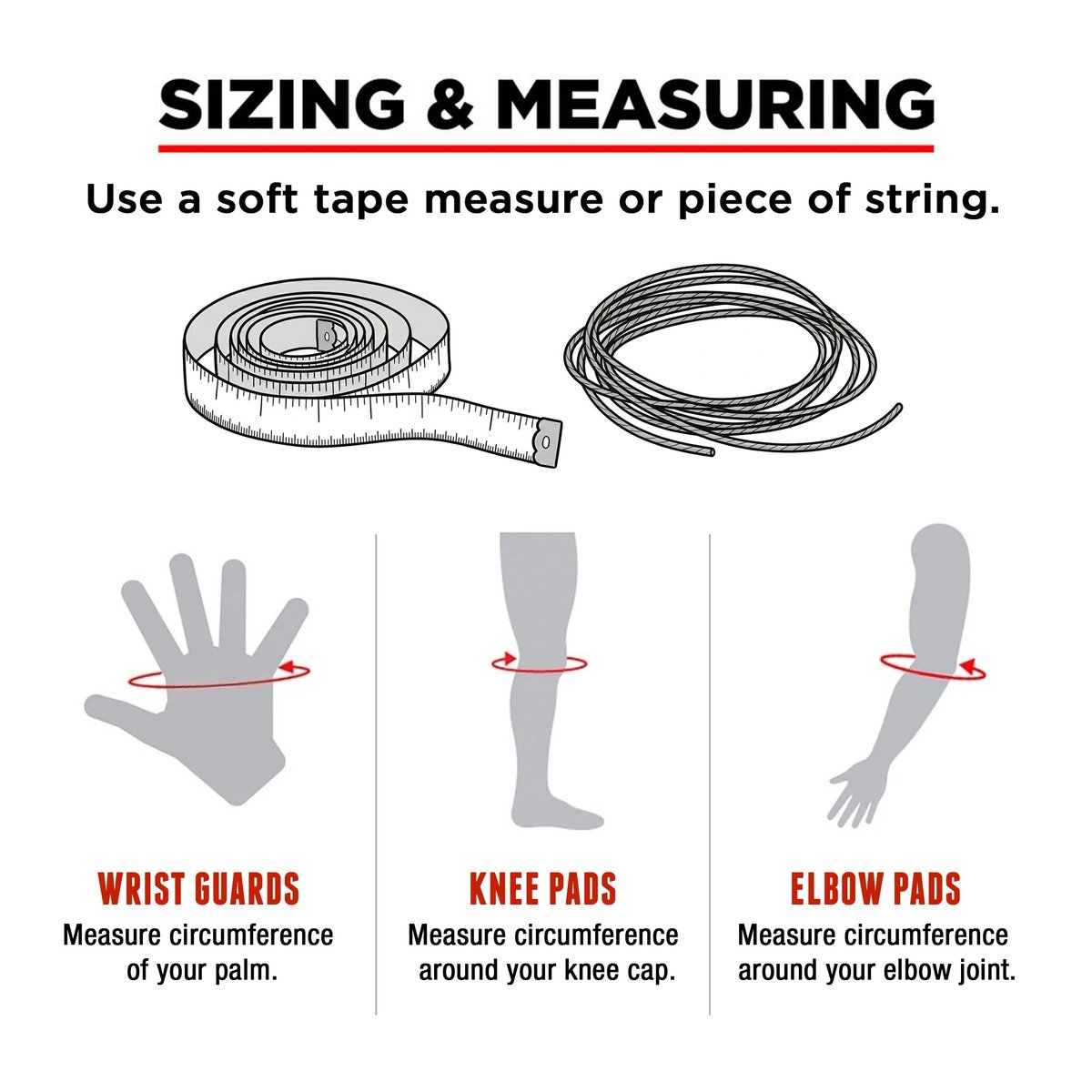
Buy pads according to your body measurements, not your clothing size. Manufacturers measure at different points, so always use the chart for the model. Measure with a soft measuring tape, with your muscles relaxed and no clothing underneath.
| Pad | Measurement point | TSG sizes in cm |
|---|---|---|
| Knee pads | Thigh circumference, 13 cm above the center of the knee | XXS 25 to 30, XS 30 to 34, S 34 to 38, M 38 to 42, L 42 to 46, XL 46 to 50 |
| Elbow pads | Lower upper arm circumference, just above the elbow | XXS 18 to 22, XS 23 to 26, S 26 to 29, M 29 to 32, L 32 to 35 |
| Wrist guards | Hand circumference at palm level (called «palm» by TSG) | S 17 to 19, M 19 to 21, L 21 to 23, XL 23 to 25 |
| Junior set knee | Thigh circumference | one size, 26 to 30 |
| Junior set elbow | Lower upper arm circumference | one size, 20 to 23 |
| Junior set wrist | Hand circumference | one size, 15 to 18 |
Values from the TSG skate protector instructions, as of 2024. Some other brands measure at the knee itself and use inches. At 187 Killer Pads, for example, the Pro Knee ranges from JR (9 to 11 inches) to 2XL (21 to 24 inches).
- If you are between two sizes, Triple 8 and 187 Killer Pads recommend the larger one. For slip-on pads, the smaller size is often the better choice, as they can otherwise slip. Try them on if possible.
- TSG points out that no size fits all body shapes. If a pad does not fit properly, choose a different model, not a larger size.
- Pads are usually marked as left and right. Check the label when putting them on.
#What is useful for whom
| Situation | Helmet | Wrist | Knee | Elbow | Other |
|---|---|---|---|---|---|
| Children | yes, child-sized half-shell helmet | yes | yes | yes | set for children, crash pants optional |
| Adult beginners | yes | yes | yes | recommended | crash pants recommended |
| Returning after a long break | yes | yes | yes | recommended | crash pants recommended |
| Street, advanced | recommended | as needed | slim sleeve pads as needed | rarely | mid- or high-top shoes to protect against impacts from the board |
| Mini ramp and skatepark | yes | optional | yes, with hard cap | recommended | crash pants optional |
| Bowl and vert | yes | optional | yes, vert pads with hard cap | yes, with hard cap | crash pants optional |
| Cruising in the city | yes | recommended | optional | optional | light at night |
| Longboard, carving and freeride | yes | yes or slide gloves | recommended | recommended | slide gloves, crash pants |
| Downhill | full-face helmet | slide gloves | yes | yes | crash pants, durable clothing |
This is our recommendation based on practical experience, not a rule. The BFU generally recommends a helmet, knee pads, elbow pads and wrist guards for skateboarding and skateparks.
According to the BFU, anyone traveling on a roadway or bike path in Switzerland at night or in poor visibility needs a clearly visible white light facing forward and a red light facing backward. Lights that clip onto clothing or a backpack are the easiest option.
#Pad sets for children and beginners
A set is practical for starting out: knee pads, elbow pads and wrist guards in one package, often called a «3-Pack» or «Six Pack» (three pairs). SKATE.CH carries sets from 187 Killer Pads (Pre-K, Junior and Six Pack), Pro-Tec (Street Gear 3-Pack for Junior and adults) and Triple 8 (Saver Series 3-Pack, also available in Junior).
- Children's sets are often made in one size for an age range. For example, Triple 8 specifies 5 to 8 years for its children's sets Little Tricky and Junior Derby. Age is only a guideline, the circumference of the thigh, upper arm and hand is what matters.
- Check the label for the weight range according to EN 14120: A for children up to 25 kg, B for 25 to 50 kg, C above that.
- Sets usually contain slip-on or hook-and-loop pads with hard caps for normal roller sports (Level 1). For bowl and vert, individual park pads are worthwhile for older children.
- A helmet is also needed, but is almost never included in the set. Buy it separately and have the child try it on.
- When a child outgrows the pads, they no longer slip but instead constrict. Then it is time for the next size.
You can find out how big a child's first board should be under Size for children.
#Common mistakes
- Helmet pushed back: The helmet is pushed back, leaving the forehead exposed. In a forward fall, it then fails to protect exactly where the head hits. The front edge should sit about two finger widths above the bridge of the nose.
- Chin strap open or too loose: Without the strap fastened, the helmet flies off on the first impact.
- Bought too large: Helmets and pads bought «to grow into» shift during a fall. A knee pad that turns to the side during a fall no longer protects you.
- Bought according to clothing size: Pads are sized by circumference. If you wear M in T-shirts, you do not necessarily need M in knee pads.
- Pads put on incorrectly: Left and right swapped, or the wrist guard splint on the back of the hand instead of under the palm.
- Hook-and-loop straps too loose: The straps should fit snugly. If dirt or lint is caught in the hook-and-loop fastening, it no longer closes properly.
- Continuing to skate with a damaged helmet: After a hard impact, an EPS helmet is spent, even without visible damage.
- Leaving pads in the car: Heat damages the helmet and foam. In summer, the inside of a car quickly gets hotter than the manufacturer allows.
- Going to the skate spot with wet pads: Wet material quickly starts to smell, and according to the BFU, wet parks are significantly more dangerous. Skate at the skatepark only when it is dry.
#Care: washing, drying, odor
Pads absorb a lot of sweat. Without care, they soon smell and the material deteriorates. The sewn-in label tells you how you may clean a pad, and its instructions must be followed. Many protective pads are not made for the washing machine: for example, the instructions for TSG skate pads show the symbols for do not wash, do not tumble dry, do not bleach and do not iron.
- Air out after every session
Do not leave pads in the bag. Open all straps and let them dry in an airy place. This is the most important step to prevent odor.
- Clean the hook-and-loop fastenings
Remove hair, lint and dirt from the hook-and-loop fastenings with a nail brush or an old toothbrush so the straps hold securely again.
- Clean the surface
Wipe the caps and fabric with a damp cloth or a soft brush. TSG recommends using only tap water for this, because cleaning agents, solvents and hairspray can damage the material, even if the damage is not visible.
- Hand wash removable foam
If the padding is removable and the label permits it, you can wash it by hand in lukewarm water. Then squeeze it out thoroughly, do not wring it.
- Air dry
Do not place on a radiator, in a tumble dryer, or in direct sunlight. Heat deforms foam and caps.
- Store correctly
Dry, ventilated, out of the sun. TSG specifies a range between 5 °C and 50 °C and advises against placing anything heavy on the pads.
#Service life: when to replace pads
Foam ages, fabric stretches out, and caps wear down. TSG recommends replacing its skate pads every 3 to 5 years with normal use, and no later than 8 years after the manufacturing date on the label. If you skate ramps a lot, you will often need new ones sooner.
- Check briefly before every session: cracks, holes, deformation, loose seams, and hook-and-loop fasteners that no longer hold.
- Cap worn through or cracked: replace the cap if the model has Recaps, otherwise replace the pad.
- Padding thin, hard, or crumbly: the foam no longer cushions impacts, so the pad needs to be replaced.
- After a heavy fall with visible damage: replace it.
- No longer fits: whether stretched out or outgrown, both mean it needs to be replaced.
- Do not repair, drill, glue, or cut it yourself. TSG points out that any modification can impair its protective function.
#Switzerland: what the BFU recommends
The BFU, the Swiss Council for Accident Prevention, gives clear recommendations for skateboarding, scootering, and inline skating. None of these are legally required, but according to the BFU they still make sense.
- A well-fitting helmet is not legally required, but is strongly recommended.
- Knee, elbow, and wrist pads, as well as sturdy shoes, are also recommended.
- At the skatepark: wear a helmet and knee, elbow, and wrist protection, and only use the park when it is dry.
- Children learn best in protected areas such as playgrounds, forecourts, or skateparks and are ideally accompanied by an adult.
- Skateboards are considered vehicle-like devices. When using one as a means of transportation, the rules for pedestrians apply to you. Where you are allowed to skate is regulated.
- At night or in poor visibility on roadways and bike paths: a white light at the front, a red one at the back.
- When buying a helmet, the BFU advises trying it on. Only a well-fitting helmet provides optimal protection.
#Brands at SKATE.CH
SKATE.CH carries helmets and protective gear from these manufacturers. All provide size charts for their models. The selection in the shop changes with the season.
- At home in skateboarding since 1973: according to Pro-Tec, the Old School Certified traces its origins to the Full-Tec from 1973.
- The Classic Certified continues the rounded shape of the first Pro-Tec helmet, now with an EPS core and tested to CPSC, ASTM F1492, and EN 1078.
- There are also the Low Pro and Full Cut Certified, as well as street and vert pads. Replacement caps are available for the Vert Knee.
- Founded by a longtime skater in a family-run upholstery shop.
- According to the company, it has been designing and making its pads for top pros for years. According to 187, the team includes Tony Hawk, Christian Hosoi, and Steve Caballero, among others.
- Replaceable caps (ReCaps) and sizes from the Pre-K set for the youngest skaters to the Pro Knee for vert.
- Founded in 1996 on the streets of New York City. Its first product was a helmet.
- THE Certified Sweatsaver is tested to CPSC and ASTM F1492 standards and, according to the product description, comes with two sets of Sweatsaver pads.
- Protection from head to toe: helmets, Saver Series sets, crash pants and longboard gloves.
| Brand | Available at SKATE.CH, among others |
|---|---|
| Pro-Tec | Low Pro, Classic Certified and Full Cut Certified helmets, street and vert knee pads, Vert Knee replacement caps, Street Gear 3-Pack, Impact Shorts |
| 187 Killer Pads | Pro, Slim and Fly knee pads, Lock-In ReCaps, elbow and wrist guards, Pre-K, Junior and Six Pack sets |
| Triple 8 | Lil 8 and Little Tricky children's helmets, Saver Series sets, KP44, Kneesaver and Covert knee pads, Wristsaver, Bumsaver crash pants, longboard and slide gloves |
| TSG | Helmets and knee, elbow and wrist guards |
| Landyachtz | Slide gloves for longboarding |
Shop status in November 2026.
#Terms
- EPSexpanded polystyrene
- Hard foam in a helmet that is partially crushed on impact, absorbing energy. After a hard impact, it is spent at that spot.
- EPPexpanded polypropylene
- Foam that springs back after an impact and is advertised as resistant to multiple impacts.
- In-Mold
- Construction in which a thin plastic shell is fused directly to the EPS foam. Typical of bicycle helmets.
- Dual certified
- A helmet tested to two standards, for US brands usually CPSC (bicycle) and ASTM F1492 (skateboard).
- MIPSrotational damping, RDS
- A low-friction layer in the helmet that shifts during an angled impact and is intended to redirect rotational forces away from the head.
- Full-face
- Helmet with a fixed chin bar that also protects the chin and face. Standard in downhill.
- HardcapHard cap
- Hard plastic cap on the front of knee or elbow pads that you slide on in the ramp.
- RecapReCap, replacement cap
- Replacement cap for knee pads when the old one has worn down.
- Knee Slide
- Deliberately dropping to your knees and sliding down the ramp on your knee pads after a failed trick.
- SleevePull-on pad
- Tubular pad that you pull on, slim and often without a hard cap.
- Puck
- Hard plastic disc on slide gloves that allows the hand to glide over the asphalt while sliding.
- EN 14120
- European standard for wrist, palm, knee and elbow protectors in roller sports, with levels 1 and 2 and weight ranges A, B and C.
#Skate shoes: Vulc or Cupsole
A skate shoe has a flat, grippy rubber sole without a heel and an upper that can withstand griptape. There are two types of sole construction.
- Thin rubber sole that is attached to the upper with a rubber strip around its perimeter and cured under heat.
- Flexible from day one, hardly any break-in time.
- Lots of board feel: You feel the concave and edge directly.
- Little cushioning on hard landings.
- The sole wears through faster.
- Preformed, cup-shaped sole that is glued to the upper and often additionally stitched.
- Stiffer, takes a few sessions to break in.
- More cushioning and more support for the foot.
- Less direct board feel.
- Usually lasts longer.
The distinction is not clear-cut. There are thin, flexible cupsoles and vulc shoes with thick insoles. Try on both constructions and decide based on how they feel.
#Skate shoes: suede, canvas or leather
- Resists abrasion from griptape the longest.
- Consistent, predictable flick because it grips the griptape slightly.
- Less airy, sensitive to moisture.
- Lightweight, airy, affordable.
- Often tears through at the ollie area after just a few sessions.
- Popular as a vegan shoe or for summer.
- Durable and holds its shape, keeps moisture out better.
- Slips a little more on the griptape than suede.
- Warmer and less breathable.
Many shoes combine materials: suede at the toes and ollie area, fabric or mesh where there is little abrasion. Synthetic suede is the alternative without animal materials. How long it lasts depends heavily on the quality.
#Skate shoes: low, mid or high
| Cut | Characteristics | Suited to |
|---|---|---|
| Low | The upper ends below the ankle. Full ankle mobility, lightweight. | Most skaters, especially for flip tricks. |
| Mid | The upper reaches the ankle. A compromise between protection and mobility. | Anyone who often hits their ankle with the board. |
| High | The upper surrounds the ankle. Cushions against blows from the board and provides a more stable feel, but restricts movement. | Transition, riders who prefer a snug fit. |
Skate shoes should fit snugly without pinching. If your heel slips or your toes have a lot of room, you lose board feel. Suede stretches slightly over time.
#Insoles
The insole that comes in the shoe from the factory is often just a thin layer of foam in cheaper models. Cushioning insoles made of PU foam or gel absorb some of the impact of landings, especially under the heel.
- More cushioning means a thicker sole and slightly less board feel.
- A thicker insole needs space. Try it on with the shoe, otherwise the shoe will be too tight.
- A good insole makes the biggest difference in Vulc shoes because the outsole itself provides little cushioning.
- Insoles can be carried over to your next pair of shoes, as long as the size is right.
If you have persistent pain in your heel, foot or knee, an insole is not the answer. Take a break and seek a medical evaluation.
#Slow down wear at ollie and kickflip areas
Griptape is sandpaper. With every ollie, the outside of your front foot drags across it, and with every kickflip, the edge near your little toe and the toe cap do. The laces also get worn through at the lower eyelets.
| Area | Cause | What helps |
|---|---|---|
| Ollie area: outside of the front foot, level with the little toe | Ollies and all tricks based on the ollie | Suede, a double layer of material or rubber reinforcement at this spot, shoe glue on the seams. |
| Kickflip area: front outer edge up to the toe cap | Kickflips and variations | One-piece toe cap without seams, rubber toe cap, shoe glue. |
| Inner toe cap and tip | Heelflips, braking with the tip of the shoe | Do not brake with the shoe, apply shoe glue to the tip. |
| Laces at the lower eyelets | Abrasion against the grip during flip tricks | Hidden eyelets or loops, skip the lowest eyelets, carry spare laces. |
| Outsole under the ball of the foot | Pushing, braking with the foot | Brake with the entire sole instead of the tip. If the sole is worn through, the shoe is finished. |
How to use shoe glue (Shoe Goo) correctly
- Prevention
On new shoes, apply a thin layer to the seams at the ollie and kickflip areas. The seams are the first thing the grip wears through. If the thread holds, the shoe holds.
- Patching holes
Clean the area and remove dust, apply glue and spread it flat with a spatula or a piece of cardboard. If the hole goes all the way through, place a piece of fabric or tape inside as a backing.
- Let it cure
Let the glue cure completely before you skate. Allow a day. If you skate too soon, it will stick to the Griptape.
- Keep it thin
Several thin layers hold better than one thick layer. A thick, smooth layer of glue changes the flick because it grips the grip differently than suede.
Griptape also plays a role: coarse grit provides better grip but wears down faster. More on this under Griptape.
#Frequently asked questions about protective gear and shoes
Can I wear a bicycle helmet for skating?
A bicycle helmet certified to EN 1078 is also approved for skateboarding and is better than no helmet. Classic skate helmets generally cover more of the back of the head and have a smooth, round shell, which is an advantage in backward falls. A helmet tested only to the US CPSC standard is strictly a bicycle helmet.
What standard should a skate helmet meet?
In Switzerland and the EU, EN 1078 with the CE mark. If it also says ASTM F1492, the helmet has additionally been tested to the US skateboard standard for more than one impact. CPSC is the US standard for bicycle helmets. For downhill, use a full-face helmet.
How do I find my helmet size?
Measure your head circumference horizontally about 2.5 cm above your eyebrows and just above your ears, and compare it with the size chart for the specific model. The helmet must fit snugly and must not shift when you shake your head.
Do I need to replace my helmet after a fall?
After a hard impact to the head, yes, if it is a helmet with rigid EPS foam, even if no damage is visible. For helmets designed for multiple impacts, replace them if the shell or foam is visibly damaged or if the manufacturer requires it. When in doubt, replace it.
Is a helmet with MIPS worth it?
The BFU has shown that rotational systems such as MIPS provide better protection against brain injuries in bicycle helmets and recommends them for that use. The BFU has no separate test for skate helmets. If you also use the helmet for cycling, a model with a rotational system is a good choice. Proper fit remains more important than any system.
What size knee pads do I need?
That depends on the manufacturer. TSG measures the circumference of the thigh 13 cm above the center of the knee, while other brands measure at the knee and specify inches. Use the size chart for the model and try the pads on. The pad must not slip when you crouch.
What do Level 1 and Level 2 mean on a pad?
These are the levels of the EN 14120 standard. Level 1 is intended for normal roller sports, Level 2 for acrobatic roller sports with higher requirements, such as ramps, bowl and vert. The letter A, B or C indicates the weight range: up to 25 kg, 25 to 50 kg or over 50 kg.
What protective gear does a child need?
A properly fitting helmet certified to EN 1078, as well as knee, elbow and wrist guards, most easily purchased as a set. Check the weight range on the label and do not buy anything for the child to grow into.
Can I put protective pads in the washing machine?
Only if the label permits it. Many protectors, such as TSG skate pads, are not intended for the washing machine. Air them out after every session, clean them with water and a brush, and hand-wash removable padding.
Are wrist guards useful?
Yes, for beginners and children, because you reflexively put your hands out to catch yourself when you fall. Advanced skaters often do without them because the splint gets in the way when grabbing the board. When longboarding, slide gloves partly replace them, but do not support the wrist.
Do I need special skate shoes?
For your first attempts, flat sneakers with smooth rubber soles are enough. Once you start practicing ollies, skate shoes are worth it: They are reinforced in the areas that the griptape wears down, and have a sole that grips the griptape. Running shoes with thick, treaded soles are unsuitable.
Vulc or cupsole for beginners?
Both work. Vulc gives you more board feel and is soft straight away. Cupsole provides better cushioning and lasts longer. If you are heavy or want to start jumping down steps early on, go for cupsole.
Sources (22)
- U.S. Consumer Product Safety Commission: Which Helmet for Which Activity (Publikation 349)
- TSG: Tested and Certified (EN 1078, CPSC, ASTM, EN 14120)
- TSG: Owner’s Manual Skate Protective Gear (EN 14120, Grössen, Pflege, Lebensdauer)
- TSG: Helmet Sizing Chart
- TSG: Owner’s Manual Pass 2.0 Helmet (Fullface für Downhill)
- TSG: EU-Konformitätserklärung Helm Meta (EN 1078)
- TSG: FAQ
- Pro-Tec: Classic Certified (Normen, Grössen, Aufbau)
- Pro-Tec: Old School Certified (Herkunft Full-Tec 1973)
- Triple 8: About Us
- Triple 8: THE Certified Sweatsaver Helmet
- Triple 8: Fit Guide
- 187 Killer Pads: About
- 187 Killer Pads: Fit Guide
- Landyachtz: Bling Hands Slide Glove
- Mips: How Mips works
- BFU: Trottinett fahren, skaten und Co.
- BFU: Skatepark und Bikepark
- BFU: Velohelm
- BFU: Wirkung von Rotationsdämpfungssystemen
- BFU: Regeln für fahrzeugähnliche Geräte
- Emerica: Cupsole vs vulcanized skate shoes
Something missing or wrong? Report an error