Key points
- The formula determines hardness, rebound, abrasion resistance and slide behavior. That is why two wheels with the same hardness can ride very differently.
- The classic trade-off: Soft wheels are comfortable and grippy, but slow on smooth ground and hard to slide. Hard wheels slide and are fast, but loud and rough.
- According to the manufacturer, Bones X-Formula (95A, 97A, 99A) and Powell-Peralta Dragon Formula (93A) resolve this trade-off with very high rebound at medium hardness. Both are the result of around ten years of development.
- Bones, Powell-Peralta and Mini Logo are backed by the same company, with its own development and factory in Ventura, California, driven by George Powell.
- Hard benchmarks for street and park are Bones STF (99A, 103A), Spitfire Formula Four (93 to 101) and Bones SPF (81B, 84B). For cruising and filming, 78A to 80A are common.
#What a urethane formula is
Skateboard wheels are cast from polyurethane, or urethane for short. It is a plastic that goes into the mold as a liquid: Several components are mixed, react with one another and cure into a tough, elastic ring. A different material results depending on which raw materials are combined and in what proportions, how warm the wheel is and how long it cures, and which additives and pigments are included. This recipe is the formula, and it is each brand's trade secret.
Same hardness, different ride feel
The hardness on the package measures only one thing: how much the surface can be indented by a test point. It says nothing about how quickly the urethane rebounds after being indented, how much material a slide removes, or how the wheel transitions from grip to slide. These are exactly the things you feel when riding. That is why a 99A wheel from one brand can feel lively and controlled, while a 99A wheel without a refined formula can feel sluggish and unpredictable.
The four properties a formula determines
| Property | What it is | How you notice it | What happens when it is lacking |
|---|---|---|---|
| Hardness | the surface's resistance to indentation, expressed in durometer on the A or B scale | grip, comfort and noise: soft is quiet and grippy, hard is loud and direct | too soft for the spot: the wheel feels sluggish and barely slides. Too hard: it slips out and transmits every impact |
| Rebound | how much energy the urethane returns after being compressed under load | the wheel maintains speed, one push carries you a long way, the board feels lively | the wheel absorbs energy, feels sluggish and loses speed with every push and every bump |
| Abrasion resistance | how little material is lost through friction and slides | the wheel stays round for a long time, the diameter barely decreases | flatspots, rapid shrinking and uneven wear |
| Friction coefficient and slide behavior | how strongly the urethane grips the ground and how it transitions from gripping to sliding | a powerslide breaks into a slide predictably and glides evenly, the wheel regains grip cleanly | the wheel bites suddenly, slips out or chatters during a slide |
Brands do not publish comparable measurements for rebound, abrasion or friction coefficient. What you read here describes the relationships, not laboratory figures.
The art of a formula lies in the fact that these four properties are not independent of one another. If a urethane is simply made softer, grip usually increases, but rebound decreases and the wheel does not slide as well. If it is made harder, it slides more easily, but you feel every pebble. A good formula shifts these relationships in your favor.
Flatspots and abrasion
A flatspot occurs when the wheel stops rotating during a slide and the ground wears away at the same spot. Abrasion resistance determines whether this produces a noticeable flat spot after one slide or only after hundreds. An abrasion-resistant urethane loses so little material per slide that normal rolling redistributes the wear around the entire circumference. A soft or poorly tuned urethane, on the other hand, tears material out at one spot, and the wheel is no longer round. Slide behavior also plays a role: A wheel that glides evenly wears down the riding surface rather than tearing it. More on causes and technique can be found under Flatspots: Causes and Prevention.
#The trade-off: soft or hard
For a long time, a simple rule applied to wheels: You had to choose. Either soft and comfortable or hard and fast for sliding. In between were compromises that had a bit of both and did neither properly.
- lots of grip, even on dusty or slightly damp surfaces
- quiet and comfortable, absorbs cracks and pebbles
- slower on smooth surfaces because the urethane gives and absorbs energy
- hardly slides, and when it does, it wears down a lot
- breaks into a slide easily and slides cleanly
- fast on smooth concrete, wood and marble
- loud and rough on coarse asphalt
- little grip on slippery surfaces and in dust
Newer formulas resolve this trade-off with a different approach: medium hardness with very high rebound. The wheel is soft enough to absorb vibrations and impacts, but returns the energy quickly instead of absorbing it. This lets it roll smoothly and still fast on rough surfaces. The coefficient of friction is also tuned so that, despite its lower hardness, it breaks into a slide and glides when you turn it sideways. Two examples are the Bones X-Formula and the Powell-Peralta Dragon Formula.
#Bones X-Formula (XF)
- Hardnesses
- 95A, 97A, 99A, also referred to as X95, X97, X99
- Shapes
- V1 Standard, V5 Sidecut, V6 Widecut, V7 Double Locks, V8 Double Wide
- Rebound
- according to Bones, very high, therefore very fast
- Development
- according to Bones, over ten years
- Production
- at Bones' own factory in Ventura, California
Bones sums up the idea behind the X-Formula in one sentence: It rolls over rough surfaces like a softer wheel and slides like a harder one. According to Bones, the urethane absorbs vibrations and cushions impacts, so it rolls more smoothly and faster on any terrain, grips when you need traction and slides when you want it to. Bones also emphasizes that the wheel cushions landings, reducing the strain on your body.
| Hardness | Character | Use |
|---|---|---|
| 95A (X95) | the softest XF, the most cushioning and grip | very rough streets, old schoolyards, DIY spots |
| 97A (X97) | the middle option: cushioned and still easy to slide | mixed spots, street and park |
| 99A (X99) | the hardest XF, the most direct, closest to a classic hard wheel | park and good surfaces, if you still want some cushioning |
The comparison of the three hardnesses follows the usual rule: softer cushions more, harder slides more easily. Bones lists the same properties for all three.
The X-Formula is right for you if your main spot does not have a perfect surface and you still want to do powerslides, ledge tricks and grinds. It is also a good choice if you jump a lot and want to reduce the strain on your knees and heels. With V7 Double Locks and V8 Double Wide, the XF is available in very wide shapes for transition and speed. All shape dimensions are listed under Profiles and shapes.
#Powell-Peralta Dragon Formula (DF)
- Hardness
- 93A as the main line (DF-93A), plus 88A, 95A and 97A
- Grip and slide
- according to Powell-Peralta, like 99A and 101A wheels
- Rebound
- according to Powell-Peralta, 18 to 20 % higher than hard wheels
- Development
- according to Powell-Peralta, around ten years in its own development department
- Durability
- according to Powell-Peralta, very long-lasting, slides without flatspots
- Shapes
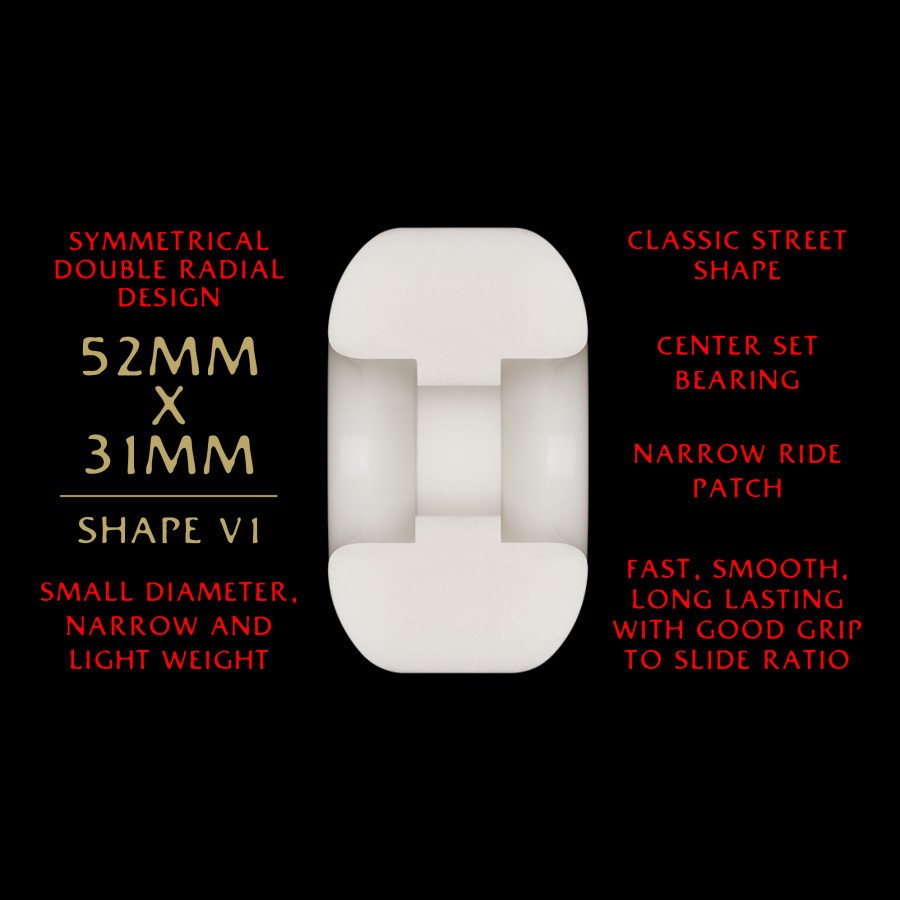
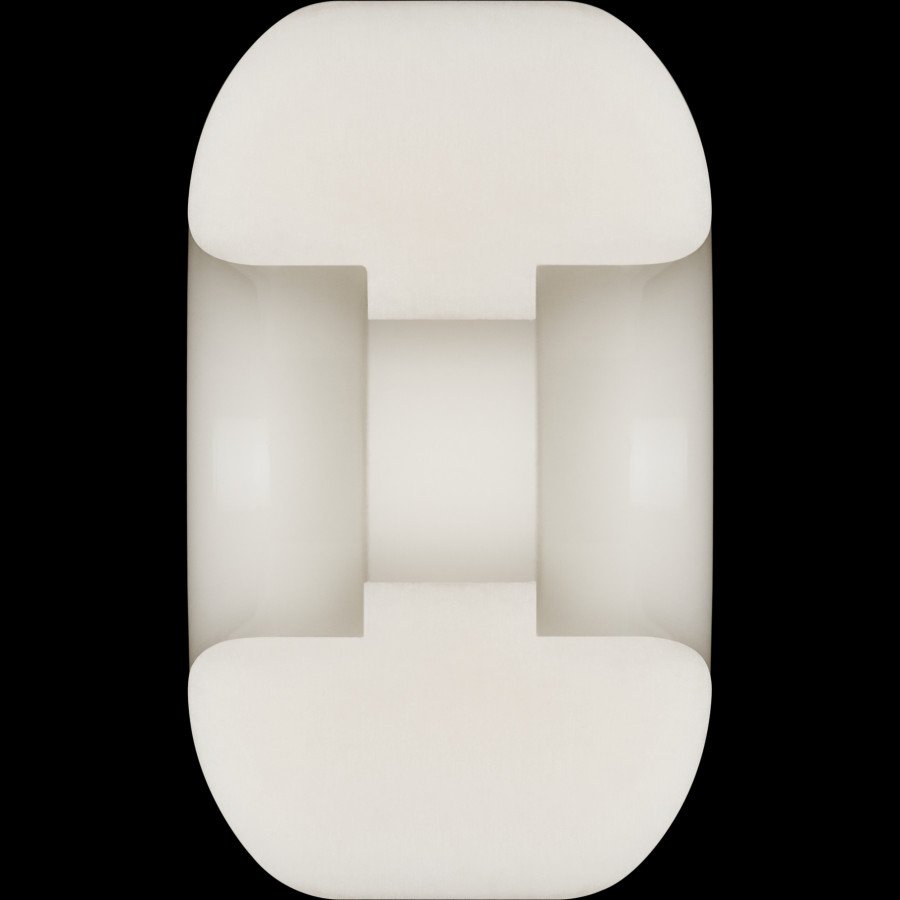
- Dragons (symmetrical, Dual Radius), Nano Rats (asymmetrical, Combination Shape), Nano-Cubics (asymmetrical)
The Dragon Formula goes one step further down: a 93A wheel that, according to Powell-Peralta, grips and slides like a 99A or 101A wheel. According to the manufacturer, the difference is not a weaker urethane, but a special blend of high-performance materials. The high rebound ensures that the softer wheel does not become sluggish.
Dragons are the obvious choice if you ride on rough asphalt, want comfort and a quiet ride, and do not want to give up slides. They are cast in the same factory as Bones. Powell-Peralta describes them as wheels that let you keep rolling where you would have to carry your board with hard wheels, and that still do not lose speed in bowls and parks like an ordinary 93A wheel.
| Line | Shape | Hardnesses |
|---|---|---|
| Dragons | symmetrical, Dual Radius Shape | 88A, 93A, 95A, 97A |
| Nano Rats | asymmetrical, Combination Shape | 88A, 93A, 97A |
| Nano-Cubics | asymmetrical, Combination Shape | 93A, 97A |
According to Powell-Peralta. 93A is the hardness for which the manufacturer describes the formula's properties. 88A is the softest level for very rough surfaces, 95A and 97A are closer to a classic hard wheel.
Other formulas from Powell-Peralta
Alongside the Dragon Formula, Powell-Peralta offers its own formulas for park, rough paths and longboard. The Soft Slide Formula (SSF) is the basis for the longboard wheels: soft and fast, but tuned to break into a slide early and in a controlled manner.
| Formula | Hardness | What distinguishes it according to Powell-Peralta | Use |
|---|---|---|---|
| Park Formula | hard | for skateparks and ramps: extra grip on smooth surfaces and twice the lifespan of ordinary wheels | skatepark, ramp |
| All Terrain Formula | 80A | soft urethane cast onto a small hard urethane core. The core holds the bearings in place, the wheel stays fast | rough paths, anywhere hard wheels do not make sense |
| Soft Slide (SSF) 85A, G-Slides | 85A | firm grip when carving, when turned sideways it slides more like a 90A wheel | all-round: park, street, commuting, some downhill |
| Soft Slide (SSF) 75A, Snakes | 75A | the softest and fastest formula, factory-sanded so slides are easy from the start. Very durable | freeride, commuting, learning slides |
| Soft Slide Pro 75A | 75A | like Snakes, but with noticeably more grip (around 30 percent according to the manufacturer) | downhill and freeride for advanced riders |
| Race | 75A to 82A | designed for maximum grip and the highest rolling speed, but less durable. Not intended for slides at high speeds | fast rolling with plenty of grip |
| Bombers | 85A | soft and fast, with the size and shape of a park wheel at 60 mm | bowl, rough skateparks, the way to the park |
| Clear Cruiser | 80A | clear urethane that, according to the manufacturer, is significantly more durable than typical clear wheels and offers plenty of grip. In 56 and 59 mm | cruising, commuting |
Information according to Powell-Peralta.
#X-Formula, Dragon and classic hard wheels compared
- 95A, 97A, 99A
- according to Bones, rolls like a softer wheel and slides like a harder one
- three hardnesses for fine-tuning
- Shapes V1, V5, V6, V7, V8
- 93A as the main line, also in 88A, 95A and 97A
- according to Powell-Peralta, grips and slides like 99A to 101A
- rebound according to the manufacturer is 18 to 20 % higher than hard wheels
- Shapes: Dragons, Nano Rats and Nano-Cubics
- 103A or 99A
- fast, grips when needed, slides controllably without flatspots
- 99A offers more control and softer landings on rougher ground according to Bones
- Shapes V1 to V6
| Feature | X-Formula | Dragon Formula | STF 103A / 99A |
|---|---|---|---|
| Hardness | 95A, 97A, 99A | 93A (also 88A, 95A, 97A) | 103A, 99A |
| Idea | cushioning of a softer wheel, slide of a harder wheel | grip and slide of a 99A to 101A wheel at 93A | hard wheel for speed and controlled slide |
| Rough ground | smooth and fast according to Bones | the softest of the three, most comfort | 103A rough, 99A more forgiving |
| Smooth ground | fast, with a little more grip than a hard wheel | grippier than a hard wheel | the strength of STF: fast and direct |
| Noise | quieter than a hard wheel | quieter than a hard wheel | loud on rough surfaces |
| Development according to manufacturer | over ten years | around ten years | no information |
Information on the idea, rebound and development according to Bones and Powell-Peralta. The rows on ground and noise follow from the hardness and are not measured values.
#George Powell: working on a better wheel since 1977
The same company and the same person are behind Bones, Powell-Peralta and Mini Logo: George Powell. The engineer began building decks and wheels in the mid-seventies and founded the Powell-Peralta brand with Stacy Peralta in 1978, from which the Bones Brigade emerged. He still runs the company today.
Bones traces its wheels back to the white urethane that came onto the market in 1977. The white color gave the brand its name. Since then, the driving force has remained the same: developing and pouring wheels themselves instead of buying them elsewhere. All formulas are created at the company's own factory in Ventura, California, and each is a distinct urethane for a specific use.
- 1977: the white urethane from which today's Bones 100's descend
- STF: the hard street wheel that slides without flatspots according to Bones
- SPF: the park wheel that is hard to flatspot on smooth surfaces according to Bones
- X-Formula and Dragon Formula: each the result of around ten years of development
Working on a single formula for ten years is anything but a given in an industry that brings out new graphics every season. It shows what matters to George Powell: not the next series, but the better product. In essence, he says that even after 40 years, he still comes to work excited every day because he wants to build a better skateboard.
You can find two related posts on the blog: George Powell: 40 years of building skateboards and the interview on the history of Powell-Peralta and production in Ventura.
#Bones: STF, SPF, ATF and 100's
Alongside X-Formula, Bones consistently divides its range by use and names each formula accordingly. The table under Profiles and shapes shows which formula is available in which shape. You can find all the Street Tech Formula wheels under Bones STF in our shop.
| Formula | Hardnesses | Idea according to Bones | Shapes | Use |
|---|---|---|---|---|
| STF (Street Tech Formula) | 103A and 99A | rolls fast, grips when needed and slides controllably without flatspots. Lasts several times longer than normal wheels according to Bones. 99A with more roll, control and softer landings on rougher ground | V1, V2, V3, V4, V5, V6 | Street, ledges, flatground |
| SPF (Skatepark Formula) | 81B and 84B | formulated to resist flatspots on smooth, slippery surfaces. High rebound, high abrasion resistance, better grip on slippery surfaces | V5, V6 | Concrete park, bowl, vert, wooden ramps |
| ATF (All-Terrain Formula) | 80A | soft urethane that rolls fast and smoothly regardless of the surface | Filmers (with core), Rough Riders | Cruising, filming, rough asphalt |
| 100's (Original Formula) | 100A | descendant of the white urethane from 1977, further developed in-house. High performance at an affordable price | V4, V5 | Beginners, budget, all-around |
Formula names and descriptions according to Bones. The hardnesses of SPF, ATF and 100's come from the Bones product names.
The B values confuse many people: 84B sounds soft, but corresponds to around 104A and is therefore very hard. 81B corresponds to around 101A. Why Bones measures this way is explained under A scale and B scale.
- tuned for street and plaza
- shapes V1 to V6, diameters from 49 mm
- 103A very hard and fast, 99A more forgiving
- according to Bones, slides in a controlled manner without flatspots
- tuned for smooth concrete and wood
- shapes V5 Sidecut and V6 Widecut
- 81B and 84B, or around 101A and 104A
- according to Bones, almost impossible to flatspot on smooth surfaces
#Spitfire: Formula Four, Classic, 80HD
Spitfire from San Francisco offers several urethanes alongside each other. Spitfire writes the hardness as «99», «99D» or «99DU». The D stands for durometer, not the Shore D scale, the values correspond to the A scale.
Formula Four (F4)
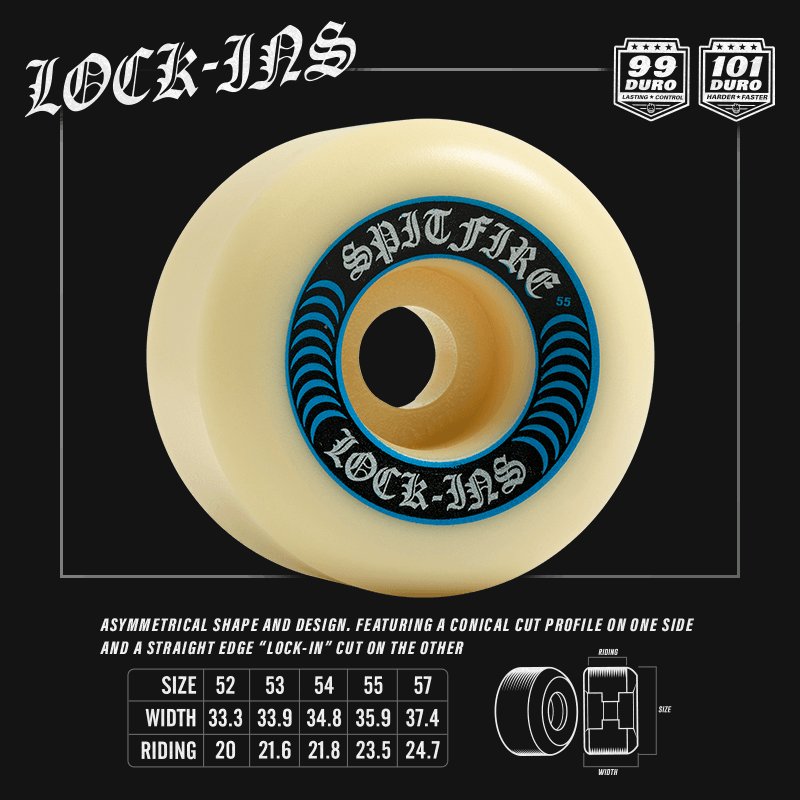
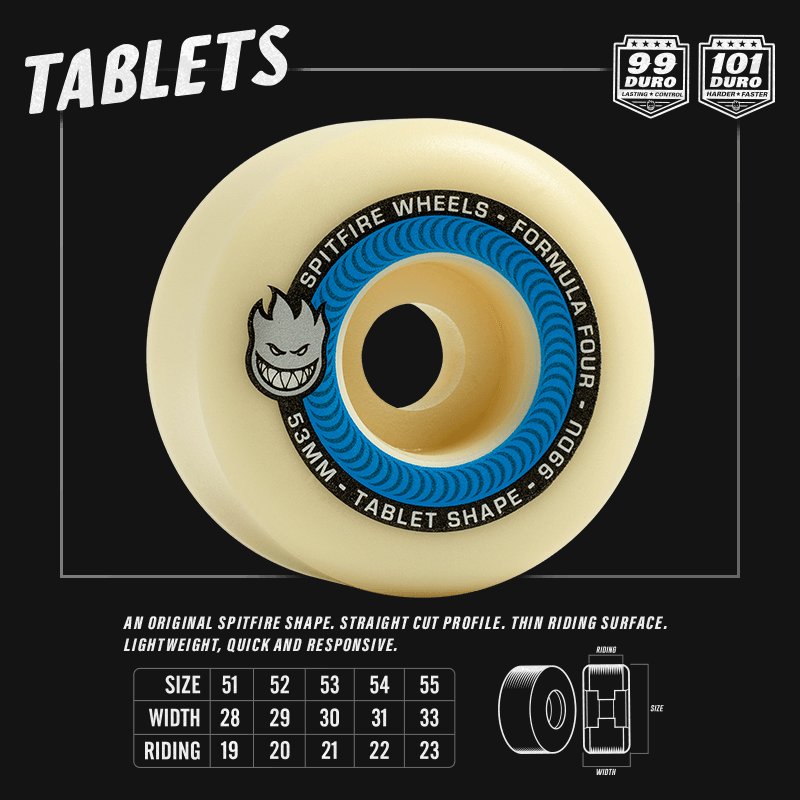
Formula Four is Spitfire's main urethane. It is considered shape-stable, fast and controlled in slides. F4 is available in four hardnesses and in all Formula Four shapes, from Classic and Tablet to the wide Full-On-Fire shapes.

| Hardness | Character | Use |
|---|---|---|
| 93 | the softest F4 compound, dampens vibrations | rough streets and spots |
| 97 | slightly more grip and comfort than 99 | all-round use on average surfaces, slippery Parks |
| 99 | the standard: balanced between grip and slide | Street and Park |
| 101 | harder, faster on smooth surfaces, slides most easily | concrete Parks, technical Street skating on good surfaces |
Not every hardness is available in every shape. Classic is available in 97, 99 and 101, most other shapes in 99 and 101. Spitfire lists 93 in Classic and Round Edge.
Classic, Burners and 80HD
Alongside Formula Four, Spitfire offers the older Classic urethane in 99 and Burners as an entry-level line. Both are solid wheels for those who rarely slide or are budget-conscious. 80HD is Spitfire's soft urethane in hardness 80 for Cruiser and filmers, offered in full shapes. Sapphires are another line.
#Mini Logo
Mini Logo comes from the same company as Bones and Powell-Peralta and is poured in the same factory. The principle: simple wheels without elaborate graphics at a lower price.
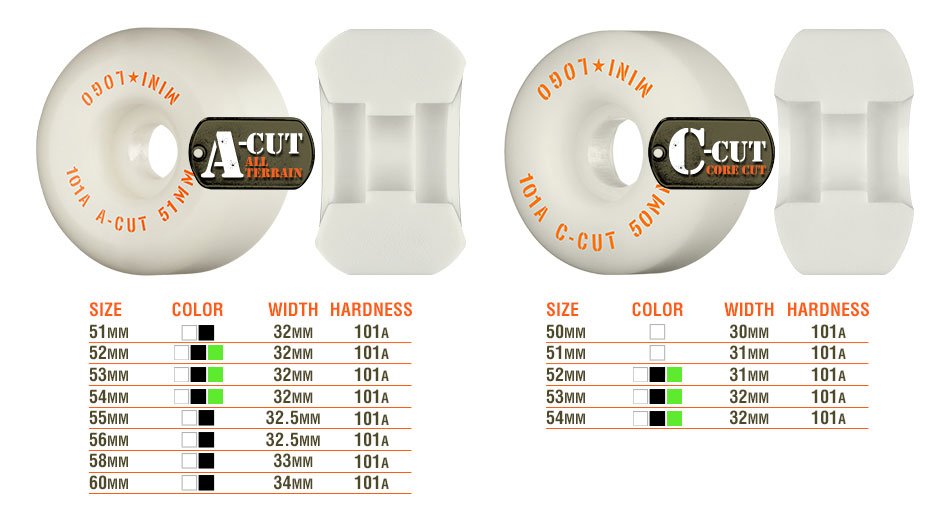
| Line | Hardnesses | Diameters |
|---|---|---|
| A-Cut | 90A, 101A | 51, 55, 58 mm |
| C-Cut | 101A | 52, 53 mm |
| Sidecut | 101A | 53, 54 mm |
| Hybrid Sidecut | 90A, 95A | 53, 54 mm |
| A.W.O.L. | 80A | 55, 59 mm |
#Ricta, OJ and Slime Balls
The three brands come from the same company in Santa Cruz and divide up the field: Ricta stands for soft and technical wheels, OJ for a wide range of urethanes and wide shapes, Slime Balls for large, colorful wheels with roots in the eighties.
Ricta
- Clouds: the best-known soft wheel for street setups. Available in 78A, 86A and 92A, from 52 to 60 mm. 78A for cruising and filming, 92A as a compromise that still works well for tricks.
- Cloud Cores: Clouds with a core that stabilizes the soft urethane.
- Speedrings: hard street wheels with a ring around the bearing seat, commonly available in 99A and 101A.
- Other lines such as Super Crystals (95A) and Chrome Clouds (92A) round out the range.
OJ
| Urethane | Hardnesses | Description |
|---|---|---|
| Elite | 99A, 101A | OJ's top urethane, selected by the team riders. Fast, durable, for every terrain |
| Original | 95A, 99A, 101A | the classic urethane of the reissue wheels. Rolls smoothly and fast on most surfaces |
| Double Duro | 99A/95A, 101A/95A | hard outer layer around a softer inner section. Rolls more smoothly over rough ground without sacrificing speed or slide |
| From Concentrate | not specified | entry-level urethane for most terrains |
| Keyframes | 87A, 92A | slightly harder than a cruiser, rolls smoothly. According to OJ, it does not slide, intended for commuting and follow filming |
| Super Juice | 78A | the cruiser wheel: rolls smoothly over most surfaces with little effort and is less likely to get caught on stones and cracks |
Slime Balls
Vomits are available in 95A, 97A and 99A in large diameters from 58 to 60 mm, Vomit Mini in 53 to 56 mm in 95A and 97A. In addition, OG Slime is available as a cruiser wheel in 78A and 60 mm. With their medium hardnesses and large diameters, Slime Balls are typical wheels for transition, pool and rough spots.
#Other brands
There are also many smaller wheel brands that mostly have their wheels produced by specialized foundries and provide little information about their urethane. With such a brand, only a direct comparison helps: same hardness, same shape, same spot. After a few sessions, pay attention to flatspots, the diameter and how evenly the wheel slides.
#The big comparison table
| Brand | Formula | Hardnesses | Shapes | Ride feel | Use |
|---|---|---|---|---|---|
| Bones | X-Formula | 95A, 97A, 99A | V1, V5, V6, V7, V8 | dampened yet fast, slides like a harder wheel | every terrain, rough streets |
| Powell-Peralta | Dragon Formula | 88A, 93A, 95A, 97A | Dragons, Nano Rats, Nano-Cubics | dampens, very high rebound, slides like a hard wheel | rough spots, all-around |
| Powell-Peralta | Soft Slide (SSF) | 75A, 85A | Snakes, G-Slides | soft and fast, slides early and predictably | Longboard, freeride, cruising |
| Bones | STF | 99A, 103A | V1, V2, V3, V4, V5, V6 | hard, fast, very abrasion-resistant | technical Street |
| Bones | SPF | 81B, 84B | V5, V6 | very hard, high rebound | concrete Park, Bowl, vert |
| Bones | ATF | 80A | Filmers, Rough Riders | soft, smooth, fast on rough pavement | cruising, filming |
| Bones | 100's | 100A | V4, V5 | classically hard, responsive | beginner, budget |
| Spitfire | Formula Four | 93, 97, 99, 101 | Classic, Round Edge, Conical, Lock-In, Tablet, OG Classic, Full On Fire | fast, holds its shape, controlled slide | Street and Park, 93 and 97 for rougher pavement |
| Spitfire | Classic | 99 | various | solid standard wheel | all-around, budget |
| Spitfire | 80HD | 80 | full shapes | soft | cruising, filming |
| Mini Logo | A-Cut, C-Cut, Sidecut, Hybrid Sidecut | 90A, 95A, 101A | A-Cut, C-Cut, Sidecut | no-frills, varies by hardness | budget, beginner |
| Mini Logo | A.W.O.L. | 80A | Cruiser | soft | cruising |
| Ricta | Clouds | 78A, 86A, 92A | various, 52 to 60 mm | soft to medium-soft, smooth | cruising, filming, rough streets |
| OJ | Elite | 99A, 101A | various | hard, fast, durable | Street, Park, transition |
| OJ | Double Duro | 99A/95A, 101A/95A | various | hard riding surface, dampened inner section | rough spots, transition |
| OJ | Keyframes | 87A, 92A | various | smooth, does not slide | filming, commuting |
| OJ | Super Juice | 78A | Cruiser | very soft, rolls over almost anything | cruising |
| Slime Balls | Vomits and Vomit Mini | 95A, 97A, 99A | 53 to 60 mm | medium-hard, large diameters | transition, pool, rough spots |
| Slime Balls | OG Slime | 78A | 60 mm | very soft | cruising |
Hardness ratings and shapes according to the manufacturers. The riding feel column summarizes manufacturer information and the usual assessment and contains no measurements.
Flatspot resistance
Bones explicitly advertises flatspot resistance for STF (slides without flatspots) and SPF (according to the manufacturer, almost impossible to flatspot on smooth surfaces). As a general rule, the softer the wheel, the more susceptible it is. Cruiser wheels around 78A to 80A are not made for sliding and quickly develop flat spots if you do it anyway.
#Which formula for whom
- Bones STF 103A, 99A on rougher ground
- Spitfire Formula Four 99 or 101
- OJ Elite 101A
- Ricta Speedrings
- Bones SPF 81B or 84B in V5 Sidecut or V6 Widecut
- Bones X-Formula 99A in V7 Double Locks or V8 Double Wide
- Spitfire Formula Four 99 or 101 in Wider Conical or Super Wide Round Edge
- OJ Elite 99A in wide shapes
- Slime Balls Vomits 97A or 99A
- Bones 100's (100A)
- Mini Logo C-Cut or A-Cut 101A
- Spitfire Classic 99 or Burners
- OJ From Concentrate
- Bones X-Formula 95A or 97A
- Powell-Peralta Dragon Formula 93A
- Spitfire Formula Four 93 or 97
- OJ Double Duro 99A/95A
- Ricta Clouds 86A or 92A
- OJ Keyframes 87A or 92A
- Bones ATF Filmers 80A
- Spitfire 80HD
- OJ Super Juice 78A
- Ricta Clouds 78A
- Bones ATF Rough Riders 80A
- Mini Logo A.W.O.L. 80A
- Slime Balls OG Slime 78A
#Frequently asked questions about urethane formulas
Why does my 99A wheel ride differently from my friend's 99A wheel?
Because hardness is only one of four properties. Rebound, abrasion resistance and slide behavior depend on the formula, and shape and diameter also play a role. Two wheels with the same number can therefore roll and slide very differently.
What is special about Bones X-Formula?
According to Bones, it rolls over rough ground like a softer wheel and slides like a harder one. This is made possible by very high rebound at medium hardness. It is available in 95A, 97A and 99A in the V1, V5, V6, V7 and V8 shapes.
Bones X-Formula or Powell-Peralta Dragon?
Both come from the same company and solve the same problem: rough ground without losing the slide. At 93A, Dragon is the softer and more comfortable option, while X-Formula can be more precisely matched to your spot with 95A, 97A and 99A.
Does a 93A Dragon really slide like a hard wheel?
That is what Powell-Peralta says: grip and slide like 99A and 101A wheels, plus, according to the manufacturer, 18 to 20 % more rebound than hard wheels.
Which is better, Spitfire Formula Four or Bones STF?
Both are proven, hard street wheels. STF 103A is nominally harder than Formula Four 101, while Formula Four 99 and STF 99A are close to each other. Ultimately, it comes down to your taste. Ride both if you can.
What does F4 99D mean at Spitfire?
F4 stands for Formula Four, 99 for the hardness. D or DU is Spitfire's abbreviation for durometer, not the Shore D scale. The value corresponds to 99A.
Are Bones SPF 84B wheels softer than STF 103A?
No. 84B is a value on the B scale and corresponds to approximately 104A. SPF 84B is therefore at least as hard as STF 103A. The difference lies in the tuning: SPF is made for smooth park surfaces, STF for the street.
Are expensive wheels worth it for beginners?
At first, you won't slide much, so an inexpensive brand formula like Bones 100's or Mini Logo is perfectly sufficient. Once you start doing powerslides and slide tricks, an abrasion-resistant formula pays off because it stays round longer.
Can I do tricks with Ricta Clouds?
With 92A, you can do many tricks, but the wheel rebounds on landing and has limited sliding ability. With 78A, it gets difficult. If you mainly want to do tricks on rough ground, formulas like X-Formula 95A or Dragon 93A are the better choice.
Sources (11)
Something missing or wrong? Report an error