Key points
- Diameter determines acceleration, speed and how the wheel rolls over obstacles: 52 to 54 mm is the street standard, 54 to 56 mm is the all-rounder, and 56 mm and above is for transition and cruisers.
- The riding surface is only the part of the wheel that touches the ground. A narrow surface slides easily and responds quickly, while a wide one provides grip and stability.
- Shapes such as Classic, Conical, Round Edge or Lock-In differ in edge shape and riding surface width. Each brand has its own names for them, and Bones numbers its shapes from V1 Standard to V8 Double Wide.
- Flatspots occur when the wheel locks up and slides across the ground. Good urethane and clean slides prevent them, while regular rotation distributes wear.
- Cored wheels are especially useful with soft urethane, because the hard core keeps the bearings properly aligned and reduces wheel flex.
#Wheel construction and dimensions
A skateboard wheel is a ring of cast polyurethane, or urethane for short. In the center are two bearing seats, each for a size 608 bearing. Everything else is a matter of shape, and it is precisely this shape that determines how the wheel rides. Four specifications are enough to describe a wheel: diameter, width, riding surface and hardness. Hardness has its own article: Wheel hardness and durometer. You can find the brands' urethane compounds under Urethane formulas compared.
- Diameter
- usually 50 to 60 mm, specified in mm
- Overall width
- around 27 to 44 mm, depending on shape
- Riding surface
- around 13 to 33 mm, depending on shape and the brand's measurement method
- Bearing seat
- for bearings 608 (22 mm outside diameter, 7 mm wide)
- Sold
- as a set of 4
The packaging often lists this compactly, for example «54 mm 99A» or «56 x 34 mm». The first number is always the diameter, a second number with «x» is the overall width. Only a few brands specify the riding surface in millimeters, including Bones (as Ride Patch), OJ and Ricta in their shape tables.
#Diameter: small, medium, large
Diameter changes four things at once: how quickly the wheel gets up to speed, how well it maintains speed, how much it weighs and how easily it rolls over cracks and small stones. There is also the ride height. For every 2 mm of additional diameter, your board sits 1 mm higher.
The physics behind it
- Acceleration: A small wheel has less mass, and the mass is closer to the axis of rotation. It can be brought up to speed more quickly with a push or by pumping. That is why a board with 52 mm feels responsive.
- Maintaining speed: A large wheel travels farther per revolution (52 mm: around 163 mm, 60 mm: around 188 mm). At the same speed it rotates more slowly, the bearing works less, and the greater mass maintains momentum longer.
- Weight: At the same width, the urethane volume increases approximately with the square of the diameter. From 52 to 56 mm that is around one fifth more material, times four wheels. You can feel that in flip tricks.
- Rolling over obstacles: The larger the radius, the shallower the angle at which the wheel hits an edge. A crack or small stone of 5 mm is one fifth of the radius for a size 50 wheel, but only one sixth for a size 60 wheel. Small wheels are more likely to get caught.
- Center of gravity: Small wheels bring the board closer to the ground. This makes pushing more comfortable and the board more stable when landing. Large wheels, on the other hand, provide more clearance between the wheel and deck, which you have to compensate for with truck height or riser pads.
| Diameter | Riding feel | Typical use | Note |
|---|---|---|---|
| 48 to 51 mm | very light, very direct, loses speed quickly | very technical street skating on smooth ground, children's boards | sensitive to cracks and small stones, wears down quickly |
| 52 to 54 mm | light, accelerates quickly, still maintains good rolling speed | Street, flatground, ledges, Park | the standard for most street setups |
| 54 to 56 mm | balanced, maintains speed noticeably better | all-round, Park, mini ramp, rougher spots | a good choice if you do not want to commit to one style |
| 56 to 58 mm | fast, smooth, a little heavier | Transition, Bowl, large parks, wide decks | check for wheelbite with low and mid trucks |
| 58 to 60 mm | lots of momentum, rolls over almost anything | Vert, Bowl, Pool, Old School shapes | usually with high trucks or riser pads |
| over 60 mm | comfortable and fast, slow to accelerate | Cruiser, filmer boards, long distances | plan for riser pads |
The ranges overlap deliberately, and the boundaries are flexible. As a rough guide: up to around 54 mm for street, above that for park and transition, and from about 59 mm for cruiser and vert.
#Width and riding surface
The overall width measures the wheel from outer edge to outer edge. The riding surface (in English, Riding Surface or Contact Patch) is only the flat part that actually contacts the ground. Two wheels with an overall width of 32 mm can have very different riding surfaces, depending on how rounded or beveled the edges are.
- less friction, breaks into a slide more easily
- lighter, responds faster to weight shifts
- less contact on rails and coping
- feels uneven surfaces more strongly
- wears into a conical shape faster with lots of slides
- more grip in turns and in transition
- more stable at speed and on landing
- distributes pressure, rolls more smoothly over rough ground
- heavier, slightly less responsive during flips
- requires more force to initiate a slide, then slides evenly
| Wheel | Diameter | Overall width | Riding surface |
|---|---|---|---|
| Bones V3 Slims | 54 mm | 30 mm | 16 mm |
| Bones V6 Widecut | 54 mm | 34 mm | 18.5 mm |
| Bones V8 Double Wide | 54 mm | 39 mm | 21 mm |
| Ricta Mid | 52 mm | 30.7 mm | 15.0 mm |
| Ricta Slim | 52 mm | 30.3 mm | 18.3 mm |
| Ricta Wide | 52 mm | 32.8 mm | 21.1 mm |
| OJ EZ Edge | 54 mm | 33 mm | 18.5 mm |
| OJ Chubbies | 54 mm | 37 mm | 22 mm |
| OJ Hard Line | 54 mm | 34 mm | 23 mm |
| OJ Full Combo | 53 mm | 42 mm | 31 mm |
Source: shape tables from Bones, Ricta and OJ. Each brand measures the riding surface slightly differently, so it is best to compare the numbers within one brand.
The riding surface does not stay constant. As it wears, a wheel with a rounded edge develops a wider contact patch because you wear into the thicker part of the profile. A straight-cut wheel retains its riding surface longer.
#Profiles and shapes
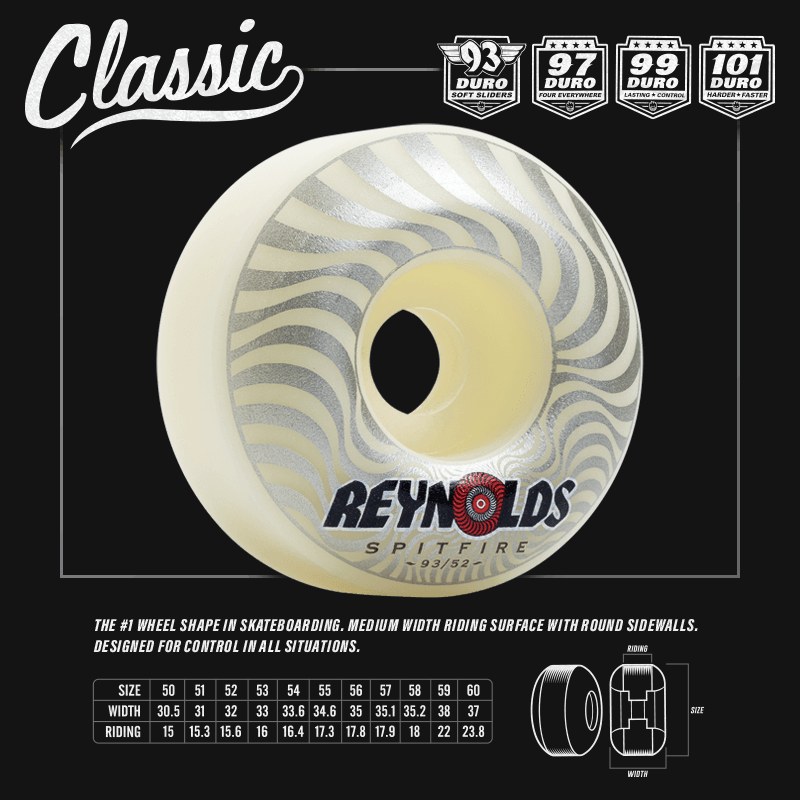
The profile describes what the wheel looks like in cross-section: rounded or angular sidewalls, a narrow or full riding surface, symmetrical or with two different sides. The names are not standardized. The designations from Spitfire and Bones are the most widespread, and many other brands take their cue from them.
Spitfire: the Formula Four shapes
| Shape | Form | Contact patch | Hardnesses | Feel and use |
|---|---|---|---|---|
| Classic | round sidewalls, symmetrical | medium | 97, 99, 101 | the all-rounder: light, fast, forgiving. Street, park, mini ramp |
| Round Edge | round edge, wider than Classic | medium | 99, 101 | combines the versatility of the Classic with the width of the Conical, controlled slides |
| Conical | tapered sidewalls, symmetrical | full | 99, 101 | large contact patch with low weight, the angled sides slide easily on ledges and coping |
| Lock-In | asymmetrical: conical on the outside, straight edge on the inside | not specified | 99, 101 | the straight inner edge keeps grinds on track, for rails, ledges and coping |
| Tablet | straight-cut profile, the original Spitfire shape | narrow | 99, 101 | light and very responsive, for technical street skating |
| OG Classic | cutaway sidewalls | wide | 99, 101 | wide contact patch with reduced weight, good for powerslides and landings |
| wider Lock-In (Full On Fire) | like Lock-In, wider | wide | 99 | Lock-In edge with more contact patch, for transition and large obstacles |
| Super Wide Round Edge (Full On Fire) | round edges, very wide | very wide | 97, 99 | lots of stability, for transition and rough spots |
| Wider Conical (Full On Fire) | like Conical, wider, with cutaway sidewalls | wide | 97, 99, 101 | lots of grip and stability for bowls, fast parks and all terrain |
Spitfire specifies the contact patch only as a class (thin, medium, full, wide, super wide), not in millimeters. Full On Fire is the line with the three full shapes. Spitfire shows the softest Formula Four in 93 for Classic and Round Edge.


Bones: V1 to V8, Filmers and Rough Riders
Bones names a wheel's shape with a V number and a name, for example V5 Sidecut. The V number refers only to the shape. Formula and hardness are specified separately, for example X-Formula 97A or STF 99A, and you read the diameter in millimeters. The same shape can therefore be available in several formulas: V5 Sidecut is available in X-Formula, STF, SPF and 100's. A higher number does not mean better, just a different shape.
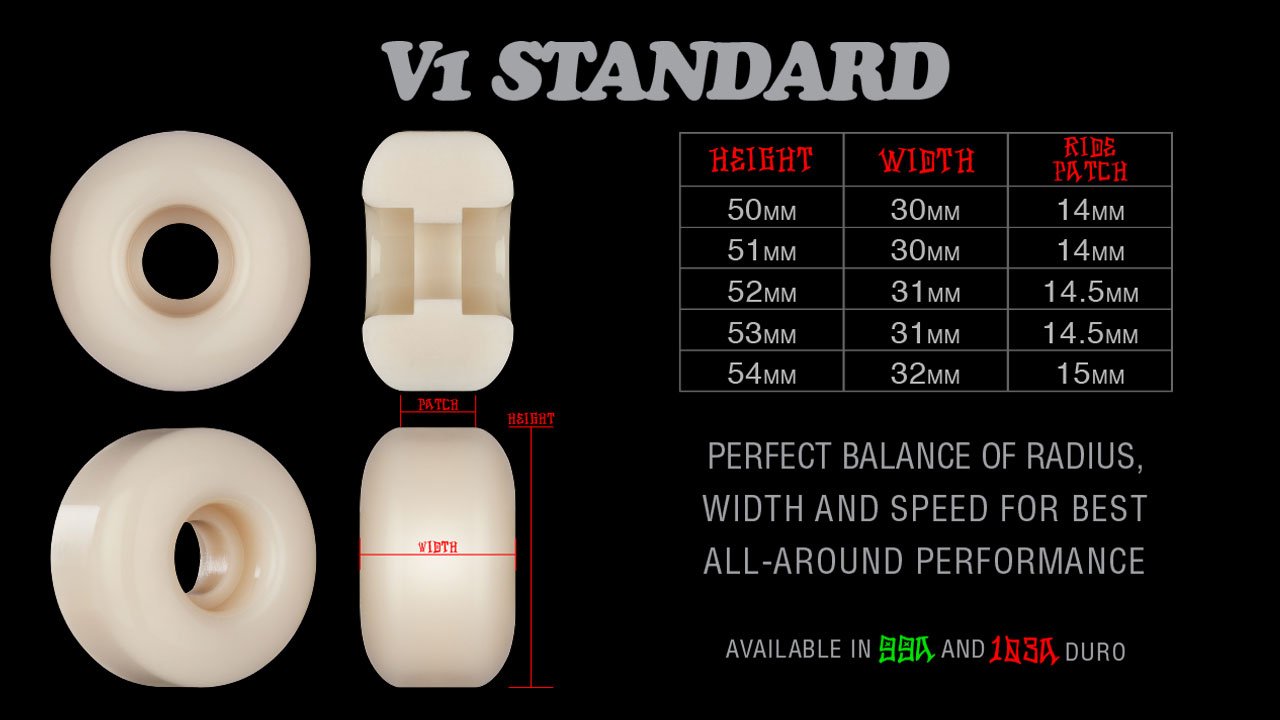
Bones calls the contact patch the Ride Patch, meaning the part of the wheel that actually contacts the ground. Bones specifies the diameter, overall width and Ride Patch in millimeters for each size. This makes it easy to compare the shapes: a V3 Slims in 54 mm has a 16 mm Ride Patch, a V8 Double Wide in the same size has 21 mm.

| Shape | Character | Width | Ride Patch | At 54 mm (width / Ride Patch) | Formulas |
|---|---|---|---|---|---|
| V1 Standard | the all-round profile: balanced between roundness, width and speed | 30 to 32 | 14 to 15 | 32 / 15 | X-Formula, STF |
| V2 Locks | narrow, with a straighter sidewall that sits snugly against the edge during a grind | 27 to 29 | 13 to 15 | not in 54 mm | STF |
| V3 Slims | narrow and light, for fast flips and breaking into a slide easily | 28 to 30 | 14 to 16 | 30 / 16 | STF |
| V4 Wide | wide contact patch for stability and secure landings | 32 to 34 | 14,5 to 17 | 34 / 17 | STF, 100's |
| V5 Sidecut | cutaway sidewalls: stable, less friction, longer grinds | 30 to 34 | 14,5 to 17 | 31 / 15,25 | X-Formula, STF, SPF, 100's |
| V6 Widecut | the Sidecut principle with a significantly wider contact patch | 33 to 36 | 17,5 to 20,5 | 34 / 18,5 | X-Formula, STF, SPF |
| V7 Double Locks | Lock-In edge like the V2, but much wider, so the slide stays smoother | 34 to 38 | 21,5 to 25,5 | 34 / 21,5 | X-Formula |
| V8 Double Wide | very wide, double-rounded edge for rolling over obstacles, sidecut sides for locking into a grind | 39 to 40 | 21 to 23 | 39 / 21 | X-Formula |
| Filmers | wheel with a core, narrower and light, maneuverable | 32 to 36 | 14,5 to 16,5 | 33 / 15,5 | ATF |
| Rough Riders | very wide contact patch for stability and smooth rolling | 40 to 44 | 32 to 33 | not in 54 mm | ATF |
All measurements from the Bones shape overview. Hardnesses by formula: X-Formula 95A, 97A, 99A; STF 99A and 103A; SPF 81B and 84B; ATF 80A; 100's 100A.
| Shape | Diameter in mm |
|---|---|
| V1 Standard | 50, 51, 52, 53, 54 |
| V2 Locks | 49, 51, 52, 53 |
| V3 Slims | 50, 52, 54 |
| V4 Wide | 51, 52, 53, 54, 55 |
| V5 Sidecut | 51, 52, 53, 54, 55, 56, 58, 60 |
| V6 Widecut | 53, 54, 55, 56 |
| V7 Double Locks | 54, 56, 58 |
| V8 Double Wide | 54, 56 |
| Filmers | 52, 54, 56, 60 |
| Rough Riders | 56, 59 |
Not every diameter is available in every formula.
The shape families in brief
- Classic, Standard, Round: round edges, medium contact patch. Very forgiving, rolls smoothly on coping and over edges. Works almost anywhere.
- Slim, Tablet, Mid: small contact patch, low weight. For flip tricks and fast footwork.
- Conical: angled sides, wide contact patch. Large contact patch without much weight, the edge grips distinctly.
- Radial, Round Edge: round edge with more width. Slides predictably and catches smoothly.
- Wide, Full, Chubbies, Double Wide: maximum contact patch for speed, bowls and rough surfaces.
- Lock-In, Locks, Double Locks, Nomads: a straight or sharp edge that rests against the edge of a rail, ledge or coping during a grind.
- Sidecut, Widecut, Cutaway: cutaway sidewall. Saves weight and reduces friction when the side rubs against the obstacle during a grind or slide.
#Cored wheels or solid urethane
Most hard street wheels are made entirely of urethane. The bearing sits directly in the urethane. In cored wheels (core or cored wheels), a hard plastic insert is molded into the center, forming the bearing seats. The urethane surrounds it like a tire.
- more urethane, so more material to wear down
- a more dampened, «solid» ride feel
- sufficiently stable in shape with hard urethane (99A and above)
- with soft urethane, the bearing seats can give way and the wheel flexes under load
- bearings sit precisely and remain parallel, even with soft urethane
- the wheel deforms less, so less energy is lost
- often lighter than a solid urethane wheel of the same size
- less usable urethane before the core is reached
- the core must be securely bonded to the urethane
That is why many soft wheels have a core: Ricta also offers the Clouds as Cloud Cores, and the Bones Filmers in ATF 80A also have a core. With hard wheels, a core is a matter of preference. Some like the more direct, slightly louder rolling feel, while others find it harsher on rough ground.
#Flatspots: causes and prevention
A flatspot is a worn-down, flat area on the riding surface. The wheel is no longer round. You hear and feel it as a rattling or knocking that gets faster with your speed.
How it happens
As long as a wheel is turning, wear is distributed around its entire circumference. If it slides sideways across the direction of travel while stationary, the ground wears away at the same spot. This happens during powerslides, 180 slides, bluntslides and braking with the board turned sideways. The rougher the ground, the higher the speed and the longer the slide, the more material is worn away at one point.
- Urethane quality: High-quality formulas are more abrasion-resistant and slide more evenly. Cheaper compounds are more likely to smear or start to tear.
- Hardness: Soft wheels grip the ground more strongly and wear away more material when you force them to slide. Hard wheels slide more easily.
- Technique: A slide that stays just short of 90 degrees allows the wheel to keep turning. If the board is exactly sideways, the wheel locks up.
- Stopping habits: If you always brake on the same side, you always wear down the same two wheels.
Several manufacturers explicitly advertise flatspot resistance, for example Bones with STF and SPF. Why abrasion resistance prevents flatspots and how the formulas differ is explained under What a urethane formula is.
#Wear, coning and rotating wheels
Wheels get smaller over time. This is normal and varies with each riding style. If you slide a lot, you may lose several millimeters in one season. If you mainly ride and ollie, you can often use the same set for years.
Coning
Coning means that the wheel becomes conical: one side has a smaller diameter than the other. The inside often wears down faster, meaning the side facing the truck, because more load is applied there when turning and sliding. If you always do powerslides in the same direction, you also wear down the same edge every time. Uneven wear is particularly visible on asymmetric shapes such as Lock-Ins. A conical wheel has less contact, grips unevenly and makes steering feel less precise.
Rotating and flipping
- Remove the wheels
Loosen the four axle nuts with the 1/2" wrench on the skate tool. Set the nuts and speed rings down so that nothing rolls away.
- Swap diagonally
The front left goes to the rear right, the front right goes to the rear left and vice versa. This moves each wheel to a different truck and a different side.
- Flip
When swapping symmetric wheels, flip them so that the former inside faces outward. The graphic then faces inward. This evens out coning. Asymmetric shapes such as Lock-Ins have a fixed inside and outside and are only swapped, not flipped.
- Install and check
Do not forget the speed rings. Tighten the nut until the wheel no longer has any side-to-side play, then back it off an eighth of a turn so that it spins freely.
How often? As soon as you see that one pair of wheels is smaller or more unevenly worn than the other. If you do a lot of slides, this may be every few weeks, otherwise every few months is enough. Use the wheel change as an opportunity to check the bearings.
When wheels are worn out
- noticeable flatspots that no longer wear back to a round shape
- cracks, broken-off pieces (chunking) or an edge that is peeling away
- severe coning despite rotation
- the diameter is so small that you get caught on every crack or the core becomes visible
- a loose bearing seat: the bearing almost falls out on its own
#Wheel finder: diameter and hardness for your use
Choose your surface and riding style, and the calculator will suggest a range for diameter and hardness. Use the result as a starting point. Within that range, it comes down to your preference.
| Use | Diameter | Hardness | Shape tip |
|---|---|---|---|
| Technical street | 50 to 53 mm | 99A to 101A | Classic, Slim, Tablet |
| All-around street | 52 to 54 mm | 97A to 99A | Classic, Radial, Conical |
| Rough streets and spots | 53 to 56 mm | 93A to 97A | Radial, Conical Full, Wide |
| Park and mini ramp | 54 to 56 mm | 99A to 101A | Classic, Conical, Sidecut |
| Bowl and vert | 56 to 60 mm | 99A to 104A (84B) | Conical Full, Sidecut, Wide |
| Cruising | 56 to 65 mm | 78A to 87A | wide, with core |
| Filming | 54 to 60 mm | 78A to 92A | medium to wide, with core |
| Beginners and children | 51 to 54 mm | 95A to 99A | Classic or Standard |
#Frequently asked questions about wheels
What wheel size should I choose as a beginner?
You can't go wrong with 52 to 54 mm and 97A to 99A in a Classic or Standard shape. This works on the street and in the park, needs no riser pad with mid and high trucks at medium steering and leaves all options open to you. Whether it fits with a low truck or loose steering, you can check in the wheelbite calculator.
Do all wheels fit all trucks?
Yes, as far as the bearing seat is concerned. Skateboard wheels accept size 608 bearings, and these fit on any standard skateboard truck with an 8 mm axle. What does not automatically fit is the clearance from the deck: large wheels need high trucks or riser pads.
Does wheel width need to match deck width?
Not directly. What matters is that the truck and deck fit together. However, very wide wheels extend beyond the edge of the deck if the trucks are chosen with little room to spare. For wheels over 36 mm in overall width, it's worth checking.
Why is my board suddenly rattling?
It's usually a flatspot. Spin each wheel individually by hand and look at the running surface: a flat, often dull spot reveals it. If it still rattles without a visible flatspot, check the bearings and whether an axle nut is loose.
How often should I rotate the wheels?
Whenever you see uneven wear. If you slide a lot, swap them diagonally every few weeks and flip the wheels over in the process. Without many slides, every few months is enough.
Can I ride different wheels at the front and back?
It's technically possible, but rarely makes sense. Different diameters tilt the board slightly, and different hardnesses grip and slide unevenly. Normally, replace all four wheels together.
Are white wheels better than colored ones?
You often hear this, but it is not generally proven. Color pigments are an additive in urethane and can change how a mixture behaves, but manufacturers adjust their formulas accordingly. More important than color are the formula, hardness and shape.
How long do skateboard wheels last?
From a few months to several years. Powerslides on rough asphalt wear away urethane, while simply rolling does so hardly at all. Good formulas retain their shape and diameter much longer than inexpensive mixtures.
Sources (5)
Something missing or wrong? Report an error