Key points
- A mounting hardware set consists of 8 countersunk bolts and 8 locknuts with 10-32 threads. Without a riser pad, 7/8" or 1" bolts fit.
- Rule of thumb for bolt length: riser thickness plus 7/8" to 1". So with a 1/8" riser, use 1" to 1 1/8", with a 1/4" riser, 1 1/4", and with a 1/2" riser, 1 1/2".
- Riser pads are hard and create clearance between the wheel and deck. Shock pads are soft and provide cushioning, but create less reliable clearance.
- Wheelbite occurs when the wheel touches the deck while turning. Remedies: tighten the trucks, use harder bushings, riser pads, higher trucks or smaller wheels.
- Up to about 54 mm, you do not need a riser with mid-height trucks. From 57 mm, 1/8" is a sensible choice, and from around 60 mm, 1/4".
#The mounting hardware set: bolts and nuts
In skate jargon, the mounting hardware set is simply called «hardware». This means the bolts and nuts used to attach the trucks to the deck. Each truck is secured with four bolts, so a set contains eight bolts and eight nuts.
- Contents
- 8 bolts, 8 locknuts
- Thread
- 10-32 (inch thread: size No. 10, 32 threads per inch)
- Head
- Countersunk head, sits flush in the deck
- Drive
- Phillips or Allen
- Nut
- Locknut with nylon ring, 3/8" wrench size
- Lengths
- 7/8", 1", 1 1/8", 1 1/4", 1 1/2"
The 10-32 thread is an American fine thread. Metric bolts from the hardware store do not fit the nuts, even though M5 looks similar. The countersunk head pulls slightly into the wood when tightened and sits flush with the griptape, so you do not feel anything under your foot. The locknut has a nylon ring that grips the thread. This prevents the bolts from coming loose on their own despite vibration.
#Bolt lengths: 7/8" to 1 1/2"
The length of a countersunk bolt is measured over its entire length, including the head. It must reach through the deck, any pads and the truck's baseplate and fill the nut completely. The nylon ring must sit fully on the thread, ideally with one or two threads protruding.
| Length (inch) | Length (mm) | Fits |
|---|---|---|
| 7/8" | 22.2 mm | Standard 7-ply deck without riser. Shortest suitable length, barely protrudes |
| 1" | 25.4 mm | Without riser (the most common length), with a thin shock pad or just long enough with a 1/8" riser |
| 1 1/8" | 28.6 mm | 1/8" riser or shock pad, thicker decks with 8 or 9 plies |
| 1 1/4" | 31.8 mm | 1/4" riser |
| 1 1/2" | 38.1 mm | 1/2" riser, cruisers and longboards |
Rule of thumb: riser thickness plus 7/8" to 1". For thicker decks or trucks with a thick baseplate, choose one length longer.
- the nut engages only a few threads
- the nylon ring does not grip, the nut comes loose
- the threads can strip
- technically unproblematic, the connection holds
- the protruding ends can hit the truck or scratch clothing and hands
- slightly more weight, looks untidy
#Phillips or Allen
- the common standard
- every skate tool has the right screwdriver, and in a pinch any Phillips screwdriver will do
- the screwdriver is more likely to slip out of the slot under high force, and the slot wears out over time
- griptape dust in the cross recess is easy to scrape out
- hex socket, the key sits deep and hardly slips out
- transfers more force, the head stays intact longer
- you need the right key: it is included with many sets and is built into most skate tools
- a hex socket filled with dirt or rounded out is difficult to deal with
It makes no difference when riding. More important than the drive type is the right tightening technique: hold the bolt at the top with the screwdriver and turn the nut underneath. This prevents the head from cutting through the griptape and wood.
#Riser pads: 1/8", 1/4", 1/2"
Riser pads are flat plates made of hard plastic that sit between the deck and the truck's baseplate. They raise the deck, increasing the distance between the wheel and the deck. They are sold in pairs, one per truck. Most have six holes, so they fit both the current and the older, longer bolt pattern.
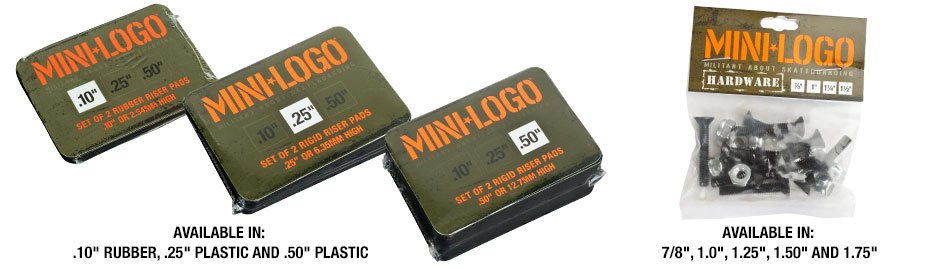
| Thickness (inch) | Thickness (mm) | Use | Bolt |
|---|---|---|---|
| 1/8" | 3.2 mm | small adjustment: wheels around 56 to 58 mm, loose trucks, protection for the deck | 1" to 1 1/8" |
| 1/4" | 6.4 mm | wheels around 59 to 65 mm, cruisers, old school setups | 1 1/4" |
| 1/2" | 12.7 mm | very large, soft wheels, cruisers and longboards | 1 1/2" |
What else a riser changes
- Clearance: In purely geometric terms, every millimeter of riser allows for a 2 mm larger wheel diameter while maintaining the same clearance to the deck. In practice, the calculation is more conservative, because wide wheels and loose trucks need more space.
- Standing height: The board becomes higher. Pushing becomes a little more strenuous, and the board becomes less stable.
- Leverage: With more height, you have more leverage on the trucks. The board turns more with the same amount of pressure.
- Pop: The tail has a longer distance to travel to the ground and strikes it at a steeper angle. Some like the higher pop, but a high board feels more sluggish for quick flip tricks.
- Deck protection: A riser distributes the forces from the baseplate over a larger area. Even 1/8" helps keep the hardware from rattling loose.
#Shock pads and angled risers
- hard plastic, does not give way
- reliable height, making it the right solution for wheelbite
- provides little damping
- in 1/8", 1/4" and 1/2"
- soft rubber or plastic, usually thin
- dampens vibrations and impacts between the truck and the deck
- is compressed, so the height gain is less than the nominal thickness
- retighten the bolts after the first few sessions, because the pad settles
- makes the board feel slightly less direct
Angled risers (Wedge Pads)
Angled risers are wedge-shaped. They tilt the baseplate relative to the deck and thus change the angle of the steering axis. If the thick side points toward the center of the board, the truck turns more (wedging). If it points toward the nose or tail, it turns less and runs more steadily (dewedging). A common combination is more steering at the front and less at the back: the board turns readily and remains stable at speed.
This is a tuning part for cruisers, surfskates and longboards. On a street deck with kicks, angled risers rarely make sense. The article Truck heights and geometry explains how the truck angle determines steering behavior. Angled risers also require longer bolts, measured at the thick side.
#Wheelbite: causes and all countermeasures
Wheelbite means that a wheel touches the underside of the deck when turning or landing. The wheel is abruptly braked, the board stops, and you keep flying forward. You can recognize the danger by dark, rubbed marks on the deck above the wheels.
Causes
- wheels that are too large for the truck height
- low trucks (Low) with little clearance from the deck
- trucks adjusted too loosely
- bushings that are too soft or worn out, cracked
- high body weight or hard landings on an edge of the deck
- wide wheels that reach closer to the edge of the deck
- decks without wheel wells and with a flat concave
Remedies, from simplest to most involved
- Tighten the trucks
Tighten the kingpin nut in quarter turns with a 9/16" wrench. This makes steering somewhat less enjoyable. Do not tighten it so much that the bushings are visibly compressed.
- Check and replace bushings
Crushed or cracked bushings no longer provide resistance. New or harder bushings limit the steering range without you having to overtighten the nut. Details at Bushings.
- Install riser pads
1/8" solves most cases with wheels up to 58 mm, 1/4" with larger wheels. Remember to use longer bolts.
- Higher trucks
If you need new trucks anyway, choose Mid or High instead of Low. See Truck heights.
- Smaller or narrower wheels
Two millimeters less in diameter provides one millimeter of clearance. For technical street skating, this is often the cleanest solution.
- Deck with wheel wells
Cruiser and old school decks often have recesses above the wheels. They create space without making the board higher.
How to check your setup: Put the board on the ground, stand with your full weight on one edge and see if the wheel touches the deck. Repeat this on both sides and at both trucks. If a gap remains visible at full steering, you are on the safe side.
#Rules of thumb: wheel size, riser, bolt length
The table applies to mid-height trucks and normally adjusted steering. With low trucks, move down one row; with high trucks, move up one row. The calculator below takes wheel size, truck height and risers into account together.
| Wheel diameter | Riser pad | Bolt length | Note |
|---|---|---|---|
| up to 54 mm | no riser | 7/8" or 1" | standard for street setups |
| 55 to 56 mm | no riser with tight trucks, otherwise 1/8" | 1" or 1 1/8" | borderline range, check setup |
| 57 to 58 mm | 1/8" | 1" to 1 1/8" | often still rideable without risers with high trucks |
| 59 to 60 mm | 1/8" to 1/4" | 1 1/8" to 1 1/4" | 1/4" with loose trucks |
| 61 to 65 mm | 1/4" | 1 1/4" | cruiser wheels |
| over 65 mm | 1/4" to 1/2" | 1 1/4" to 1 1/2" | longboard range |
The usual guidelines differ from one another by one or two millimeters. They agree on the following: up to 54 mm no riser, from about 57 mm 1/8", around 60 mm the transition to 1/4".
| Truck height | Wheels without risers |
|---|---|
| Low | up to about 52 or 53 mm |
| Mid | up to about 56 mm |
| High | up to about 58 mm, up to 60 mm with tight adjustment |
Guidelines. The height designations low, mid and high are not standardized and differ by a few millimeters depending on the brand.
#Tool: the skate tool
There are three nut sizes on a skateboard, all in inches. A skate tool combines the three matching socket wrenches and usually also a Phillips screwdriver and an Allen key for the hardware.
| Wrench size | Purpose | Thread |
|---|---|---|
| 3/8" (9.5 mm) | Hardware nuts (truck on deck) | 10-32 |
| 1/2" (12.7 mm) | Axle nuts (wheels) | 5/16"-24 |
| 9/16" (14.3 mm) | Kingpin nut (steering) | 3/8"-24 |
Metric wrenches are only an approximate fit and round off the nuts over time. Trucks with an inverted kingpin have an Allen bolt instead of a kingpin nut.
- T-tool: the classic shape, sturdy and inexpensive. The three socket wrenches are at the ends.
- Y-tool: three arms, fits comfortably in the hand, same function.
- Ratcheting tool: faster for assembly, a little more expensive and delicate.
- Thread cutter: Some tools have a built-in cutter for the axle thread. With it, you can salvage a flattened axle end that the nut no longer fits onto.
#Frequently asked questions about bolts and riser pads
What bolt length do I need without a riser pad?
7/8" or 1". With a normal 7-ply deck, 1" is always the right choice; 7/8" is the shorter option with no protrusion. For thicker decks, use 1" or 1 1/8".
Do I need riser pads?
Not with wheels up to 54 mm and mid-height trucks. From about 57 mm or with trucks ridden very loose, 1/8" is advisable, from around 60 mm, 1/4". If you don't have wheelbite, you don't need a riser.
What is the difference between a riser pad and a shock pad?
A riser pad is hard and reliably creates clearance between the wheel and deck. A shock pad is soft and dampens vibrations, but gives way under load. The riser helps prevent wheelbite, the shock pad provides comfort.
Can I use bolts from a hardware store?
Hardly, in Switzerland. Skateboard hardware has a 10-32 inch thread and a countersunk head. Metric bolts fit neither the nuts nor the holes properly. A mounting set costs little and contains everything that fits.
How tight should I tighten the bolts?
Until the head is flush with the griptape and the baseplate sits snugly. Don't tighten them any further, or you'll crush the wood. Retighten them briefly after the first session, especially with shock pads.
Can I stack two riser pads?
It works, but it is a makeshift solution. Two pads can move against each other, and the bolts must be correspondingly longer. A single pad of the right thickness is better.
My bolts keep coming loose. Why?
Usually the nylon rings in the nuts are worn out, or the bolts are too short and the ring doesn't engage at all. New hardware of the right length fixes this. A thin riser or a shock pad additionally dampens vibrations.
Which side of the nut faces the truck?
The flat metal side sits against the baseplate, the nylon ring points downward and goes onto the thread last. Only then does the nut lock.
Something missing or wrong? Report an error