Key points
- Bushings are the truck's spring. They determine how much force it takes to steer and how the board returns to center. No other part changes the ride feel so much for so little money.
- Hardness is given in Shore A. Street bushings range from about 78A (very soft) to 100A (very hard), and most trucks come with around 90A.
- The standard combination for street: a barrel on the bottom, a cone on top. Two barrels provide more stability, two cones allow more turning.
- The kingpin nut is for fine-tuning. If you have to tighten it considerably or almost unscrew it, you need harder or softer bushings.
- Squeaking almost always comes from the pivot cup, not the bushings.
#What bushings do
Each truck has two polyurethane bushings. They sit on the kingpin, one between the baseplate and hanger, the other between the hanger and kingpin nut. The hanger's ring is sandwiched between them. When you lean into a turn, the hanger tilts and compresses both bushings on one side. The urethane gives way, building up counterpressure and pushing the hanger back as soon as you take your weight off.
- Function 1: Resistance
- How much force you need to tilt the deck
- Function 2: Return to center
- How quickly and forcefully the board returns to center (rebound)
- Function 3: Damping
- Absorb vibrations and impacts between the hanger and baseplate
- Function 4: Guidance
- Keep the hanger centered on the kingpin so it does not rub against the steel
Bushings are often overlooked because they are small and cheap. Yet they have more influence on steering feel than the difference between two truck brands. A truck that feels too unstable or too stiff to you is rarely the wrong truck. Most often, it has the wrong bushings in it.
#Hardness: durometer from 78A to 100A
As with wheels, bushing hardness is measured with a durometer on the Shore A scale. The higher the number, the harder the urethane. The scale and its limits are explained in more detail under wheel hardness. For bushings, a rough classification is sufficient.
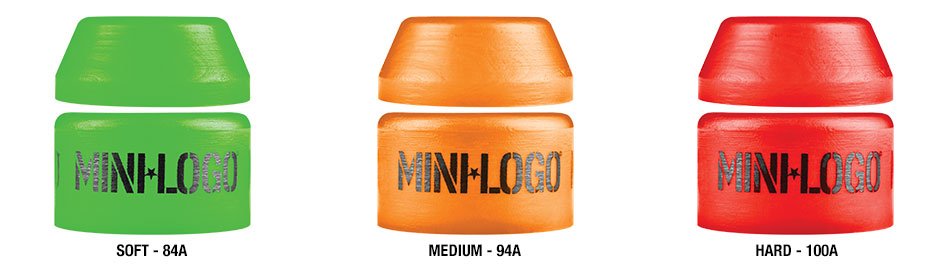
| Hardness | Classification | Ride feel | Typical use |
|---|---|---|---|
| 78A to 85A | Very soft | Tilts with little pressure, turns deeply, little support on landings | Children, very light riders, Cruiser, carving |
| 86A to 90A | Soft to medium | Turns easily, returns noticeably to center | Light to medium-weight riders, bowl, loose street setups. The usual factory setup is around 90A. |
| 91A to 94A | Medium to hard | Clearly defined center, requires deliberate pressure | All-round use for medium-weight to heavy riders, street with stairs and gaps |
| 95A to 97A | Hard | Very stable, little turning without a lot of weight | Heavy riders, vert, high speeds |
| 98A to 100A | Very hard | Almost rigid. Steering is mainly done through kickturns. | Very heavy riders, riders who want their trucks as tight as possible |
Practical guidelines from our shop. Values from different brands are not exactly comparable because the urethane formulas differ in rebound.
Two bushings with the same number can feel different. Hardness only describes how strongly the material resists indentation. The number does not indicate how quickly it rebounds. A urethane with a lot of rebound feels lively and actively pushes the board back. One with little rebound feels damped and calm. Temperature also plays a role: urethane gets harder in the cold. A setup that works in summer can feel one step tighter in winter.
#Shapes: Barrel, Cone, Stepped
Besides hardness, the shape determines how much urethane stands in the hanger's way. More material means more resistance, especially at the end of the turning range.
- A cylinder with straight walls, the same thickness throughout.
- Lots of material: consistent, strong resistance throughout the turning range.
- Stable, good return to center, clear center position.
- Used as the bottom bushing in practically every street truck.
- A truncated cone: wide at the bottom, narrow at the top.
- Little material at the narrow end: the hanger tilts easily, and resistance only increases late in the turn.
- Turns in quickly and allows deep turns, with less support.
- The classic top bushing in street trucks.
- A wide base with a step, with a narrower section above it. Also known as a Stepped Cone.
- The wide base fills the bushing seat and provides support early, while the narrow section allows movement.
- Depending on the design, it feels somewhere between a cone and a barrel or is tighter than a barrel.
- Common mainly in longboard trucks, less common in street trucks.
| Bottom (Boardside) | Top (Roadside) | Character | For whom |
|---|---|---|---|
| Barrel | Cone | Standard: stable base, lively steering | Most street and park riders. Factory setup on many trucks. |
| Barrel | Barrel | Tight, very stable, strong return to center | Heavy riders, vert, big gaps, high speeds |
| Cone | Cone | Very responsive steering, little support | Cruiser, surfing on asphalt, very lightweight riders |
| Hard barrel | Softer cone | Stable on landings, yet easy to initiate turns | Anyone who wants support but not a stiff board |
Independent sells the sets accordingly as «Cylinder» (cylindrical on top) and «Conical» (conical on top).
#Top and bottom bushings, flat and cup washers
The terms «top» and «bottom» come from the truck as it sits on a table: baseplate at the bottom, kingpin nut at the top. On a board in motion, it is the other way around. The English terms are clearer: Boardside is the bushing next to the deck, Roadside is the one facing the road.
| Lower bushing (boardside) | Upper bushing (roadside) | |
|---|---|---|
| Position | Between baseplate and hanger | Between hanger and kingpin nut |
| Size | Taller and usually thicker | Shorter |
| Common shape | Barrel | Cone or short barrel |
| Function | Carries most of the load. Determines stability and basic resistance. | Determines how easily the truck turns and how it returns to center. |
| Wear | Gets compressed and spreads out over time | More prone to tearing, especially at the narrow end of a cone |
Because the lower bushing carries more load, a change there has a greater effect. If you only want to make turning easier, first replace the upper bushing with a softer one or a cone. If you want more support overall, replace both.
Washers
A steel washer sits between the bushing and the baseplate and another between the bushing and the nut: the large bottom washer below and the smaller top washer above. They distribute pressure evenly across the urethane. Their shape noticeably changes how the bushing behaves.
- The bushing can expand freely sideways.
- Softer turning, more steering range, a fluid feel.
- The bushing deforms more and wears out a little faster.
- The raised edge surrounds the bushing and holds it in shape.
- More resistance at the end of the steering range, stronger return to center, a more precise center.
- The cup must fit the diameter of the bushing. Cups that are too small cut into the urethane.
#Choosing according to body weight and riding style
The hardness must suit your weight, because your weight is the force you use to steer. Within that range, riding style is the deciding factor: if you carve and ride in the bowl, choose the softer side. If you jump stairs and ride fast in a straight line, choose the harder side.
| Body weight | Loose: carving, bowl, cruising | All-round: street and park | Firm: gaps, vert, speed |
|---|---|---|---|
| up to 40 kg | 78A to 81A | 81A to 85A | 85A to 88A |
| 40 to 55 kg | 81A to 85A | 85A to 88A | 88A to 90A |
| 55 to 70 kg | 85A to 88A | 88A to 91A | 91A to 94A |
| 70 to 85 kg | 88A to 90A | 90A to 94A | 94A to 96A |
| over 85 kg | 90A to 92A | 92A to 96A | 96A to 100A |
Practical guidance based on our experience in the shop, not a manufacturer standard. The hardness levels vary between brands. If in doubt, choose the middle column and fine-tune with the kingpin nut.
- You keep getting wheelbite: Bushings are too soft or wheels are too large for the truck height. Go one level harder or use a barrel instead of a cone on top.
- You have to stand on the edge to turn: Bushings are too hard. Go one level softer or use a cone instead of a barrel on top.
- The board starts to oscillate at speed (speed wobbles): Too soft or not enough return to center. Go harder, use two barrels or cup washers.
- The board does not return to center: Bushings are worn or the nut is too loose. Replace the bushings.
- Landings feel spongy: Bottom bushing is too soft. Go harder on the bottom, the top can stay as it is.
You normally ride the same bushings at the front and back. Some people set the rear truck slightly tighter so the board runs more steadily at speed. For street setups that are also ridden switch, both should be the same. You can find complete setup suggestions under Setups by riding style.
#Brands and their distinguishing features
| Brand | Line | Hardnesses | Distinguishing feature |
|---|---|---|---|
| Independent | Genuine Parts Cushions for Stage 11 | 78A, 88A, 90A, 92A, 94A, 96A | Six color-coded levels: White (78A), red (88A), orange (90A), blue (92A), black (94A), yellow (96A). Available as Cylinder and, from 88A to 94A, as Conical. |
| Independent | Original Cushions for Stage 4 | 88A, 90A, 92A, 94A | A specific shape for the Stage 4. Note the color code: red is 90A here, white is 88A. |
| Bones | Hardcore | 81A (Soft), 91A (Medium), 96A (Hard) | A hard core (insert) sits in the center, bonded to the urethane. It keeps the bushing snug around the kingpin. According to Bones, no break-in period is required. |
| Thunder | Stock equipment | 90du | T-II with a bushing tapered on one side (Single Taper), Inverted Editions also with 90du. |
| Venture | Stock equipment | 90du on the V8 Hollows | Lo and Hi come with different bushings, identifiable by their color. |
| Lurpiv | Stock equipment | 92A | Deliberately tuned soft for quick steering response. |
| Riptide | Various urethane formulas | N/A | A specialist from the longboard field with many shapes and finely graduated hardnesses. For street trucks, choose the version for standard kingpin. |
| Venom | Various urethane formulas | N/A | Also from the longboard and downhill field. A wide selection of shapes and hardnesses, mainly for reverse kingpin trucks. |
Hardnesses for Independent and Bones according to manufacturer websites, Thunder and Venture according to their own catalogs, Lurpiv as a guideline, not specified by the manufacturer. As of November 2026.
What the core does in Bones Hardcore
A normal bushing has a hole through which the kingpin passes. The urethane needs to be able to move, so there is some play between it and the steel. You feel this play as a slight lack of precision around the center position. Hardcore bushings have a hard insert molded into the center and firmly bonded to the urethane. It fits snugly around the kingpin and holds the bushing in position on both sides. Bones describes the effect as follows: the side that is not being compressed at that moment also works and pulls the hanger back. The result is a more precise center and an even return to center.
#Adjusting the kingpin nut correctly and breaking in bushings
The kingpin nut preloads the bushings. This shifts the point at which the urethane begins to resist. It is a fine adjustment within a narrow range. Beyond that range, you damage the bushings or risk the nut coming loose.
- Finding the basic setting
Tighten the nut until the top washer can no longer be turned by hand and the hanger has no play on the kingpin. The end of the kingpin should now be at least flush with the nut. This is the neutral position: the bushings are in contact but not compressed.
- Adjusting in quarter turns
From here, tighten or loosen in increments of a quarter to half a turn. Ride a few turns after each adjustment. Even half a turn makes a noticeable difference.
- Matching both trucks
Count the turns and set the front and back the same. Check by placing the board on the ground and pressing sideways on the nose and tail in turn. Both trucks should feel the same.
- Observe the limits
Upper limit: If the bushing visibly bulges beyond the washer, the nut is too tight. Lower limit: The kingpin thread must pass all the way through the nut's locking ring, otherwise the nut can vibrate loose.
| Condition | Identified by | Consequence |
|---|---|---|
| Too tight | Bushing bulges out at the sides, washer cuts into it, kingpin protrudes by several threads | The urethane loses its springiness, cracks and hardens. The truck feels dead, the kingpin is under constant stress, and the pivot cup wears out faster. |
| Correct | Washers sit snugly, bushings retain their shape, thread flush with the nut to about two threads visible | Steering springs back smoothly, board returns to center. |
| Too loose | Washer spins freely, hanger rattles, thread ends inside the nut | Hanger hits the kingpin, wheelbite, the nut can come loose. |
Break-in
New bushings are stiffer during the first few hours and return to center unevenly because the urethane has not yet seated itself in the hanger and washers. Deliberately make lots of turns in both directions and readjust the nut after two or three sessions. If the board sits crooked or a wheel does not touch the ground during this time, this is normal and will go away. According to the manufacturer, bushings with a core, such as Bones Hardcore, do not need a break-in period.
Bushings do not last forever. Replace them if they have cracks, are permanently squashed crooked or into a mushroom shape, feel hard and brittle, or the board no longer stands straight on its own. If you skate several times a week, you will notice after a few months to a year that the steering becomes less precise. A fresh set makes an old truck feel like new again.
#Pivot cups and squeaky trucks
The pivot cup is the small urethane or plastic socket in the baseplate. It holds the pivot, the nose of the hanger. With every steering movement, the pivot turns and tilts in the cup. The cup holds the hanger in position and absorbs impacts. If it is worn out, the hanger has play: The steering becomes imprecise, the truck sits crooked or makes a cracking noise.
- Material
- Urethane or plastic, hardness varies by brand
- Wear
- Becomes oval, cracks or crumbles. Faster with trucks ridden very tight.
- Inspection
- Remove the hanger and inspect the cup: It must be round, free of cracks, and hold the pivot without play.
- Replacement
- Inexpensive, brand-specific. Pivot cups are not interchangeable between all brands.
Fixing squeaks
If the truck squeaks or creaks when steering, the pivot is almost always rubbing dry inside the pivot cup. Less often, the bushings are rubbing against the washers or in the bushing seat. The noise is not dangerous, but it indicates friction, and friction means wear.
- Disassemble the truck
Unscrew the kingpin nut, remove the top washer and bushing, and pull the hanger out of the pivot cup. Remember the order of the parts.
- Clean and inspect
Wipe the pivot and pivot cup clean with a cloth. Sand and dust act like sandpaper there. If the cup is cracked or worn out, replace it.
- Lubricate the pivot cup
Apply a small amount of silicone-based lubricant to the cup. Household alternatives include a little dry soap or candle wax, which you scrape into the cup. Water only helps for minutes.
- Treat the bushings too
If the noise continues, also apply a thin layer of silicone or soap to the contact surfaces of the bushings against the washers and hanger.
- Assemble and adjust
Insert the hanger, place the bushing and washer on top, and tighten the nut to its previous position.
Further maintenance work on trucks, bearings and wheels is described under Care and maintenance. Trucks: Construction shows the construction of the truck with all its parts.
#Frequently asked questions about bushings
What bushing hardness do I need?
As a starting point: up to 55 kg, around 85A to 88A, between 55 and 85 kg, around 88A to 94A, above that, 92A to 96A. If you ride bowl a lot and like carving, choose the softer side. If you jump down stairs or prefer a firm setup, choose the harder side.
How tight should the kingpin nut be?
Tight enough that the washers are seated and the hanger has no play, and the end of the kingpin is at least flush with the nut. From there, adjust in quarter turns to your preference. If the bushing bulges out at the sides, it is too tight.
How often do bushings need to be replaced?
When they show cracks, are permanently deformed or the board no longer returns smoothly to center. With regular riding, this is often the case after a few months to about a year. Always replace all four.
Why does my truck squeak?
Usually the pivot is rubbing dry in the pivot cup. Disassemble the truck, clean the cup and lubricate it with a little silicone, soap or wax. Do not use oil.
What is the difference between a barrel and a cone?
A barrel is a cylinder with plenty of material and provides consistent, strong resistance. A cone tapers, allowing the hanger to tilt more easily and turn more deeply. The usual street combination is a barrel on the bottom and a cone on top.
Are soft bushings better for beginners?
Not necessarily. Beginners need the hardness that matches their weight. Bushings that are too soft make the board unstable and lead to wheelbite, while bushings that are too hard prevent you from learning to turn at all. Children and lighter people often need softer bushings than the stock 90A ones.
My truck turns more easily to one side. What causes this?
Common causes include a bushing compressed on one side, a bent washer, or a worn-out pivot cup. Take the truck apart, check the parts, and seat the hanger properly in the cup. If the problem persists, the axle may be bent.
Can I replace just the top bushing?
Yes, that makes sense for fine-tuning. A softer or conical top bushing makes it easier to initiate turns without the truck losing much support on landings. If the bushings are worn, replace both.
Sources (5)
Something missing or wrong? Report an error