Key points
- A truck consists of a baseplate and a hanger, connected by the kingpin. Two urethane bushings cushion the steering, and the pivot sits in the baseplate's pivot cup.
- You steer by shifting your weight: the hanger rotates around an inclined axis between the pivot and the kingpin. This inclination turns leaning into steering.
- When buying, the following count in this order: suitable width, suitable height, then construction and weight.
- Two trucks together weigh around 650 to 800 g, making them the heaviest individual parts on the board.
- Kingpins, bushings, pivot cups, nuts and speed rings are wear parts and can be replaced individually. If the axle is bent or has slipped, the hanger needs replacing.
#Construction: the parts of a truck
The truck connects the deck and wheels and is the only part of the skateboard that steers. Every board has two of them. All street trucks have shared the same basic construction for decades: two aluminum parts, one steel bolt, two rubber bushings. The differences between brands lie in angles, wall thicknesses and materials, not in the principle.
| Part | Material | Function |
|---|---|---|
| Baseplate | Aluminum, cast or forged | Base plate. Attached to the deck with four bolts, it holds the kingpin and pivot cup. Its angle determines how the truck steers. |
| Hanger | Aluminum, cast | The movable T-shaped body. It holds the axle, sits with the pivot in the baseplate and with a ring between the bushings. It is the part used for grinds. |
| Axle | Steel, solid or hollow, rarely titanium | The continuous steel axle in the hanger. The wheel bearings sit on its two ends, which have a diameter of 8 mm. |
| Kingpin | Hardened steel, solid or hollow | The large bolt that holds the hanger and baseplate together. You adjust the preload of the bushings using its nut. |
| Bushings (steering bushings) | Polyurethane | Two rubber bushings on the kingpin, one above and one below the hanger. They cushion the steering movement and return the board to a straight position. |
| Top washer and bottom washer | Steel | Washers on the kingpin. The large bottom washer sits below the lower bushing on the baseplate, the small top washer above the upper bushing under the nut. Usually cup-shaped (cup washer), which supports the bushing at the sides, less often flat. |
| Pivot | Part of the hanger | The projection on the hanger. A second bearing point alongside the kingpin, around which the hanger rotates. |
| Pivot cup | Urethane or plastic | The bearing cup in the baseplate in which the pivot sits. A wear part. |
| Kingpin nut | Steel, self-locking | Holds the assembly of washers, bushings and hanger together. Wrench size 9/16". |
| Axle nuts | Steel, self-locking | Hold the wheels on the axle. Wrench size 1/2". The plastic ring inside prevents them from loosening. |
| Speed rings | Steel | Small washers on either side of each wheel. They ensure that only the inner race of the bearing contacts the hanger and nut. |
- Wrench sizes
- Axle nuts 1/2", kingpin nut 9/16", mounting bolt nuts 3/8". A skate tool has all three.
- Axle diameter
- 8 mm, matching the bore of type 608 bearings
- Threads
- Axle 5/16"-24, kingpin 3/8"-24 (inch fine threads). Metric nuts do not fit.
- Speed rings
- 2 per wheel, 8 per board
- Mounting bolts
- 4 per truck, 8 per board
Speed rings are the parts most often forgotten. Without them, the outer race or the bearing shield rubs against the hanger or the nut, slowing the wheel and causing the bearing to wear out faster. How bearings, spacers and speed rings work together is explained under Bearings.
#How a truck steers
A skateboard has no steering wheel. You steer by shifting your weight onto the toe or heel edge. The geometry of the truck is what turns this into a curve.
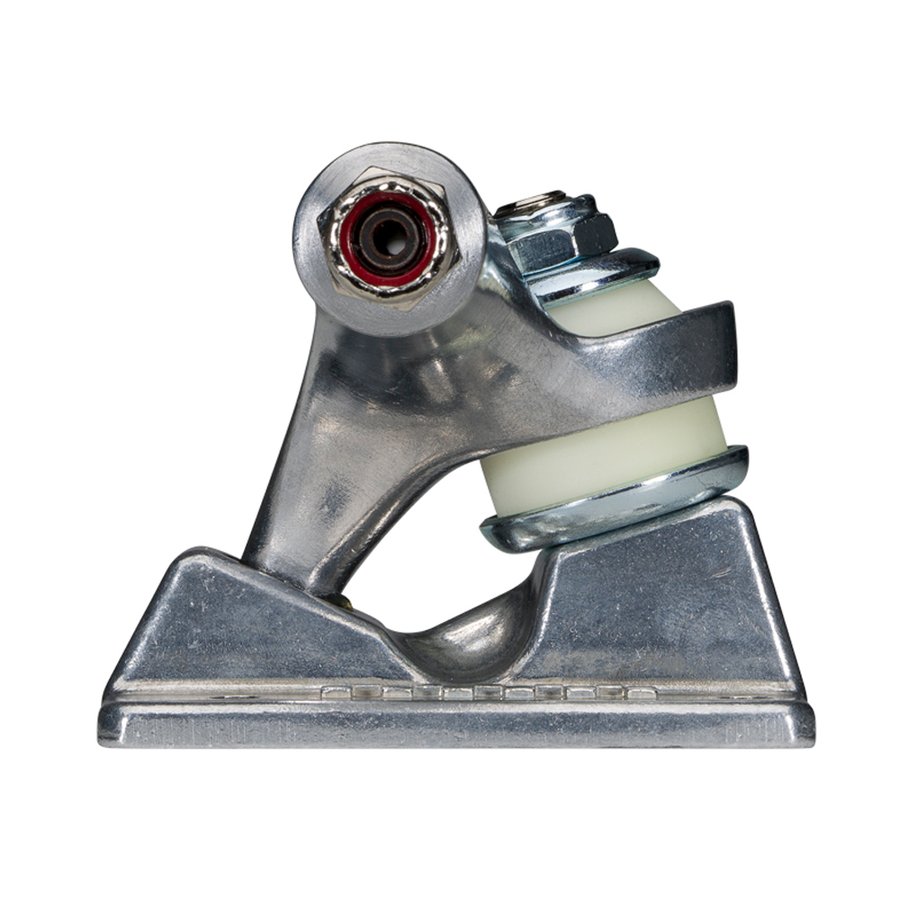
The hanger is supported at two points: at the front by the pivot in the pivot cup, at the rear by its ring between the two bushings on the kingpin. The imaginary line through these two points is the steering axis. It is neither horizontal nor vertical, but inclined relative to the deck. When you tilt the deck to the side, the wheels have to stay on the ground. The hanger therefore rotates relative to the baseplate around the steering axis. Because this axis is inclined, one end of the axle swings forward and the other backward: the truck steers.
- Inclined steering axis: The steeper its angle to the deck, the more steering angle is produced per degree of tilt. The flatter it is, the more you have to lean.
- Mirror-image mounting: The trucks are mounted so that the kingpins point toward the center of the board. This causes the front truck to steer into the turn and the rear truck in the opposite direction. Together they produce an arc.
- Bushings as a spring: When steering, one side of each bushing is compressed. The resistance you feel and the force that returns the board to a straight position come from the urethane.
- Kingpin nut for preload: When you tighten it, the bushings are pre-compressed and the steering becomes stiffer. The geometry does not change.
Angles, heights and the differences between brands are explained in detail in the article Truck heights and geometry.
#Baseplate mounting pattern
The baseplate has four holes for the mounting bolts. The spacing across the direction of travel has always been the same. Along the direction of travel, there are two standards, because baseplates became shorter in the early 1990s to leave more room for the nose and tail.
| Mounting pattern | Lengthwise spacing | Widthwise spacing | Where found |
|---|---|---|---|
| New School (current standard) | 2 1/8" (about 54 mm) | 1 5/8" (about 41 mm) | Practically all current decks and trucks |
| Old School | 2 1/2" (about 64 mm) | 1 5/8" (about 41 mm) | Decks up to about the early 1990s, reissues, some cruisers and longboards |
| 6-hole baseplate | both spacings | 1 5/8" (about 41 mm) | Baseplate with six holes, fits both mounting patterns |
The measurements vary by one millimeter depending on the source (54 or 55 mm, 64 or 65 mm, 41 or 42 mm), because the inch measurements are rounded differently.
Many current decks are drilled with both mounting patterns, especially old-school shapes and cruisers. If your deck only has the old mounting pattern and your truck only has the new one, only two of the four bolts will fit. Two bolts are not enough. In that case, you need a truck with a 6-hole baseplate. Independent offers them in the wide sizes 159, 169 and 215, and Tracker also offers them. Slappy also offers trucks with a 6-hole baseplate.
The article Hardware and riser pads explains what bolt length you need and when a riser pad belongs between the baseplate and the deck.
#Weight: how much does a truck weigh
A street truck weighs between about 300 and 400 g, depending on its size and construction. Two trucks therefore weigh more than any other individual part on the board. Most of the weight is not in the aluminum, but in the two steel parts: axle and kingpin.
| Truck | Construction | Weight |
|---|---|---|
| Ace AF1 33 | Cast, solid axle | 379 g |
| Ace AF1 33 Hollow | Cast, hollow axle and hollow kingpin | 352 g |
| Ace AF1 33 Low | Cast, low height | 361 g |
| Slappy ST1 Classic 8.0 | Cast, solid axle | 374 g |
| Slappy ST1 Hollow 8.0 | Cast, hollow axle and hollow kingpin | 354 g |
| Lurpiv Solid 140 | Cast, solid axle | 353 g |
Ace and Slappy according to their own size charts. Lurpiv: approximate value, not specified by the manufacturer.
Each size increment adds about 7 to 15 g. According to the manufacturer, an Ace AF1 weighs 366 g in size 22 and 427 g in size 77. The difference between standard and hollow is about 20 to 30 g per truck, or 40 to 60 g for the whole board. You can find the full comparison of all construction types under Construction types: weight comparison.
#What to compare when buying
Trucks are the longest-lasting part of a skateboard. A set usually outlasts several decks and sets of wheels. It is therefore worth determining the right size rather than buying based on color.
- Width
The axle width must match the deck width, with no more than 1/4" (6 mm) of difference. This is the most important criterion and the most common buying mistake. All tables can be found under Truck widths.
Matching truck width to the deck - Height
Low, mid or high determines how large the wheels you can ride without a riser pad can be and how the pop feels. Almost any height works for wheels from 52 to 54 mm, but from 56 mm you need a high truck or riser pads. Details under Truck heights.
- Kingpin type
Standard or inverted. With an inverted kingpin, the bolt head is on the bottom and no nut protrudes beyond the hanger. This provides more clearance for grinds such as Smith and Feeble.
- Construction and weight
Standard, hollow, forged or titanium. The difference is 20 to 60 g per truck and the price. For your first board, the standard version of a name-brand truck is sufficient. More under Construction types.
- Turning characteristics
Every brand has its own geometry and feels different. This is a matter of personal preference and can only be settled by trying them out. If possible, borrow the board of someone who rides a different brand.
- Stock bushings
Most street trucks come with bushings around 90A. They are often too hard for light riders and too soft for heavy riders. That is no reason not to buy a truck: Bushings cost little and can be changed in five minutes.
- Replacement parts and warranty
For the major brands, you can get kingpins, pivot cups, bushings and nuts individually. Independent advertises a lifetime warranty («Guaranteed for Life»), while Thunder and Venture refer to a shared warranty policy, since both brands come from the same company.
#Breaking in: the first few hours
New trucks feel stiffer during the first few hours than they do later. This is almost entirely due to the bushings. Fresh urethane still has sharp edges and does not yet sit snugly in the hanger and washers. It settles with each turn.
- Tighten the kingpin nut until the washers can no longer be turned by hand and the thread is flush with the nut or protrudes slightly.
- Ride for half an hour, doing nothing but turns: tight arcs, slalom, carving to both sides. This puts pressure on the bushings all the way around.
- If the board sits crooked afterward or not all four wheels touch the ground, this is normal. The bushings have not yet settled evenly. Loosen the nut by half a turn, continue riding turns and then readjust.
- After the first two or three sessions, check the kingpin nut, the axle nuts and the mounting bolts. Everything settles a little and often needs a quarter turn.
- Make your final hardness adjustment only after about a week. Before then, the feel will continue to change from session to session.
The hanger itself also has a kind of break-in period. When factory-new, its underside is rounded and often painted or polished. The first grinds therefore either do not slide at all or slide unpredictably. After a few dozen grinds, a flat track has formed that locks cleanly onto edges and coping.
#Typical defects and what you can do
| Defect | How to recognize it | Cause | Remedy |
|---|---|---|---|
| Broken kingpin | The hanger hangs loose, and the board can no longer be ridden. The break is usually at the thread or directly under the head. | Hard impacts on landings, material fatigue after years, an overtightened nut as a constant load. | Replace the kingpin. On most trucks, it is pressed into the baseplate and can be driven out with a hammer and punch. Make sure the length is correct: Low trucks have shorter kingpins. |
| Worn-out pivot cup | The hanger has noticeable play, the truck cracks or squeaks, the board sits crooked and the steering feels spongy. | Wear. The pivot rubs inside the cup with every steering movement. Trucks tightened very hard accelerate this. | Replace the pivot cups. This costs little and noticeably changes the ride feel. |
| Bent axle | One wheel sits at an angle or wobbles, the board pulls to one side, and bearings wear unevenly. | Hard landings on one wheel, primo landings, impacts against edges. | Do not bend it back. Replace the hanger. Available separately from some brands, otherwise get a new truck. |
| Axle slip | The axle has shifted sideways in the hanger. It protrudes farther on one side, while on the other there is barely any thread left for the nut. | The axle is cast into the hanger. Strong lateral impacts can loosen this connection. | Tapping it back only helps briefly, the axle will shift again. Replace the hanger. With brand-name trucks, this is often a warranty claim. |
| Damaged axle thread | The axle nut can no longer be threaded on or engages at an angle. | Nut started at an angle, impact on the axle end, nut threaded on too far without a wheel. | Rethread the axle. Many skate tools have a rethreader in the axle wrench for this purpose. The Ace AF1 comes with nuts that rethread the axle as they are screwed on. |
| Cracked or crushed bushings | Imprecise steering, board tilts without resistance, visible cracks or frayed edges. | Age, overtightened nut, heat, oil or solvents. | Replace bushings in pairs, ideally on both trucks at the same time. |
| Cracked baseplate | Crack at a bolt hole or around the pivot seat, truck wobbles despite tight bolts. | Impacts, mounting bolts that have come loose while riding, rarely also material defects in cast baseplates. | Replace immediately. Baseplates are available separately from several brands. |
| Hanger ground through | The steel of the axle becomes visible on the underside of the hanger. | Years of grinding, especially on rough concrete. | Replace the hanger. Once the axle is exposed, it lacks support and bends more easily. |
How to replace kingpins, bushings and pivot cups, and what to include in a small spare parts kit, is covered in the article Care and maintenance.
#Grinding and wear
The hanger is made to be worn down. Aluminum is softer than steel coping, granite or concrete and loses a little material with every grind. This is intentional: Soft metal slides on a hard surface instead of catching.
- Breaking in: Over time, a flat track forms on the underside and, on trucks ridden a lot on round rails, a groove forms. Both help with locking in. This is why many skaters only really like their trucks after a few months.
- Wax: On rough concrete and unpainted steel, skate wax reduces friction and protects the hanger. Too much wax makes edges unpredictably fast, including for everyone else at the spot.
- Kingpin Clearance: In 50-50 and 5-0, the hanger rests straight on the surface. In Smith, Feeble or Hurricane, the truck tilts and the kingpin nut comes close to the edge. The distance between the kingpin and the upper edge of the hanger is called kingpin clearance. According to Slappy, it ranges from just under 4 mm to a little over 12 mm, depending on the truck.
- Ground-down nut: If the kingpin nut regularly grinds against the surface too, it becomes rounded and eventually can no longer be loosened. Replace the nut in time or switch to a truck with an inverted kingpin.
- Baseplate: During slides on the nose or tail, the edge of the baseplate also grinds against the surface. This is not a concern as long as the bolt holes remain intact.
- Lifespan
- Usually several years. If you skate curbs and ledges every day, you can grind a hanger down almost to the axle in a few years.
- Replacement needed
- When the steel of the axle becomes visible or the wall between the grind surface and the axle is paper-thin
- Hollow axle
- On hollow trucks, the axle sits just as deep in the hanger as on standard trucks. They do not grind through any faster.
- Titanium axle
- Lighter than steel. It makes no difference to hanger wear.
Whether cast or forged parts last longer and why hollow trucks sound different when grinding is covered under Construction: durability and grind feel.
#Frequently asked questions about trucks
Which way around are trucks mounted?
The kingpins and bushings point toward the center of the board, the hangers outward toward the nose and tail. If the trucks are mounted the wrong way around, the board steers in the opposite direction to the lean. The exception is longboard trucks with a reverse kingpin: on these the kingpin nut points outward toward the nose or tail.
Do all trucks fit all decks?
As far as the bolt pattern is concerned, almost always: current decks and trucks have the new school bolt pattern. Exceptions are old decks and reissues with an old school bolt pattern, for which you need a 6-hole baseplate. The width of the truck must also match the width of the deck.
How tight should you tighten the axle nuts?
Tight enough that the wheel has no noticeable side-to-side play but still spins freely. Tighten until the wheel slows down, then loosen by an eighth to a quarter turn. A very slight click when moving it from side to side is fine.
How long do trucks last?
With normal use, several years and several decks. You replace wear parts such as bushings and pivot cups in the meantime. A truck is usually only replaced when the hanger has been ground down to the axle or the axle is bent.
Can I use different brands at the front and back?
Technically yes, but it is not recommended. Every brand has a different height and geometry. The board will then sit at a slight angle and steer differently at the front than at the back. Use the same model in the same size at the front and back.
Does a beginner need expensive trucks?
No. The standard version from an established brand in the right width is the best choice. Hollow, forged and titanium save weight, but make no difference to how well you learn to steer or land.
What are speed rings and do I really need them?
They are the small washers on the axle, one on each side of every wheel. They keep the hanger and nut away from the outer ring and the shield of the bearing. Without them, the wheel spins less freely and the bearings wear out faster.
My new truck sits crooked. Is it defective?
Usually not. New bushings settle in during the first few hours. Loosen the kingpin nut a little, ride tight turns for a while and then readjust. If the truck remains crooked, check whether the pivot is seated correctly in the pivot cup and whether the bushings sit straight on the kingpin.
Sources (6)
Something missing or wrong? Report an error