Key points
- Axle width (the overall width from axle end to axle end) is what matters, not the number on the packaging. It should match the deck width.
- A difference of no more than 1/8" (about 3 mm) is ideal, and up to about 1/4" (about 6 mm) is rideable. The wheels then sit approximately flush with the edge of the deck.
- Each brand uses different designations: Independent 139, Thunder 147, Venture 5.2, Ace 33, Krux 8.0, Mini Logo 8.0, and Royal 139 all have an 8.0" (203 mm) axle.
- On street trucks, the axle is about 66 mm (2.6") wider than the hanger. If you only know the hanger width, you can use this to calculate the axle width.
- Trucks that are too narrow make the board tippy, while trucks that are too wide make it sluggish and cause the wheels to protrude.
#Two measurements: hanger width and axle width
Two widths can be measured on a truck, and almost all confusion about sizes comes from the fact that sometimes one measurement is given, sometimes the other. The hanger is the aluminum body you grind on. The axle is the steel axle that runs through the hanger and protrudes on both sides. The wheels sit on these two ends.
- Hanger width
- Width of the aluminum body, from bearing seat to bearing seat. Determines how much surface you have for grinding.
- Axle width (overall width)
- From axle end to axle end. Determines where the wheels sit on the outside, and therefore whether the truck fits the deck.
- Difference
- On street trucks, about 66 mm (2.6"), or about 33 mm per side for the wheel, bearings, speed rings, and nut.
- Measurement to compare
- Deck width against axle width. Never deck width against hanger width.
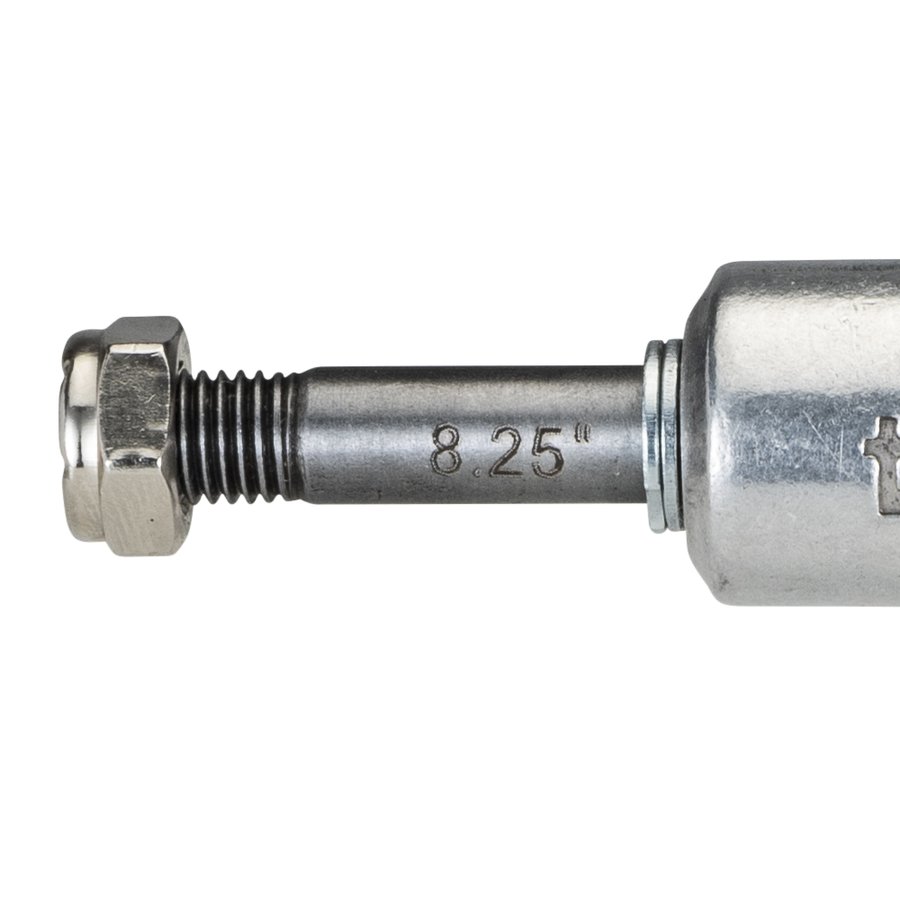
You can verify the difference by calculation. Ace specifies a 143 mm hanger and an 8.25" (210 mm) axle for the AF1 44; for the Lurpiv 140, a 140 mm hanger and an 8.11" (206 mm) axle are used as a guide. In both cases, about 66 mm remains for the two wheel seats. If you only know the hanger width of a truck, you can calculate as follows: hanger in mm plus 66, divided by 25.4, gives the axle width in inches. This is a rule of thumb for classic street trucks. It does not hold for longboard trucks with a 150 or 180 mm hanger or for old trucks with shorter wheel seats.
#The rule: wheels flush with the edge of the deck
The axle width should match the deck width. Viewed from above, the wheels then sit approximately flush beneath the edges of the deck. An 8.25" deck (210 mm) gets a truck with an 8.25" axle, an 8.5" deck (216 mm) one with an 8.5" axle.
| Total difference | Per side | Assessment |
|---|---|---|
| 0 to 1/8" (0 to 3 mm) | up to 1.6 mm | Ideal. You can hardly see the difference and cannot feel it. |
| 1/8" to 1/4" (3 to 6 mm) | 1.6 to 3.2 mm | Rideable. Many people deliberately ride this way, narrower or wider depending on preference. |
| more than 1/4" (over 6 mm) | over 3.2 mm | Noticeable. The board behaves differently than expected, see the next section. |
The tolerance of about 1/4" is generally considered the limit; Slappy and Arbor specify 1/4". The ideal is considered to be 1/8".
Why flush? Your foot presses on the edge of the deck, and the board is supported by the wheels. When the edge and wheel are aligned, your pressure acts directly over the support point. You have full control when steering, without the board tipping beyond the wheels. During flip tricks, the board rotates cleanly around its longitudinal axis because the mass of the wheels sits no farther out than necessary. And when landing, placing your feet over the truck bolts also puts them directly over the wheels.
The calculator above uses the same data as the tables below. You can find out how to choose the right deck width in the article Deck sizes.
#What happens when trucks are too narrow or too wide
- The edge of the deck extends beyond the wheels. When you press on the edge, your weight acts outside the point of contact.
- The board tips more quickly, steers more nervously, and feels wobbly on landings.
- If you land on the edge instead of over the bolts, the board is more likely to tip onto its side (primo).
- Grinds require more precision because the hanger offers less surface area.
- More leverage on the bushings: The truck feels softer than its adjustment suggests.
- Wheels flush with the edge of the deck, plus/minus 1/8".
- Steering, stability, and flip behavior as designed for the deck and truck.
- Feet over the truck bolts are also over the wheels.
- Full hanger width for grinds without the wheels sticking out.
- The wheels stick out beyond the sides of the deck.
- When pushing and doing flip tricks, you are more likely to catch a wheel with your shoe or shin.
- Less leverage on the bushings: The board steers more sluggishly and requires more pressure.
- More weight on the outside. The board rotates more slowly during kickflips and heelflips.
- During slides and on curbs, the wheel touches the ground or the edge before the deck does.
The manufacturers' tables show a clear trend: When in doubt, the deck can be wider than the axle, not the other way around. Ace recommends decks from the axle width up to 1/4" wider for every AF1 size. Independent specifies decks from 8.2" to 8.375" for the 144 with an 8.25" axle. A slightly wider deck is generally considered unproblematic, whereas significantly wider trucks are not recommended.
#Why each brand uses different size designations
There is no standard for truck sizes. The designations have evolved over time: Some use the hanger width in millimeters, others in inches, and still others use the axle width or a size code with no direct measurement. A “149” is therefore not the same width for every brand, and a “5.25” is not a 5.25" wide truck, but a truck with a hanger approximately 5.25" wide and an 8.0" axle.
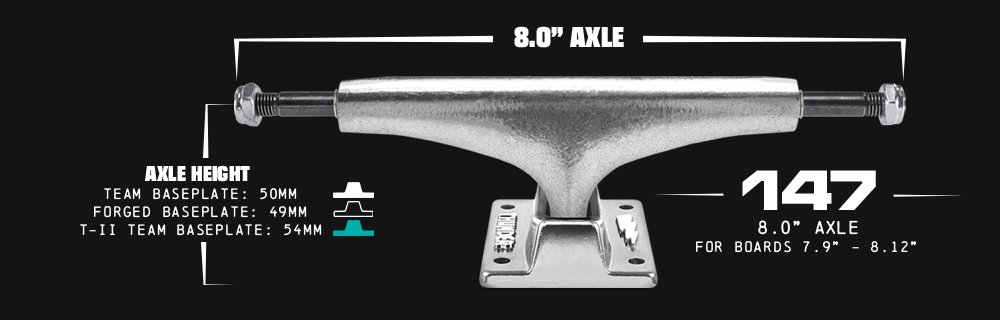
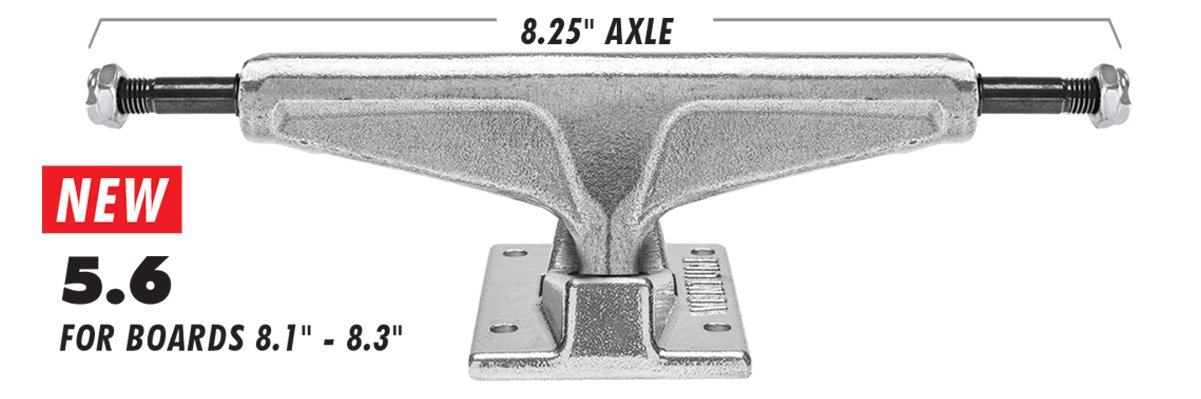
| Brand | Designations | Meaning of the number | Example for 8.0" axle (203 mm) |
|---|---|---|---|
| Independent | 109, 129, 139, 144, 149, 159, 169, 215 | Based on the hanger width in mm, but not exact. The 215 is an exception to the pattern. | 139 |
| Thunder | 143, 145, 147, 148, 149, 151, 161, 181 | Model number with no direct relation to a measurement | 147 |
| Venture | 5.0, 5.2, 5.6, 5.8, 6.1 (sometimes also listed as 5.25) | Based on the hanger width in inches | 5.2 |
| Ace | AF1: 22, 33, 44, 55, 60, 66, 77, 80. Classic: 00 to 66 | Size code with no relation to a measurement | 33 |
| Krux | 7.6, 8.0, 8.25, 8.5, 9.0 | Axle width in inches | 8.0 |
| Royal | 127, 139, 144, 149, 159 | Hanger width in mm | 139 |
| Mini Logo | 7.13, 7.63, 8.0, 8.38, 8.75 | Axle width in inches | 8.0 |
| Slappy | 7.5 to 13.0 | Matching deck width in inches | 8.0 |
| Lurpiv | 140, 145, 150, 160 | Hanger width in mm | 140 (axle 8.11") |
| Film | 5.25 to 6.0 | Hanger width in inches | 5.25 |
With Venture, the size for 8.0" decks causes confusion. Venture lists it as 5.2 in its own size chart and current catalog. The same size also appears as 5.25 or «5.2 / 5.25». If you have an older truck marked 5.25, measure the axle rather than relying on the number.
#Size charts by brand
All tables show the axle width in inches and mm and the deck width range recommended by the manufacturer. The millimeter values are calculated from the inch measurements and rounded to whole mm. Where the hanger width does not come from the manufacturer, this is noted. Information current as of November 2026.
Independent
| Size | Axle inches | Axle mm | Hanger mm* | Recommended deck width | Available as |
|---|---|---|---|---|---|
| 109 | 6.9" | 175 | 108 | 6.25" to 7.6" | Stage 11 (special size) |
| 129 | 7.6" | 193 | 127 | 7.4" to 7.8" | Stage 11, Mid |
| 136 / 139 | 8.0" | 203 | 137 | 7.8" to 8.2" | 139: Stage 11, Mid. 136: Stage 4 |
| 144 | 8.25" | 210 | 143 | 8.2" to 8.375" | Stage 11, Mid |
| 146 | 8.375" | 213 | N/A | 8.125" to 8.625" | Stage 4 |
| 149 | 8.5" | 216 | 150 | 8.375" to 8.6" | Stage 11, Mid |
| 151 | 8.625" | 219 | N/A | 8.375" to 8.875" | Stage 4 |
| 159 | 8.75" | 222 | 156 | 8.6" to 9.0" | Stage 11, Mid |
| 166 | 9.0" | 229 | N/A | 8.5" to 9.5" | Stage 4 |
| 169 | 9.125" | 232 | 165 | 9.0" to 9.5" | Stage 11 |
| 215 | 10.0" | 254 | 187 | 9.5" to 10.5" | Stage 11 |
Axle and deck width range: Independent size chart. *Hanger width: approximate value, not specified by the manufacturer. According to Independent, the Stage 11 Hollow is only available starting at size 139.
Thunder
| Size | Axle inches | Axle mm | Hanger mm* | Recommended deck width |
|---|---|---|---|---|
| 143 | 7.125" | 181 | 114 | 7.4" and narrower |
| 145 | 7.62" | 194 | 127 | 7.4" to 7.9" |
| 147 | 8.0" | 203 | 137 | 7.9" to 8.12" |
| 148 | 8.25" | 210 | 144 | 8.12" to 8.38" |
| 149 | 8.5" | 216 | 150 | 8.38" to 8.62" |
| 151 | 8.75" | 222 | 156 | 8.62" to 8.85" |
| 161 | 9.125" | 232 | 165 | 8.9" to 9.5" |
| 181 | 10.0" | 254 | N/A | 9.5" and wider |
Axle and deck width range: Thunder size chart. *Hanger width: approximate value, not specified by the manufacturer. Not every line is available in every size: Titanium Lights 145 to 149, Lights 145 to 151, Hollow Lights 145 to 161, Team Hollows 147 to 149.
Venture
| Size | Axle inches | Axle mm | Hanger mm* | Recommended deck width | Heights |
|---|---|---|---|---|---|
| 5.0 | 7.62" | 194 | 128 | under 7.9" | Lo and Hi |
| 5.2 (sometimes also 5.25) | 8.0" | 203 | 137 | 7.9" to 8.1" | Lo and Hi |
| 5.6 | 8.25" | 210 | 143 | 8.1" to 8.3" | Hi |
| 5.8 | 8.5" | 216 | 150 | 8.4" to 8.6" | Hi |
| 6.1 | 8.75" | 222 | 155 | 8.62" and wider | Hi |
Axle and deck width range: Venture size chart. *Hanger width: approximate value, not specified by the manufacturer.
Ace
| Size | Axle inches | Axle mm | Hanger mm | Recommended deck width |
|---|---|---|---|---|
| 22 | 7.75" | 197 | 132 | 7.25" to 8.0" |
| 33 | 8.0" | 203 | 137 | 8.0" to 8.25" |
| 44 | 8.25" | 210 | 143 | 8.25" to 8.5" |
| 55 | 8.5" | 216 | 149 | 8.5" to 8.75" |
| 60 | 8.75" | 222 | 155 | 8.75" to 9.0" |
| 66 | 9.0" | 229 | 163 | 9.0" to 9.25" |
| 77 | 9.25" | 235 | 175 | 9.25" and wider |
| 80 | N/A | N/A | 188 | around 10" |
All specifications from Ace. The overview graphic on the same page lists slightly different hanger measurements for some sizes (22: 130 mm, 60: 156 mm, 66: 162 mm) and decks around 9.5" for the 77. For the 80, Ace only specifies the hanger and deck width.
| Size | Axle inches | Axle mm | Hanger mm | Recommended deck width |
|---|---|---|---|---|
| 00 | 6.5" | 165 | 98 | 6.5" and narrower |
| 11 | 7.25" | 184 | 117 | 7.25" to 7.5" |
| 22 | 7.6" | 193 | 127 | 7.5" to 7.875" |
| 33 | 8.0" | 203 | 136 | 7.875" to 8.25" |
| 44 | 8.35" | 212 | 146 | 8.25" to 8.75" |
| 55 | 9.0" | 229 | 162 | 8.75" to 9.125" |
| 66 | 9.35" | 237 | 171 | 9.125" to 9.75" |
Note: AF1 and Classic have the same numbers, but different widths. A Classic 44 has an 8.35" axle, an AF1 44 has an 8.25" axle. A Classic 55 (9.0") is the same width as an AF1 66.
Krux
| Size | Axle inches | Axle mm | Recommended deck width |
|---|---|---|---|
| 7.6 | 7.6" | 193 | 7.25" to 8.0" |
| 8.0 | 8.0" | 203 | 7.75" to 8.25" |
| 8.25 | 8.25" | 210 | 8.0" to 8.25" |
| 8.5 | 8.5" | 216 | 8.25" to 9.0" |
| 9.0 | 9.0" | 229 | 8.5" to 10.5" |
All specifications from Krux. Krux gives very wide deck width ranges. For flush wheels, you are better off following the rule that axle width equals deck width plus or minus 1/4".
Royal
| Size | Axle inches | Axle mm | Hanger mm* | Suitable deck width** |
|---|---|---|---|---|
| 127 | 7.75" | 197 | 127 | 7.625" to 7.875" |
| 139 | 8.0" | 203 | 139 | 7.875" to 8.125" |
| 144 | 8.25" | 210 | 144 | 8.125" to 8.375" |
| 149 | 8.5" | 216 | 147 | 8.375" to 8.625" |
| 159 | 8.75" | 222 | 159 | 8.625" to 8.875" |
Axle: Specifications from Royal. For the 127, Royal lists 7.75" for Raw and Inverted, and 7.5" (190 mm) for Ultra Light. *Hanger: Approximate value, not specified by the manufacturer. **Royal does not specify a deck range, the range shown is the axle width plus/minus 1/8". Older Royal trucks have inch sizes (5.0, 5.25, 5.5), whose designations do not always match the actual width. Be sure to measure them.
Mini Logo
| Size | Axle inches | Axle mm | Hanger mm | Suitable deck width* |
|---|---|---|---|---|
| 7.13 | 7.13" | 181 | 116 | 7.0" to 7.25" |
| 7.63 | 7.63" | 194 | 128 | 7.5" to 7.75" |
| 8.0 | 8.0" | 203 | 137 | 7.875" to 8.125" |
| 8.38 | 8.38" | 213 | 147 | 8.25" to 8.5" |
| 8.75 | 8.75" | 222 | 157 | 8.625" to 8.875" |
Axle, hanger and height (49.5 mm to the center of the axle, the same for all sizes) as stated by Mini Logo. *Mini Logo does not state a deck range; shown is the axle width plus/minus 1/8".
Slappy and Lurpiv
| Size | For deck width | Deck mm | Hanger mm |
|---|---|---|---|
| 7.5 | 7.5" | 191 | 123.5 |
| 7.75 | 7.75" | 197 | 130 |
| 8.0 | 8.0" | 203 | 136 |
| 8.25 | 8.25" | 210 | 143 |
| 8.5 | 8.5" | 216 | 149 |
| 8.75 | 8.75" | 222 | 156 |
| 9.0 | 9.0" | 229 | 162 |
| 9.25 | 9.25" | 235 | 168 |
| 9.5 | 9.5" | 241 | 174 |
| 10.0 | 10.0" | 254 | 187 |
Slappy names the truck after the deck width it fits. Judging by the values, the column that Slappy calls «Axle width (mm)» in its own table corresponds to the hanger width (an 8.5" wide axle would be 216 mm). Larger ST1 sizes are available up to 13.0.
| Size | Axle inches | Axle mm | Hanger mm | Recommended deck width |
|---|---|---|---|---|
| 140 | 8.11" | 206 | 140 | 7.75" to 8.125" |
| 145 | 8.3" | 211 | 145 | 8.25" to 8.5" |
| 150 | 8.5" | 216 | 150 | 8.25" to 8.5" |
| 160 | 8.9" | 226 | 160 | 8.75" to 9.0" |
Approximate values, not specified by the manufacturer. The Lurpiv website was unavailable during research.
Film
| Brand | Size | Axle inches | Axle mm | Hanger mm | Suitable deck width |
|---|---|---|---|---|---|
| Film | 5.25 | 8.0" | 203 | 133 | 7.875" to 8.125" |
| Film | 5.5 | 8.125" | 206 | 139 | 8.0" to 8.25" |
| Film | 6.0 | 8.66" | 220 | 152 | 8.5" to 8.75" |
All values are guidelines for the ideal deck width, not specified by the manufacturer. Notably, a Film 5.5 has only an 8.125" axle, not 8.25".
#Cross-brand overview by deck width
Find your deck in the first column and read across to see which size fits for each brand. In each case, the truck listed is the one whose axle is closest to the deck width. If an axle width is in parentheses, it differs from the exact inch measurement in the row.
| Deck width | Independent | Thunder | Venture | Ace AF1 | Krux K5 | Royal |
|---|---|---|---|---|---|---|
| up to 7.375" (up to 187 mm) | 109 (6.9") | 143 (7.125") | N/A | Classic 11 (7.25") | N/A | N/A |
| 7.5" to 7.75" (191 to 197 mm) | 129 (7.6") | 145 (7.62") | 5.0 (7.62") | 22 (7.75") | 7.6 | 127 (7.75") |
| 7.875" to 8.125" (200 to 206 mm) | 139 | 147 | 5.2 | 33 | 8.0 | 139 |
| 8.25" to 8.38" (210 to 213 mm) | 144 | 148 | 5.6 | 44 | 8.25 | 144 |
| 8.5" (216 mm) | 149 | 149 | 5.8 | 55 | 8.5 | 149 |
| 8.75" (222 mm) | 159 | 151 | 6.1 | 60 | 8.5 or 9.0 | 159 |
| 9.0" to 9.25" (229 to 235 mm) | 169 (9.125") | 161 (9.125") | N/A | 66 (9.0"), 77 (9.25") | 9.0 | N/A |
| 9.5" to 10.5" (241 to 267 mm) | 215 (10.0") | 181 (10.0") | N/A | 77, 80 | 9.0 (according to Krux, up to 10.5") | N/A |
For 8.125", 8.0" trucks fit just as well as 8.25" trucks, and for 8.38", 8.25" and 8.5" trucks fit. Both are within 1/8".
| Deck width | Slappy ST1 | Lurpiv | Film | Mini Logo |
|---|---|---|---|---|
| 7.5" to 7.75" | 7.5, 7.75 | N/A | N/A | 7.63 |
| 7.875" to 8.125" | 8.0 | 140 (8.11") | 5.25 (8.0"), 5.5 (8.125") | 8.0 |
| 8.25" to 8.38" | 8.25 | 145 (8.3") | 5.5 (8.125") | 8.38 |
| 8.5" | 8.5 | 150 (8.5") | 6.0 (8.66") | 8.38 |
| 8.75" | 8.75 | 160 (8.9") | 6.0 (8.66") | 8.75 |
| 9.0" and wider | 9.0 to 13.0 | 160 (8.9") to 9.0" | N/A | N/A |
#Special cases: wheel width, shaped decks, kids' boards
Wide wheels
The rule assumes normal street wheels whose bearings sit close to the outside. With wide cruiser wheels whose core is centered or set toward the inside, the wheel extends beyond the end of the axle. Together, two such wheels can make the running gear wider by a centimeter or more. For a cruiser setup, the axle can therefore be closer to the lower limit of the tolerance. More on this under Wheels.
Shaped decks and old school
For decks that are not the same width throughout, what counts is the width where the trucks sit, not the maximum width. An old school shape measuring 10" at its widest point is often considerably narrower over the front truck. Measure across the front and rear mounting holes and use the larger of the two measurements so that the same truck fits at the front and rear. With old decks, also check the mounting hole pattern, see Baseplate mounting hole pattern.
Kids' and mini decks
There are only a few trucks for decks under 7.4" (188 mm): Independent 109 with a 6.9" axle, Thunder 143 with 7.125" and Ace Classic 00 and 11 with 6.5" and 7.25". A normal 129 or 145 truck protrudes about 8 mm on each side under a 7.0" deck. This is a real tripping hazard for children when pushing.
Different widths at the front and rear
On street and park boards, you ride the same width at the front and rear. Different widths are used on surfskates and some downhill setups, where the rear truck is deliberately chosen to be narrower or lower. This relates to steering geometry and is covered in the article Truck heights and geometry.
#Measuring an existing truck yourself
For used trucks, worn-off markings or complete boards without branded trucks, a measuring tape is the only solution. Here's how:
- Measure axle width
Measure from one end of the axle to the other, across the entire truck. The nuts can be mounted, they sit approximately flush with the ends of the axle. Divide the result in mm by 25.4 to get the width in inches.
- Measure deck width
Measure the deck at its widest point between the trucks, across the direction of travel, from edge to edge on the underside. For shaped decks, also measure across the mounting holes.
- Compare
If the difference is under 3 mm, the truck is an ideal fit. Up to 6 mm is rideable. Beyond that, it is worth choosing a different size.
- Visual check on the assembled board
Place the board on the ground and look straight down at the edge. You should either not see the wheels at all or see only a narrow strip of them.
Matching truck width to the deck
| Inches | mm | Inches | mm |
|---|---|---|---|
| 7.6" | 193 | 8.5" | 216 |
| 7.75" | 197 | 8.75" | 222 |
| 8.0" | 203 | 9.0" | 229 |
| 8.125" | 206 | 9.125" | 232 |
| 8.25" | 210 | 9.5" | 241 |
| 8.375" | 213 | 10.0" | 254 |
1 inch equals 25.4 mm.
#Frequently asked questions about truck widths
What trucks do I need for an 8.0" deck?
A truck with an 8.0" axle (203 mm): Independent 139, Thunder 147, Venture 5.2, Ace AF1 33, Krux 8.0, Mini Logo 8.0, Royal 139 or Slappy 8.0. The Independent 149 is half an inch too wide for an 8.0" deck.
What trucks fit an 8.25" deck?
Independent 144, Thunder 148, Venture 5.6, Ace AF1 44, Krux 8.25, Royal 144 or Slappy 8.25. All have an 8.25" axle (210 mm).
Can I ride 8.0" trucks on an 8.25" deck?
Yes. The difference of 1/4" (6 mm, or 3 mm per side) is at the tolerance limit. The board steers a little more directly and tips more easily. Many street skaters ride exactly this setup. The other way around, with 8.25" trucks under an 8.0" deck, the wheels protrude slightly, which tends to get in the way when pushing and flipping.
Is the number on Independent trucks the width in millimeters?
Only approximately, and only for the hanger. A 139 has a hanger of approximately 137 mm and an axle of 203 mm (8.0"). The number helps distinguish the sizes, but to compare with the deck you need the axle width.
Are Independent 149 and Thunder 149 the same width?
Yes, both have an 8.5" axle (216 mm). But that is a coincidence. For the other sizes, the numbers do not match: Independent 139 corresponds to Thunder 147, Independent 144 corresponds to Thunder 148, Independent 159 corresponds to Thunder 151.
What is the difference between Venture 5.2 and 5.25?
In Venture's current chart, the size with an 8.0" axle is called 5.2. The same size is also often listed as 5.25. For older trucks, it is worth measuring the axle.
Do I also need to buy new trucks for a new deck?
Only if the new deck width differs from the axle width by more than about 1/4". You can keep the trucks when going from 8.0" to 8.125" or 8.25". When jumping from 8.0" to 8.5", they no longer fit.
Does the wheel count toward the width too?
With normal street wheels, hardly at all, as they are roughly flush with the end of the axle. Wide Cruiser wheels with a centered core stick out farther. In that case, the truck can be slightly narrower than the deck.
Sources (11)
- Independent Truck Company: Trucks und Size Chart
- Thunder Trucks: Size Chart
- Thunder Trucks: Truck Styles
- Venture Trucks: Ride The Right Size Truck
- Venture Trucks: Katalog Fall 2026
- Ace Trucks: Sizing Chart
- Krux Trucks: Size Guide
- Royal Trucks: Trucks
- Slappy Trucks: Size Chart und Specs
- Slappy Trucks: What Size Skateboard Trucks for an 8.5" Deck
- Arbor Collective: Skateboard Trucks Guidebook
Something missing or wrong? Report an error