Key points
- Truck height is measured from the mounting surface of the baseplate to the center of the axle. 46 to 56 mm is common. There is no standard for low, mid, and high.
- The gap between the wheel and the deck is the truck height minus the wheel radius. Two millimeters more wheel diameter costs one millimeter of clearance.
- Low trucks: board closer to the ground, faster pop, more stable, but wheelbite occurs sooner. High trucks: room for larger wheels and more lean.
- How a truck turns is determined by the position of the steering axis between the pivot and bushings. That is why trucks of the same width and height from different brands feel different.
- Inverted kingpin (bolt head underneath, for grinds) and reverse kingpin (longboard design) are two different things.
#What truck height is and how it is measured
Truck height is the distance from the mounting surface of the baseplate, that is, the underside of the deck, to the center of the axle. It tells you how high the deck sits above the wheel centers. This is how it is usually measured, and Thunder explicitly refers to it as «Axle Height» in its own table. Occasionally, it is measured to the top edge of the hanger instead. For unfamiliar brands, check which measurement is meant.
| Class | Height | Typical wheels without riser pad | Typical use |
|---|---|---|---|
| Low | 46 to 49 mm | 50 to 53 mm | Technical street skating, flip tricks, ledges |
| Mid | 50 to 53 mm | 52 to 56 mm | All-round: street and park |
| High | 53.5 to 58 mm | 54 to about 60 mm | Transition, bowl, larger and softer wheels |
Common categories, not a standard. Wheel sizes are guidelines and apply to trucks adjusted relatively tight.
#Heights by brand in millimeters
| Brand | Line | Height | Class by mm |
|---|---|---|---|
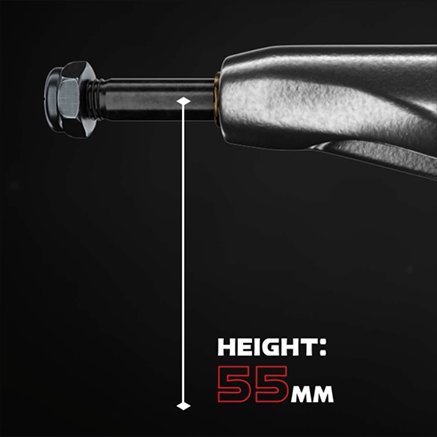
| Independent | Stage 11 Standard, Stage 11 Hollow | 55 mm | High |
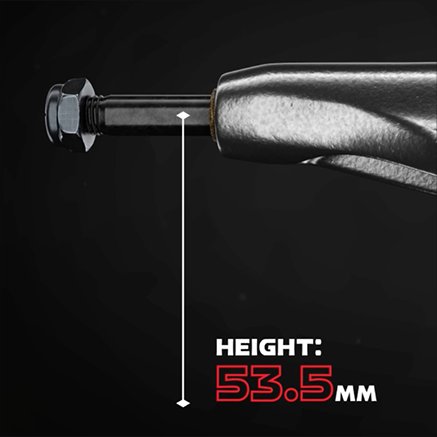
| Independent | Stage 11 Forged Hollow, Forged Titanium | 53.5 mm | High |
| Independent | Stage 4 | 55 mm | High |
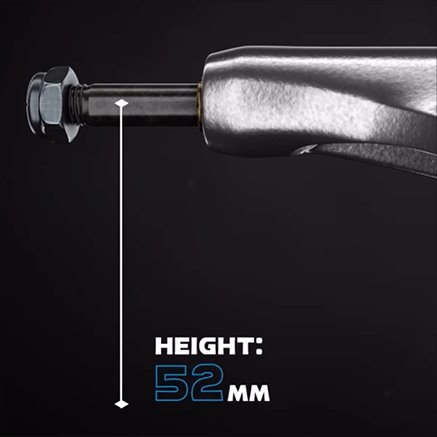
| Independent | Mid, Mid Hollow (Inverted Kingpin) | 52 mm | Mid |
| Independent | Mid Forged Hollow | 50.5 mm | Mid |
| Thunder | Team Edition, Team Hollows: 143, 145, 147 | 50 mm | Mid |
| Thunder | Team Edition, Team Hollows: 148, 149, 151 | 52 mm | Mid |
| Thunder | Team Edition: 161, 181 | 53 mm | Mid |
| Thunder | Lights, Hollow Lights, Titanium Lights (Forged Baseplate): 145, 147 | 49 mm | Low |
| Thunder | Lights, Hollow Lights, Titanium Lights: 148, 149, 151 | 51 mm | Mid |
| Thunder | Hollow Lights: 161 | 52 mm | Mid |
| Thunder | T-II (147 to 181) | 54 mm | High |
| Venture | Lo (5.0, 5.2) | 48 mm | Low |
| Venture | Hi (5.0 to 6.1) | 53.5 mm | High |
| Ace | AF1, AF1 Hollow, Classic | 53 mm (2.1") | Mid |
| Ace | AF1 Low | 49 mm (1.93") | Low |
| Mini Logo | all sizes 7.13 to 8.75 | 49.5 mm | Low |
| Royal | current sizes 127 to 159 | 52 mm | Mid |
| Krux | K5 | N/A | N/A |
| Slappy | ST1 Classic, Hollow, Inverted | 53.9 mm | High |
| Slappy | ST1 Lows | 50.0 mm | Mid |
| Lurpiv | Solid | 55 mm | High |
| Film | Standard | 52.5 mm | Mid |
As of November 2026. «Class by mm» consistently follows the categories low up to 49 mm, mid 50 to 53 mm, high from 53.5 mm, regardless of the manufacturer's name. The heights of Independent, Thunder, Ace, Slappy, and Mini Logo are stated by the manufacturers themselves; Krux does not state a height. The values for Venture, Royal, Lurpiv, and Film are guidelines, not specified by the manufacturer. The Ace AF1 is also sometimes listed as 52 mm; Ace itself states 53 mm.
Two things stand out. First, Thunder heights increase with width: The narrow sizes are 2 mm lower than the medium sizes, the wide ones 1 mm higher. If you switch from a 147 to a 148, you get not only a wider truck, but also a higher one. Second, a forged baseplate reduces height: by 1 mm for Thunder and by 1.5 mm for Independent. Forged aluminum is stronger, so the plate can be thinner. More on this under construction types.
#What height changes: Pop, stability, wheelbite, wheel size
- The deck sits closer to the ground, with a lower center of gravity and a more stable feel during manuals and landings.
- The tail has a shorter distance to travel to the ground. The pop comes earlier and requires less force.
- The angle of the deck during the pop is flatter.
- Less clearance above the wheels. Wheelbite can occur even with medium-sized wheels and a loose adjustment.
- Pushing is slightly more comfortable because your standing leg bends less.
- A compromise between the two.
- Enough clearance for wheels up to about 56 mm with a normal adjustment.
- Feels neutral to most riders.
- The largest selection of models is in this range.
- More clearance: larger wheels and a deeper lean without wheelbite.
- The tail has a longer distance to travel. The pop comes later, and the deck is steeper when it leaves the ground.
- Higher center of gravity. The board responds more strongly to weight shifts.
- More distance between the deck and the ground, helpful on rough surfaces and at coping.
Calculate clearance instead of guessing
The distance between the top of the wheel and the underside of the deck can be calculated: truck height minus half the wheel diameter, plus the thickness of a riser pad, if present. A 52 mm high truck with 54 mm wheels gives 52 minus 27, or 25 mm. If you switch to 58 mm wheels, 23 mm remain. Every additional 2 mm of wheel diameter costs 1 mm of clearance, every additional millimeter of truck height gives 1 mm back.
| Truck height | 52 mm wheel | 54 mm wheel | 56 mm wheel | 58 mm wheel | 60 mm wheel |
|---|---|---|---|---|---|
| 48 mm | 22 mm | 21 mm | 20 mm | 19 mm | 18 mm |
| 50 mm | 24 mm | 23 mm | 22 mm | 21 mm | 20 mm |
| 52 mm | 26 mm | 25 mm | 24 mm | 23 mm | 22 mm |
| 53.5 mm | 27.5 mm | 26.5 mm | 25.5 mm | 24.5 mm | 23.5 mm |
| 55 mm | 29 mm | 28 mm | 27 mm | 26 mm | 25 mm |
Calculated: truck height minus wheel radius. The value applies at the center of the wheel with the deck level. Concave and wheel wells change it by a few millimeters. A 1/8" riser pad adds 3.2 mm.
This clearance is used up when turning. When you lean the deck, the edge on the inside of the turn lowers toward the wheel. How much lean is possible before the two touch depends on clearance, deck width, truck width and bushing hardness. If the wheel touches the deck, it brakes abruptly: this is wheelbite.
| Truck height | Example | Largest wheel |
|---|---|---|
| 48 mm | low trucks such as Venture Lo | 52 mm |
| 50 mm | Thunder 147 Team | 56 mm |
| 52 mm | Ace Classic | 60 mm |
| 53.5 mm | Venture Hi | 62 mm |
| 55 mm | Independent Stage 11 Standard | 63 mm |
These values are guidelines, not specifications provided by the manufacturer. They represent the upper limit of what is possible with tightly adjusted trucks, not a recommendation. If you ride loose trucks, stay a few millimeters below these values or install riser pads.
#Geometry: kingpin angle, pivot and steering axis
Two trucks with identical widths and heights can ride completely differently. The reason is geometry, meaning the positions of the pivot, kingpin and axle relative to one another. Manufacturers of street trucks generally do not publish these angles. However, the principle is the same for all of them.
- Steering axis (pivot axis): The line from the pivot through the center of the bushing seat. The hanger rotates around it. Its angle relative to the deck is the truck's most important measurement. On longboard trucks, it is called the baseplate angle and is specified.
- Steep steering axis: More steering per degree of lean. The truck responds immediately and turns tightly, but becomes twitchy at speed.
- Shallow steering axis: Less steering per degree of lean. You have to lean the deck further, but the board remains stable at speed.
- Kingpin angle: On street trucks, the kingpin does not lie on the steering axis, but across it. Its angle determines how the bushings are loaded: more in compression or more in shear. This shapes how progressively the resistance increases as you turn.
- Axle offset (rake): If the axle does not lie exactly on the steering axis, but in front of or behind it, the deck rises or falls slightly when turning. This changes how strongly the truck wants to return to center on its own and whether it turns more quickly at the beginning or end of its steering travel.
- Bushing seat: The recess in the hanger where the bushings sit. A tight seat holds the urethane firmly and provides a clearly defined center. An open seat allows more movement and feels more fluid.
The interaction of these elements produces a truck's character: how quickly it responds, how deeply it can lean, how clearly you can feel the center position and how it behaves at high speed. Bushings can amplify or dampen this character, but they cannot reverse it. A truck with a shallow steering axis will not turn tightly even with soft bushings. It will only lean more easily.
#How trucks change the wheelbase
A deck's wheelbase is measured between the inner mounting holes. The wheelbase you actually ride is the distance from axle to axle. The truck sits between the two: depending on the model, the axle sits at a different distance in front of the mounting holes. Two different trucks under the same deck therefore result in effective wheelbases that differ by a few millimeters.
- Shorter effective wheelbase
- Tighter turning circle, board turns faster, feels more agile and less stable at speed
- Longer effective wheelbase
- Larger turning circle, more stable straight-line tracking, slightly longer lever between tail and rear axle
- Order of magnitude
- A few millimeters per truck. Noticeable especially in a direct comparison.
- Effect of riser pads
- None on the wheelbase, as long as they are flat. Wedge-shaped pads (wedges) change the angle of the steering axis.
There are hardly any manufacturer specifications for axle position. Venture makes this a feature of the V8: the baseplate has additional holes that allow the truck to be mounted in an offset position and the wheelbase to be adjusted. If a deck suddenly feels shorter or longer with a new truck brand, this is often the reason, not the deck. You can find wheelbase basics under Deck sizes.
#Why Independent, Thunder, Venture and Ace steer differently
The following descriptions summarize what the manufacturers themselves say about their trucks, what can be derived from the measurements and what is considered common experience among skaters. None of the four brands publishes measured values for the angles. Use this classification as a guide, not a ranking.
- At 55 mm, the Stage 11 Standard is the tallest of the four. Plenty of clearance for wheels and lean.
- Steers evenly throughout its travel and allows deep lean.
- Considered an all-round truck and is especially common in bowl and transition.
- Relatively heavy in the standard version. The Mid line (52 mm, inverted kingpin) offers a lower option for street.
- Built lower: 49 to 52 mm in the common sizes.
- Thunder itself describes the geometry as quick to respond. The truck turns early and directly.
- The low profile and light weight make it a typical street truck.
- For those who want more height, the T-II offers a version with 54 mm and revised geometry.
- In two clearly distinct heights: Lo (48 mm) and Hi (53.5 mm).
- Considered the calmest of the four: stable center position, less twitchy at speed.
- Turns less deeply than Independent or Ace. This helps with landings and on ledges.
- The V8 baseplate allows the wheelbase to be adjusted.
- At 53 mm, in the upper mid-range, with the AF1 Low at 49 mm.
- Turns very readily. The baseplate angle is considered steeper, and the truck particularly responsive.
- Feels smooth and "surfy," but requires calm footwork at speed.
- Popular in bowls, pools and with everyone who likes to carve a lot.
Kingpin clearance compared
One measurement that can be compared directly is the clearance between the kingpin and the top of the hanger. It determines how far you can tilt the truck in a Smith, Feeble or Hurricane before the kingpin catches on the edge. Slappy has published a comparison table on this.
| Truck | Clearance from kingpin to top of hanger | Tilt angle before the kingpin makes contact |
|---|---|---|
| Slappy Ultra Low Inverted Hollow Light | 12.5 mm | 25° |
| Slappy Inverted Kingpin | 9 mm | 20° |
| Slappy Classic | 6.3 mm | 15° |
| Independent Mid (Inverted Kingpin) | 6.3 mm | 9° |
| Ace AF1 | 5.3 mm | 11° |
| Venture High | 5.1 mm | 14° |
| Independent Stage 11 | 3.9 mm | 8° |
| Thunder | 3.8 mm | 7° |
The values come from a manufacturer comparing its own trucks with those of its competitors and, according to Slappy, were measured with a smartphone. They show the approximate magnitude, but are not a neutral measurement.
#Standard kingpin, reverse kingpin and inverted kingpin
On a classic skateboard truck, the kingpin points toward the center of the board, with the axle on the outside in front of it. This design is called standard kingpin or traditional kingpin, TKP for short. On longboard trucks, the arrangement is reversed: the kingpin points outward toward the nose and tail, with the axle on the other side. This is the reverse kingpin, RKP for short.
- Kingpin points toward the center of the board, hanger sits on the outside.
- Low profile, deck close to the ground.
- The hanger is exposed and far from the kingpin. This makes the design suitable for grinding.
- Steers progressively: little at first, more as the lean increases.
- Can become unstable at high speed.
- Kingpin points outward toward the nose and tail.
- Higher profile. Designed for decks with a longer wheelbase.
- Steers directly and predictably, even at high speed.
- The baseplate angle is specified and often selectable, usually between 40° and 50°.
- The kingpin is in the way. Hardly suitable for grinding and flip tricks.
| Brand | Flat baseplate | Steep baseplate |
|---|---|---|
| Paris | 43° | 50° |
| Caliber | 44° | 50° |
| Randal | 42° | 50° |
| Bear | 40° | 52° |
| Atlas | 40° | 48° |
Approximate guidelines. Around 50°: a lot of steering with little lean, for carving and cruising. Around 40° to 44°: more lean for the same amount of steering, more stable at speed, for freeride and downhill. Longboard hangers are usually 150 or 180 mm wide.
#Baseplate angles on longboard trucks: 50°, 44°, 40° and the turning circle
Longboard trucks have an angle in degrees marked on the baseplate: 50°, 44°, 42° or 40°. This is the angle of the steering axis relative to the baseplate, meaning the line through the pivot and the center of the bushing seat. The hanger rotates around this line when you lean into a turn. The number tells you how much of this rotation translates into steering and how much into lean.
The geometry behind it is simple. A flat steering axis (small angle) lets the deck tilt a long way without the wheels turning sharply. A steep steering axis (large angle) converts the same lean into a lot of steering. As an approximation for typical lean angles: Steering angle = lean × tangent of the baseplate angle. At 45°, the truck steers through the same number of degrees as you lean the deck. At 50° it is about a fifth more, at 40° about a sixth less.
- 50° baseplate
- 1.19° steering per 1° of lean
- 45° baseplate
- 1.00° steering per 1° of lean
- 40° baseplate
- 0.84° steering per 1° of lean
| Baseplate angle | Steering per degree of lean | Steering angle at 15° of lean | Turn radius | Turning circle (diameter) | Typical use |
|---|---|---|---|---|---|
| 50° | 1.19 | 17.1° | about 0.97 m | about 1.9 m | Carving, cruising, dancing |
| 48° | 1.11 | 16.0° | about 1.04 m | about 2.1 m | Carving and freeride |
| 45° | 1.00 | 14.5° | about 1.16 m | about 2.3 m | All-round |
| 44° | 0.97 | 14.0° | about 1.20 m | about 2.4 m | Freeride, fast all-round |
| 42° | 0.90 | 13.1° | about 1.29 m | about 2.6 m | Freeride and downhill |
| 40° | 0.84 | 12.3° | about 1.38 m | about 2.8 m | Downhill |
| 35° | 0.70 | 10.3° | about 1.66 m | about 3.3 m | Rear truck in a downhill setup |
| 30° | 0.58 | 8.5° | about 2.01 m | about 4.0 m | Rear truck in a downhill setup |
Calculated for a board with a 60 cm wheelbase, the same truck at the front and rear, and 15° of deck lean. The steering angle is calculated exactly (tangent of the steering angle = tangent of the baseplate angle × sine of the lean), and the turn radius is the wheelbase divided by twice the tangent of the steering angle. Pure geometry as an approximation: bushings, wheel grip and your weight are not included. The relationships between the angles are correct, while the absolute distances in meters depend on the board.
- A lot of steering for little lean.
- Tight turning circle, the board responds to small shifts in weight.
- Pumping and carving are easy.
- More twitchy at high speeds: Small movements produce large steering inputs.
- Steering and lean are roughly in a one-to-one ratio.
- More stable than 50°, more maneuverable than 40°.
- Slides are easy to control.
- The compromise when one board needs to do everything.
- You have to lean the deck further for the same amount of steering.
- Larger turning circle, but plenty of margin at speed.
- Steering inputs from uneven surfaces and wobbles are dampened.
- Sluggish in the city and on narrow paths.
Why the number changes the turning circle so much
In the calculation example in the table, at the same lean, the same board with 50° baseplates rides a circle just under two meters in diameter, while with 40° baseplates it needs around 2.8 meters. That is around 40 percent more space, solely because of ten degrees at the baseplate. Conversely, this means that with 40° you have to lean into the same turn much further. That is exactly what makes flatter baseplates so stable at speed. A small wobble of one degree steers the truck by only 0.84° instead of 1.19°.
Steep in front, flat in back: split setups
In downhill, the trucks are often set up differently: a steeper baseplate in front (for example 44° to 50°), and a significantly flatter one in back (30° to 40°). The front truck steers, while the rear truck follows and contributes little steering. This keeps the rear stable, leaving less opportunity for speed wobbles, which almost always start at the rear truck. The turning circle becomes larger because the rear truck contributes little to the turn.
- Same angles in front and back: The board steers symmetrically and rides the same in both directions. Right for carving, dancing and freeride with switch riding.
- Flatter in back than in front: stable at speed, with a clear direction of travel. Right for downhill.
- Change the angle without a new baseplate: An angled riser tilts the whole truck by a few degrees. The thick side toward the center of the board makes the steering axis steeper (wedging), while the thick side facing outward makes it flatter (dewedging). More on this under Bolts, riser pads and wheelbite.
#Surfskate trucks explained briefly
A surfskate should be able to accelerate from a standstill by pumping and turn as tightly as a surfboard on a wave. The steering range of a normal truck is not enough for this. Surfskates therefore have a special truck with a very large steering range in front and a largely normal truck in back that serves as a pivot point.
- Swivel arm with spring: The hanger sits on an arm that can also swivel sideways. A spring in the base returns it to its original position. The Carver C7 works this way. The spring preload can be adjusted with an adjustment nut. Ride feel: soft, flowing, very loose.
- Reverse kingpin with an extreme angle: An RKP truck whose hanger can swivel much farther than usual. The Carver CX is built this way and does not need a spring or an additional joint. Ride feel: tighter, faster, more stable at speed, easier to maintain.
- Adapter: There are also swivel adapters that are bolted between the deck and a normal truck, giving it an additional joint.
All systems have this in common: The front truck sits considerably higher than a street truck, and the rear truck is matched to its height. Surfskate trucks are wide, Carver sets are usually 9.0" (229 mm) wide. They are not built for ollies, flip tricks and grinds. For which board is suited to which purpose, see Types of skateboards.
#Frequently asked questions about height and geometry
Low or high: Which is better for beginners?
A mid height of around 50 to 53 mm or a high standard truck. This lets you ride wheels from 52 to 56 mm without worrying about wheelbite. Very low trucks are only worthwhile once you know you like small wheels and a low board.
What truck height do I need for 54 mm wheels?
54 mm wheels fit on almost any truck from about 50 mm in height without a riser pad. On trucks with 48 or 49 mm, they work with a tight setting. If you ride loose, a 1/8" riser pad helps.
Can I turn a low truck into a high one with a riser pad?
In terms of height, yes: A 1/8" (3.2 mm) riser pad brings a 49 mm high truck to just over 52 mm. However, the geometry and steering characteristics remain those of the low truck. You also need longer mounting bolts.
Is the Independent Standard a high truck?
Yes. At 55 mm, the Stage 11 Standard is clearly in the high range, even though it is not called that. The Independent Mid at 52 mm is the lower alternative.
What is wheelbite and how do I prevent it?
Wheelbite means that a wheel touches the deck and locks up when you turn. Remedies in this order: harder bushings or a tighter setting, smaller wheels, riser pads, higher trucks. Some decks also have wheel wells, which are recesses above the wheels.
What is the difference between an inverted kingpin and a reverse kingpin?
The inverted kingpin is a kingpin installed upside down in a normal street truck. It creates clearance for grinds. The reverse kingpin is the design used in longboard trucks, where the kingpin and hanger have swapped sides.
Can I bolt longboard trucks onto a normal skateboard deck?
The bolt pattern usually fits, but it rarely makes sense. Reverse kingpin trucks are higher and wider. The tail can barely reach the ground, and the kingpin gets in the way when grinding. It can work for a cruiser based on a street deck, but not for tricks.
Why does my board feel so different with trucks from another brand?
Because the height, steering axis, axle position and bushings all change at the same time. Even a 3 mm difference in height and a wheelbase that differs by a few millimeters are noticeable. Give yourself two or three sessions before you judge.
Sources (8)
- Independent Truck Company: Trucks (Höhen je Linie)
- Thunder Trucks: Size Chart (Axle Height je Grösse)
- Thunder Trucks: Truck Styles
- Venture Trucks: Ride The Right Size Truck
- Venture Trucks: Katalog Fall 2026
- Ace Trucks: Sizing Chart
- Slappy Trucks: Size Chart, Specs und Kingpin Clearance
- Arbor Collective: Skateboard Trucks Guidebook
Something missing or wrong? Report an error