Key points
- Almost all street trucks have a cast aluminum hanger with a steel axle cast into it. The differences between product lines lie in the axle, kingpin and baseplate.
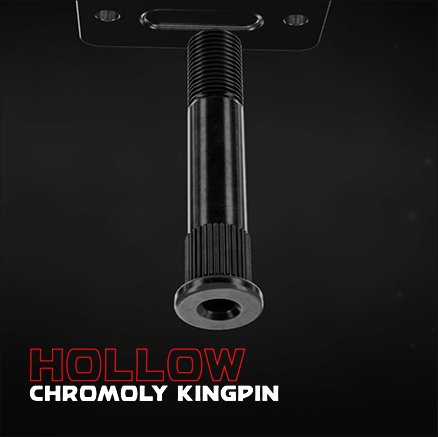
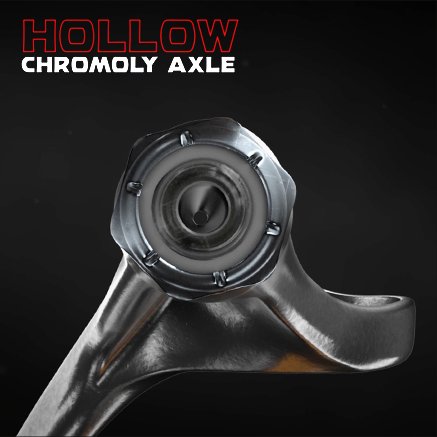
- Hollow means the axle and kingpin are drilled hollow. According to manufacturers' tables, this saves around 20 to 30 g per truck.
- Forged almost always means a forged baseplate for street trucks. It is stronger, thinner and makes the truck 1 to 1.5 mm lower.
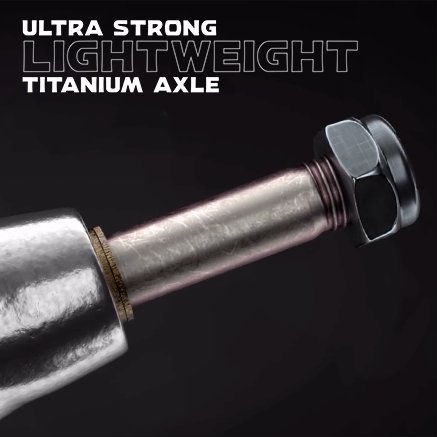
- Titanium replaces the steel axle and saves the most weight, but also costs the most.
- The inverted kingpin saves little weight. It creates clearance above the hanger for grinds.
#Overview: what the names mean
Every brand makes its truck in several versions: same shape, same geometry, different materials. The names sound like marketing, but they usually describe precisely which part is manufactured differently. If you know the four building blocks, you can make sense of every product line.
| Term | What is different | Effect |
|---|---|---|
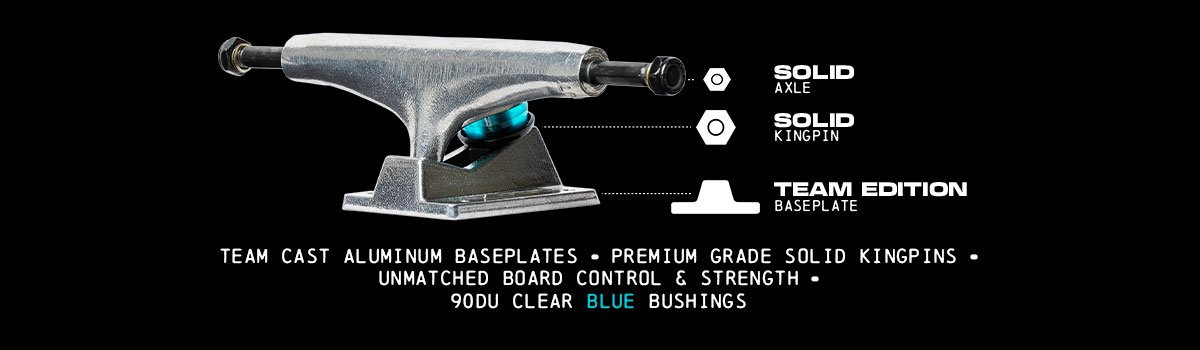
| Standard, Team, Classic | Hanger and baseplate are cast, axle and kingpin are solid steel | The baseline. Heaviest, cheapest, least susceptible to damage. |
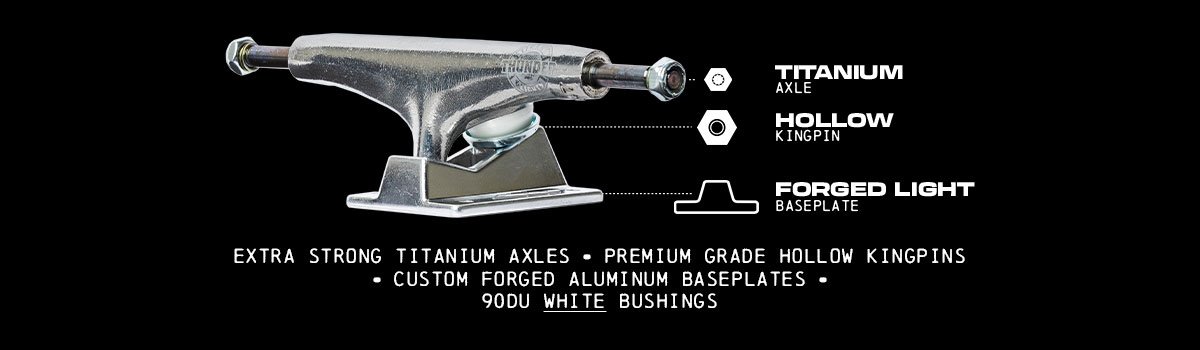
| Hollow | Axle and kingpin are drilled hollow | Around 20 to 30 g lighter per truck. Geometry and height unchanged. |
| Forged | Baseplate is forged instead of cast | Stronger, thinner baseplate. Truck is 1 to 1.5 mm lower and slightly lighter. |
| Lights | At Thunder: forged baseplate and hollow kingpin | Lighter and lower than the Team Edition. |
| Titanium | Titanium axle instead of steel | Greatest weight saving in a single part. |
| Inverted Kingpin | Kingpin screwed in from the hanger side, head instead of nut at the hanger | More clearance for grinds, little effect on weight. |
| Low, Mid, Lo, Hi | Different baseplate or hanger height | Concerns height, not material. See truck heights. |
| Brand | Line | Baseplate | Axle | Kingpin | Height |
|---|---|---|---|---|---|
| Independent | Stage 11 Standard | Cast | Solid steel | Solid | 55 mm |
| Independent | Stage 11 Hollow | Cast | Hollow steel | Hollow | 55 mm |
| Independent | Stage 11 Forged Hollow | Forged | Hollow steel | Hollow | 53.5 mm |
| Independent | Stage 11 Forged Titanium | Forged | Titanium | Hollow | 53.5 mm |
| Independent | Mid | Cast | Solid steel | Inverted | 52 mm |
| Independent | Mid Hollow | Cast | Hollow steel | Inverted | 52 mm |
| Independent | Mid Forged Hollow | Forged | Hollow steel | Inverted | 50.5 mm |
| Thunder | Team Edition | Cast (Team) | Solid steel | Solid | 50 to 53 mm |
| Thunder | Team Hollows | Cast (Team) | Hollow steel | Hollow | 50 to 52 mm |
| Thunder | Lights | Forged | Solid steel | Hollow | 49 to 51 mm |
| Thunder | Hollow Lights | Forged | Hollow steel | Hollow | 49 to 52 mm |
| Thunder | Titanium Lights | Forged | Titanium | Hollow | 49 to 51 mm |
| Thunder | Inverted Editions | Cast (Team) | Solid steel | Inverted, solid | Not specified |
| Thunder | T-II | Cast (T-II Team) | Solid steel | Solid | 54 mm |
| Venture | Team Edition | Cast | Solid steel | Solid | Lo or Hi |
| Venture | V-Forged | Forged | Solid steel | Solid | Hi |
| Venture | V-Hollow | Forged | Hollow steel | Hollow | Hi |
| Venture | V8 Team Edition, V8 Hollows | Cast (V8, adjustable wheelbase) | Solid or hollow | Solid or hollow | Hi |
| Ace | AF1 | Not specified | Solid steel | Solid | 53 mm |
| Ace | AF1 Hollow | Not specified | Hollow steel | Hollow | 53 mm |
| Ace | AF1 Low | Not specified | Solid steel | Solid | 49 mm |
| Royal | Raw, Inverted, Ultra Light | Not specified | Solid (Ultra Light: hollow) | Solid, inverted or hollow | Not specified |
According to manufacturers' descriptions: Independent (Trucks page), Thunder (Truck Styles and Size Chart), Venture (Fall 2026 catalog), Ace (Sizing Chart), Royal (manufacturer's page). Thunder heights depend on the size.
#Casting, forging and CNC
Aluminum can be shaped in three ways. Each results in a different metal structure and therefore different strength at the same weight.
- Liquid aluminum is poured into a mold and solidifies there.
- Sand casting (sand cast): a sand mold, made anew for each part. Rough surface, slow cooling.
- Gravity casting (gravity cast): a reusable steel mold, with the metal flowing in under gravity alone. Smoother surface, finer structure.
- Die casting (die cast): metal is injected under pressure. Fast and cheap, but prone to trapped air. Typical of trucks on cheap complete boards.
- Any shape is possible. The steel axle can be cast directly into the part.
- A solid aluminum blank is pressed into a die under very high pressure.
- No pores. The structure is compacted and follows the shape of the part.
- Higher strength at the same cross section. The part can therefore be thinner and lighter.
- Only simple shapes are economical. An axle cannot be forged into the part.
- More expensive in tooling and manufacturing.
- The part is milled from a solid block.
- Very tight tolerances: axle perfectly straight, bearing seats perfectly flat, no play.
- High-strength wrought alloys can be used.
- A lot of material waste and long machine time, correspondingly expensive.
- Hardly widespread in street trucks.
Why is the hanger almost always cast, even on «Forged» trucks? Because the steel axle is placed in the mold during casting and enclosed by the aluminum. This creates a firm connection without bolts or a press fit. This is not possible when forging. The baseplate, on the other hand, is a flat plate with two mounting points, making it ideal for forging. When the packaging says «Forged», Independent, Thunder and Venture mean the baseplate.
#Alloys: aluminum, steel, titanium, magnesium
| Part | Material | Properties |
|---|---|---|
| Hanger, cast baseplate | Aluminum casting alloy A356 or A357, heat-treated to T6 | Aluminum with around 7 % silicon and some magnesium. Flows well into the mold, can be hardened, grinds well. A357 contains slightly more magnesium and achieves higher strength. |
| Forged baseplate | Wrought aluminum alloy, typically 6061 | Can be forged and hardened. Stronger and tougher than cast material at the same cross section. |
| Axle | Chromium-molybdenum steel (Chromoly), for example 4140 or SCM440 | Quenched and tempered steel with high strength and toughness. Withstands impacts without breaking and is more likely to bend than crack. |
| Kingpin | High-strength alloy steel, Grade 8 is the usual strength grade | Takes the tensile force from the preloaded bushings and the impacts from landings. |
| Titanium axle | Titanium alloy, Ti-6Al-4V is commonly used | Around 44 % lighter than steel at comparable strength. More elastic than steel and considerably more expensive. |
| Magnesium | Magnesium alloy for hanger and baseplate | About one third lighter than aluminum. |
An example: For Lurpiv, AA357 with T6 heat treatment is specified for the hanger and baseplate, and SCM440 for the axle. The major brands do not specify their alloys in detail on their own sites.
What T6 means
T6 is not a material, but a condition after heat treatment. The cast part is first heated at a high temperature so that the alloying elements dissolve evenly in the aluminum. It is then quenched and subsequently held at a moderate temperature for several hours. This causes tiny particles to precipitate, stiffening the structure. The result is a significantly stronger and harder part than immediately after casting. For trucks, this is doubly important: the hanger should withstand impacts without cracking and wear down evenly when grinding instead of smearing.
#Hollow kingpin, hollow axle and titanium axle
Steel is the densest material in the truck, almost three times as heavy as aluminum. Anyone looking to save weight therefore starts with the axle and kingpin. Slappy sums it up in an article of its own: a truck is a cast part around two solid steel parts, and these are the exact two parts that all brands hollow out for their lightweight models.
Why hollow is hardly weaker
An axle is subjected primarily to bending loads. Under bending, the material at the outer edge carries almost the entire load, while the center contributes very little. The bending stiffness of a round rod depends on the fourth power of its diameter. A calculation example: if a 4 mm hole is drilled into an 8 mm thick rod, it loses a quarter of its weight, but only around 6 % of its bending stiffness. These numbers are an example, not manufacturer specifications. They do, however, show why hollowing is worthwhile.
| Truck | Standard | Hollow | Difference |
|---|---|---|---|
| Ace AF1 22 | 366 g | 340 g | 26 g |
| Ace AF1 33 | 379 g | 352 g | 27 g |
| Ace AF1 44 | 387 g | 359 g | 28 g |
| Ace AF1 55 | 396 g | 368 g | 28 g |
| Ace AF1 60 | 405 g | 376 g | 29 g |
| Slappy ST1 8.0 | 374 g | 354 g | 20 g |
| Slappy ST1 8.5 | 388 g | 368 g | 20 g |
Sources: Ace sizing chart, Slappy specification table. Royal states that the Ultra Light with a hollow axle and hollow kingpin weighs 7 % less than the standard truck.
Titanium axle
Titanium is around 44 % lighter than steel. A titanium axle therefore saves more weight than a hollow-drilled steel axle while remaining solid. Independent combines it with a forged baseplate and hollow kingpin on the Stage 11 Forged Titanium, as does Thunder on the Titanium Lights. The disadvantage is the price: titanium is expensive to purchase and labor-intensive to machine. Titanium is also more elastic than steel: the axle flexes a little more on impact.
#Forged baseplate and inverted kingpin
Forged baseplate
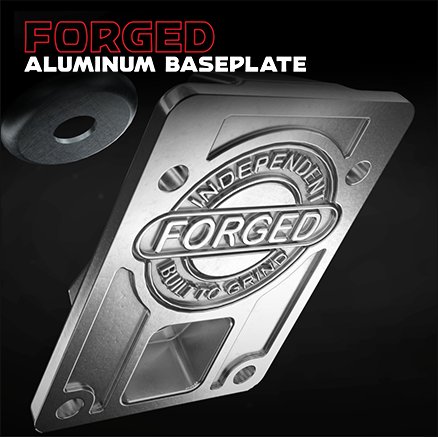
A forged baseplate is thinner than a cast one for the same load capacity. This saves weight and lowers the truck. Manufacturers state the difference: Independent's Stage 11 Forged Hollow is 53.5 mm high instead of 55 mm, and the Mid Forged Hollow is 50.5 mm instead of 52 mm. At Thunder, the forged baseplate is 1 mm lower than the cast Team baseplate in every size.
- Height
- 1 to 1.5 mm lower than the same truck with a cast baseplate
- Effect on wheels
- Correspondingly less clearance. Allow for this with large wheels.
- Effect on bolts
- Thinner plate: mounting bolts that were barely long enough with a cast baseplate now have more thread protruding.
- Ride feel
- Board sits slightly lower. Geometry and steering behavior remain the same.
Inverted kingpin
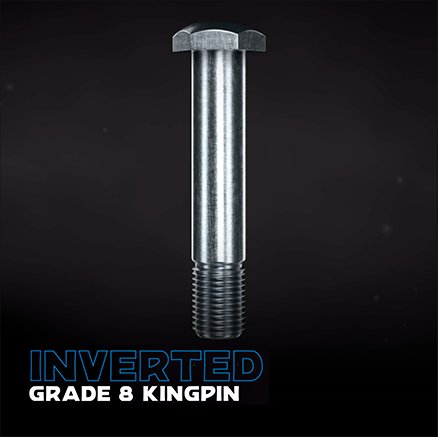
With a standard kingpin, the bolt is inserted into the baseplate from below, and the nut sits on top of the hanger. The nut and threaded end protrude beyond the hanger. With an inverted kingpin, the bolt is reversed: it is screwed in from the hanger side, its flat head with a hex socket rests on the top washer, and the thread engages with the baseplate or a nut inside it. When the board is standing on its wheels, the bolt head points downward toward the ground.
- The nut sits on the hanger and protrudes beyond it.
- Adjust using the 9/16" wrench on any skate tool.
- Kingpins are widely available as spare parts.
- During tilted grinds such as Smith and Feeble, the nut can catch on the edge and is ground down over time.
- Nothing protrudes beyond the hanger. Significantly more clearance for tilted grinds.
- Adjust using a hex key on the bolt head. Not every skate tool has the right size.
- The kingpin and often the baseplate are model-specific. Replacements are available only from the manufacturer.
- According to Thunder, slightly lighter because there is no nut.
Slappy's comparison table shows how much clearance the inverted kingpin provides: the Slappy Classic has 6.3 mm of clearance between the kingpin and the top edge of the hanger, while the inverted kingpin version has 9 mm. The same table lists 3.9 mm for the Independent Stage 11 and 6.3 mm for the Independent Mid with an inverted kingpin. The full table is available under Truck Heights and Geometry. Inverted kingpins are available from Independent (Mid), Thunder (Inverted Editions), Royal (Inverted), Slappy and Krux, where the version is called DLK.
#Weight comparison in grams
Reliable weights are hard to find. Few manufacturers publish them, and depending on the figure, bushings and nuts may or may not be included in the weight. The following tables therefore clearly distinguish between manufacturer specifications and approximate values not supplied by the manufacturer. All values are per truck. For a board, multiply by two.
| Size | Axle | AF1 | AF1 Hollow | AF1 Low |
|---|---|---|---|---|
| 22 | 7.75" | 366 g | 340 g | 348 g |
| 33 | 8.0" | 379 g | 352 g | 361 g |
| 44 | 8.25" | 387 g | 359 g | 370 g |
| 55 | 8.5" | 396 g | 368 g | 379 g |
| 60 | 8.75" | 405 g | 376 g | 388 g |
| 66 | 9.0" | 412 g | 382 g | N/A |
| 77 | 9.25" | 427 g | 396 g | N/A |
Source: Ace sizing chart. Ace Classic for comparison: 22 (7.6") 352 g, 33 (8.0") 368 g, 44 (8.35") 397 g, 55 (9.0") 412 g.
| Size | Classic | Hollow | Lows | Ultra Low Inverted Hollow Light |
|---|---|---|---|---|
| 7.75 | 367 g | 347 g | 336 g | 330 g |
| 8.0 | 374 g | 354 g | 343 g | 337 g |
| 8.25 | 381 g | 361 g | 350 g | 344 g |
| 8.5 | 388 g | 368 g | 357 g | 351 g |
| 8.75 | 395 g | 375 g | 364 g | 358 g |
| 9.0 | 402 g | 382 g | 371 g | 365 g |
Source: Slappy specification table. Lurpiv Solid (approximate value, not specified by the manufacturer): 140 at 353 g, 145 at 359 g, 150 at 365 g, 160 at 375 g.
| Brand | Standard | Lighter lines | Lightest line |
|---|---|---|---|
| Independent Stage 11 | Standard: 377 g | Hollow: 334 g. Forged Hollow: N/A | Forged Titanium: 323 g |
| Thunder | Team (Standard): 337 g | Lights: 318 g. Hollow Lights: N/A | Titanium Lights: 283 g |
| Venture | Standard: 357 g | V-Lights: 340 g | V-Hollow: 320 g |
| Royal | Inverted Kingpin: 360 g | N/A | N/A |
| Krux | 351 g | N/A | N/A |
| Ace | 363 g | N/A | N/A |
All trucks are sized for 8.0". The values do not come from the manufacturers and some refer to older model generations (for example Venture V-Lights). Ace is listed here at 363 g, while the manufacturer specifies 379 g for the current AF1 33 and 368 g for the Classic 33. The values are useful for judging the order of magnitude, not for comparing weights to the gram.
What can be said despite all the uncertainty: within a brand, the standard truck and the lightest version differ by around 40 to 55 g per truck, or 80 to 110 g for the whole board. The step from standard to hollow saves 20 to 45 g per truck, and the step to titanium saves another 10 to 35 g. Across all brands, the heaviest standard truck and the lightest titanium truck in the table are separated by a good 90 g. Magnesium trucks are considerably lighter still.
#Durability and grind feel
You grind on the hanger, and the hanger is made from the same casting across Standard, Hollow, Forged and Titanium models from the same brand. There are therefore hardly any differences within a brand when grinding. The differences are between brands and between aluminum and magnesium.
- Alloy hardness: A softer hanger slides more smoothly and locks in faster, but wears down faster. A harder one lasts longer and feels more slippery on rough edges.
- Wall thickness: The amount of aluminum between the grinding surface and the axle determines the lifespan. Lightweight hangers with cutout areas have less material to wear through.
- Hollow axle: It sits just as deep in the hanger as a solid one. The hanger does not wear through any sooner. Some people hear a higher-pitched sound when landing on hollow trucks. This does not change how they slide.
- Magnesium: Lighter than aluminum, but grinds noticeably differently. Many riders describe magnesium hangers as slower on concrete and stone. This is based on experience, not measurement.
- Kingpin: The kingpin breaks more often than any other part. Solid kingpins can withstand more than hollow ones. However, it can be replaced individually on most trucks.
- Baseplate: Cast baseplates rarely break, forged ones even less often. What matters is that the mounting bolts are tight. A loose baseplate works itself apart at the holes.
| Construction | Durability | Typical weak point | Suitable for |
|---|---|---|---|
| Standard (all solid) | Most material to wear through | Hanger wears down from grinds | Everything, including heavy riders and large gaps |
| Hollow | Equivalent for normal skating | Hollow kingpin under very hard impacts | Street, Park, Transition |
| Forged Hollow, Lights | Stronger baseplate, rest like Hollow | Hollow kingpin | Technical street skating, Park |
| Titanium | Tough, bend-resistant axle | Hollow kingpin, high replacement cost | Anyone who counts every gram |
| Magnesium | Lighter, more vulnerable to hard impacts | Hanger and kingpin | Flatground and technical street skating |
Assessment based on construction principles and our experience in the shop. Manufacturers' load tests are not public.
Typical defects and how to fix them are described in the article Trucks: typical defects.
#Value for money: what is worth it for whom
Prices rise with each level: Standard is the cheapest, Hollow costs a little more, Forged Hollow more again, and Titanium is clearly the most expensive. The weight savings do not increase to the same extent. The first step saves the most weight per franc.
- Cheapest entry point into a branded truck.
- Same geometry and feel as the expensive lines.
- Lasts the longest and is the most forgiving.
- Around 40 to 110 g more weight on the board compared with the lightweight lines.
- Best ratio of extra cost to weight savings.
- 40 to 60 g less on the board according to manufacturer tables.
- Height and geometry unchanged. You can switch without having to adjust.
- Also has a forged baseplate: a little lighter and 1 to 1.5 mm lower.
- The lower height is often desirable for technical street skating.
- With large wheels, factor in the lost clearance.
- Lightest version with a solid axle that is not hollowed out.
- Small additional weight saving over Forged Hollow at a substantial price premium.
- Not every size is available. Thunder offers the Titanium Lights only from 145 to 149.
Also consider where else you can save weight. Wheels and bearings rotate and have a greater effect on acceleration than stationary mass. A smaller wheel diameter often saves more than switching from standard to hollow. Setups by riding style shows how the parts work together.
#Frequently asked questions about construction types
What does hollow mean for trucks?
The axle and kingpin are drilled hollow lengthwise. According to manufacturers' tables, this saves about 20 to 30 g per truck. In some lines, only one of the two parts is hollow, for example, only the kingpin in the Thunder Lights.
What does forged mean?
Forged. With street trucks, this almost always refers to the baseplate. Instead of being cast, it is pressed from solid aluminum under high pressure, making it stronger and allowing it to be thinner. The truck is 1 to 1.5 mm lower.
Are hollow trucks less strong?
Not noticeably for normal street and park skating. The center of a round rod carries hardly any load when it bends. If you are very heavy or often jump high drops, a solid kingpin and solid axle give you a greater safety margin.
Are titanium trucks worth it?
Only if weight is very important to you. Compared with the next-lightest version with a steel axle, you save another 10 to 35 g per truck and pay significantly more for it. For the feel of the ride, the step from standard to hollow makes more of a difference.
Which trucks are the lightest?
In the size for 8.0", Thunder Titanium Lights lead at around 283 g, followed by Venture V-Hollow and Independent Forged Titanium at around 320 g (approximate values, not specified by the manufacturer). Most standard trucks weigh between 340 and 380 g.
What does an inverted kingpin do?
It provides more clearance above the hanger. On smith, feeble and similar grinds, there is no nut to catch on the edge. It has little effect on weight or steering. For adjustment, you need an Allen key instead of the usual 9/16" wrench.
Do forged trucks grind differently?
No. The baseplate is forged, grinding is done on the hanger, and it is the same casting as on the standard truck. You are more likely to notice the 1 to 1.5 mm reduction in height when popping than when grinding.
Can I mix parts from different lines?
Within the same brand and generation, often yes: hangers and baseplates of the same size generally fit together, as do kingpins and bushings. On inverted kingpin models, the baseplate and kingpin are separate parts. Parts from different brands do not fit together because the pivot and geometry differ.
Sources (10)
- Independent Truck Company: Trucks (Linien und Höhen)
- Thunder Trucks: Truck Styles
- Thunder Trucks: Size Chart (Team, Forged und T-II Baseplate)
- Venture Trucks: Katalog Fall 2026
- Ace Trucks: Sizing Chart (Gewichte)
- Ace Trucks: About
- Royal Trucks: Trucks
- Krux Trucks: Trucks
- Slappy Trucks: Size Chart, Gewichte und Kingpin Clearance
- Slappy Trucks: Lightest Skateboard Trucks
Something missing or wrong? Report an error