Key points
- Every skateboard needs 8 size 608 bearings: 8 mm bore, 22 mm outside diameter, 7 mm width. They fit in every skateboard wheel.
- The ABEC number describes manufacturing tolerances for industrial bearings. It says nothing about impact resistance, material, lubrication or sealing, and that is exactly what matters for skating.
- Steel bearings from a good skate brand are enough for almost everyone. Bones Reds are by far the best-selling skateboard bearings in the world, while Bones Swiss have been the benchmark for decades. Ceramic balls do not rust and are lighter, but cost several times more.
- Spacers and speed rings keep the bearings parallel and protect them from lateral pressure. Speed rings should always be fitted, while spacers are particularly worthwhile with soft wheels and slides.
- Water and dirt are the main enemies. Cleaning and re-oiling usually brings sluggish bearings back to life, but cannot fix rust in the race.
#608 size and construction
Skateboards roll on an industrial standard: the 608 size deep-groove ball bearing. Each wheel has two, one on each side, for a total of eight per board. Because all skateboard wheels and all standard trucks are designed to this size, every skate bearing fits in every wheel.
- Bore (inside)
- 8 mm, fits the axle
- Outside diameter
- 22 mm, fits the bearing seat of the wheel
- Width
- 7 mm
- Balls
- usually 7, 6 larger ones in some models
- Quantity
- 8 per board, sold in sets of 8
The parts
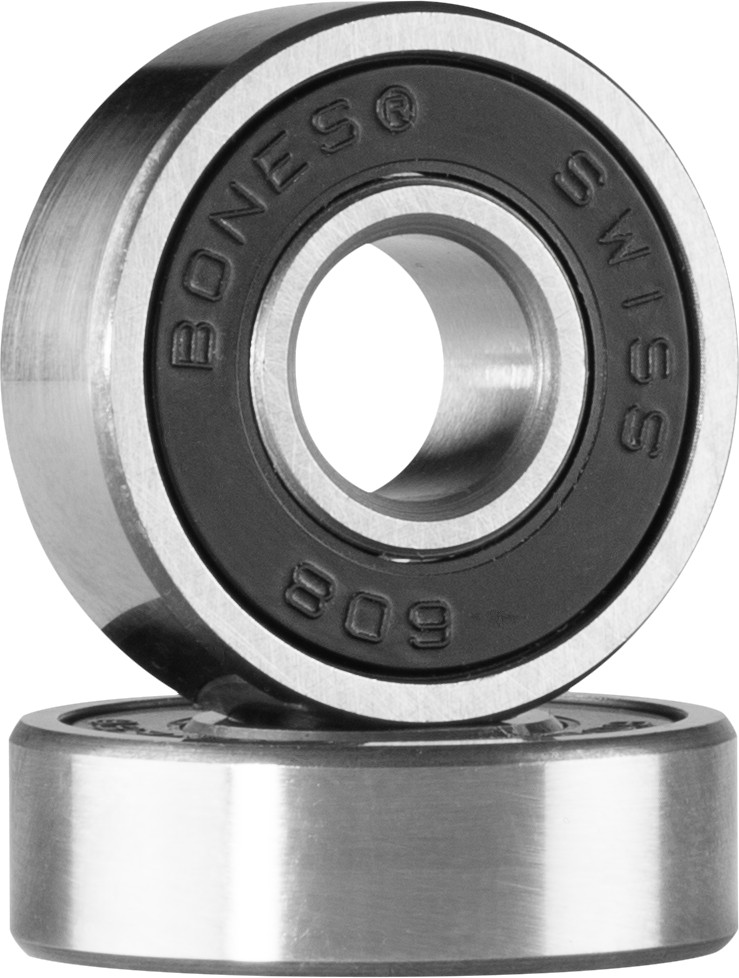
- Outer ring: sits firmly in the urethane or the core of the wheel and rotates with it.
- Inner ring: sits on the axle and remains stationary. It is used to clamp the bearing between the axle shoulder, spacer and nut.
- Balls: roll in the raceways (grooves) of the two rings. Made of hardened steel or ceramic.
- Cage (retainer, cage): keeps the balls equally spaced. In skate bearings, usually made of nylon or a similar plastic, in basic bearings, made of stamped sheet metal.
- Shield (cover): closes the side of the bearing, keeping lubricant in and dirt out.
Shields: rubber or metal
- Steel disc with a rubber coating, clipped into the groove in the outer ring
- can be lifted out with a needle and reinserted
- non-contact or lightly rubbing, seals better against dust
- standard for skate brands, for example on only one side in Bones bearings, with the back left open
- thin sheet metal disc, held by a snap ring (C-ring) or permanently press-fitted
- press-fitted shields are damaged when removed, so the bearing cannot be cleaned properly
- a small gap to the inner ring, dust and water get in more easily
- common in inexpensive bearings and complete boards
Designations such as «608-2RS» or «608ZZ» indicate exactly that: RS stands for rubber seals, ZZ for metal shields on both sides. Bearings with no shields at all also exist. They spin very freely and are noticeably louder, but collect dirt faster. The Bronson Raw are deliberately built this way.
#ABEC scale and «Skate Rated»
ABEC stands for Annular Bearing Engineering Committee, a committee of the American bearing industry. The scale has the ratings 1, 3, 5, 7 and 9. The higher the number, the tighter the manufacturing tolerances: the rings are more accurately round, the dimensions vary less, and the raceways are smoother.
This matters for machines that rotate very fast and very precisely. Bones provides the calculation: milling machines run at 20 000 to 30 000 revolutions per minute, which requires ABEC 7 or 9. A 54-mm wheel rotating at 20 000 revolutions per minute would be traveling at around 204 km/h. When skating, even at just under 50 km/h, you only reach about 4700 revolutions per minute, and most skating takes place below 2000 revolutions per minute. With a 54-mm wheel, that is around 20 km/h.
What ABEC does not measure
- Resistance to impacts and lateral forces, such as landings, turns and slides
- Quality and grade of the steel and balls
- Type and suitability of the lubricant
- Design and material of the cage
- The clearance between the balls and the raceway
- Sealing, maintenance and cleaning
«Skate Rated»
Bones Bearings does not provide an ABEC rating at all and instead prints «Skate Rated» on the packaging. This means that tolerances, bearing clearance, material and lubrication are designed for the stresses of skating rather than an industrial standard. This is a manufacturer's designation, not an independent standard. The idea behind it is sound, however, and other skate brands such as Bronson do the same.
#Steel, ceramic, titanium and lubrication
- Rings and balls made of hardened bearing steel
- Robust and inexpensive, a good set costs about 20 to 60 US dollars
- Rusts if water gets in
- The quality of the steel, balls and surface makes the difference between product lines
- Balls made of silicon nitride, rings still made of steel
- Balls are lighter and harder than steel and do not rust
- Less friction, less heat, requires less lubricant
- The steel rings can still rust
- Expensive: around 80 to 155 US dollars per set
- in skateboarding, usually steel bearings with a titanium-containing coating
- the coating is intended to harden the surface and protect against rust
- the benefit depends heavily on the quality of the bearing underneath
Opinions differ on ceramics. Bones describes the ceramic balls as lighter, harder, stronger, and more durable than the best steel balls. On the other hand, it is often said that ceramic balls are more likely to chip under hard impacts and are therefore better suited to ramps than street. What is certain: the speed gain over a good, well-maintained steel bearing is small, while the price difference is large.
Oil or grease
- thin, low resistance, the bearing spins freely immediately
- is displaced and washed out more quickly
- needs replenishing more often, 1 to 2 drops per bearing are enough
- Examples: Bones Speed Cream, Bronson High Speed Ceramic Oil
- viscous, stays in the bearing and provides better protection against water and dust
- noticeably slower at first, breaks in after a few kilometers
- lasts a long time without maintenance
- Examples: bearings filled with grease instead of oil at the factory
#Brands and lines
Bones Bearings
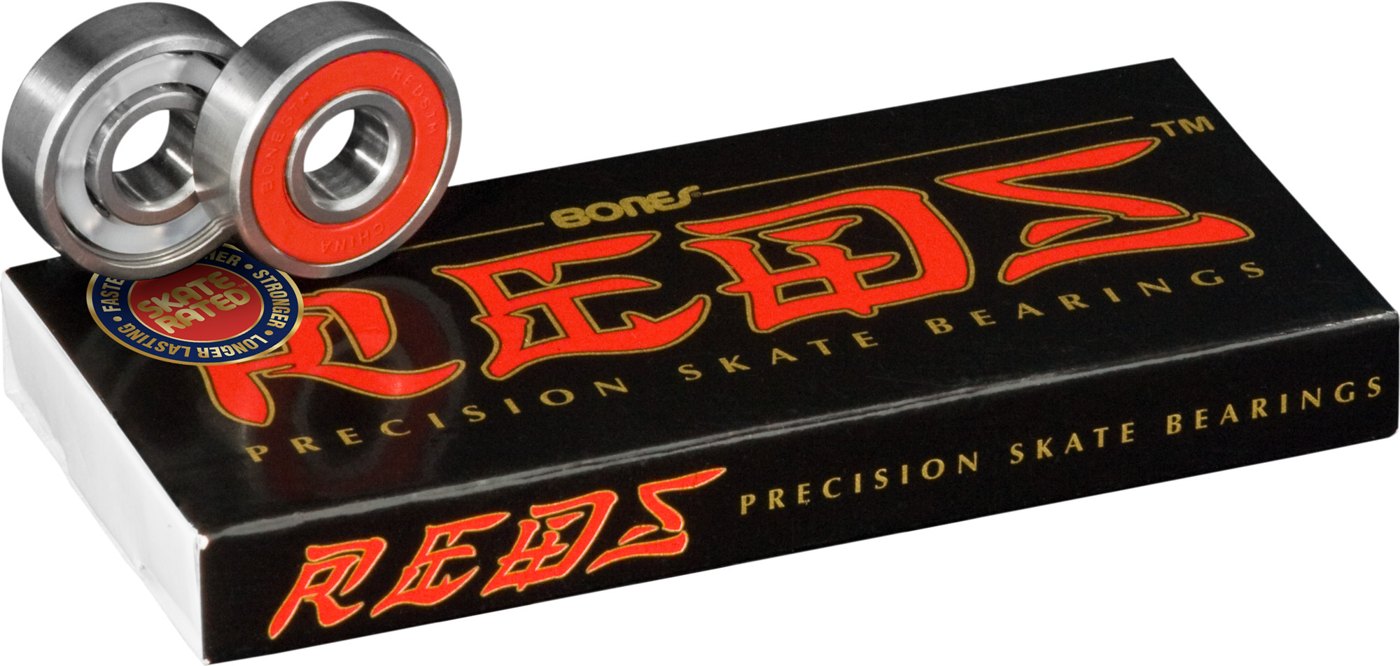
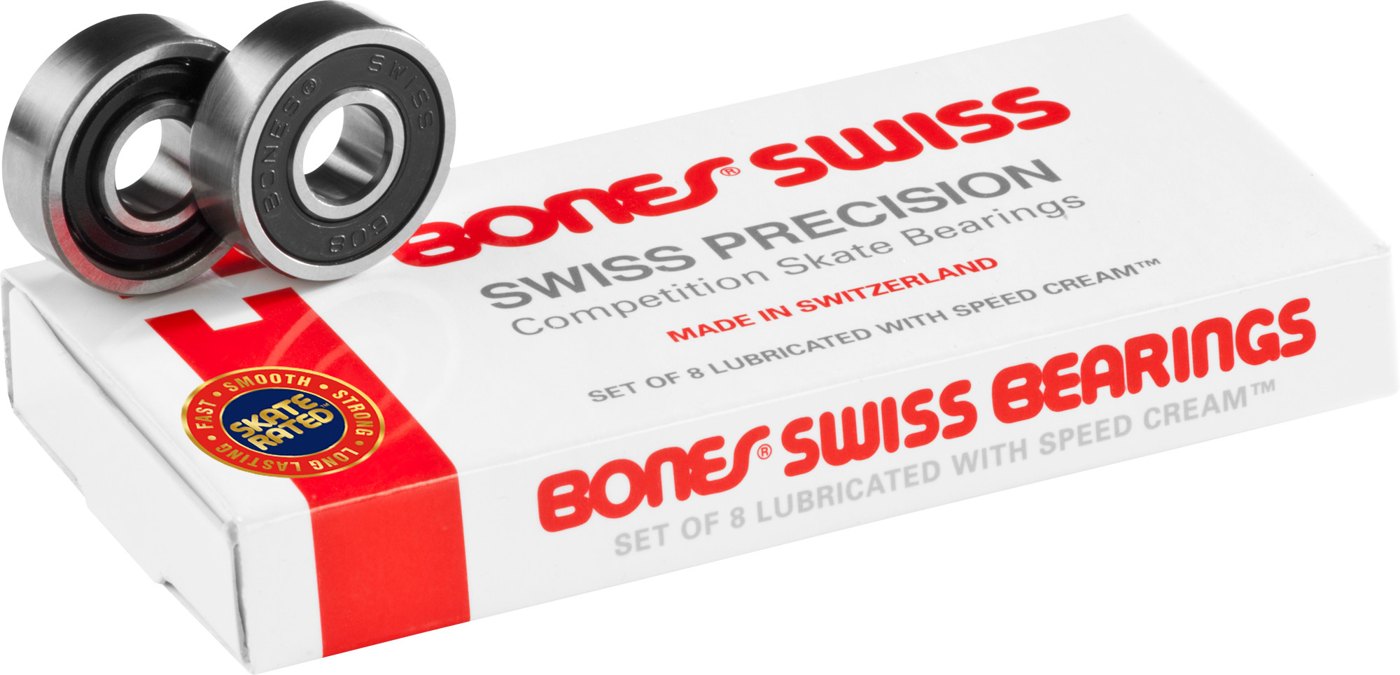
Bones Bearings comes from the same company as Bones Wheels and Powell-Peralta. There are two families: Reds, made in China to Bones specifications, and Swiss, which come from Switzerland. All lines have a single, non-contact, removable rubber shield, a nylon cage, and are oiled with Speed Cream at the factory.
Bones Swiss have been the standard against which every other skateboard bearing must be measured for decades. They are extremely durable: if you clean and oil them from time to time, you can ride the same set through many decks. Many pros swear by them and ride nothing else. Bones Reds are by far the best-selling skateboard bearing in the world and the first choice for most people: the same construction with a rubber shield and nylon cage, the same lubrication, a lower price.
| Line | Origin | Distinguishing feature |
|---|---|---|
| Swiss | Switzerland | the classic since the early eighties, made by a Swiss bearing manufacturer. Supplied with 4 spacers |
| Super Swiss 6 | Switzerland | 6 larger balls instead of 7, for more speed, strength, and durability. With 4 spacers |
| Swiss Ceramics | Switzerland | Swiss with ceramic balls, only 1 drop of oil per bearing needed. With 4 spacers |
| Reds | China | the standard and the best-selling bearing: developed by Bones as an affordable alternative to Swiss |
| Big Balls Reds | China | 6 balls instead of 7, 17 percent larger according to Bones. Intended to roll faster, last longer, and roll over dirt more effectively |
| Super Reds | China | better steel for the rings, higher-quality balls, finer surface. According to Bones, as fast as Reds, but quieter, smoother, and longer-lasting |
| Race Reds | China | extended inner ring with a built-in half spacer (0.200"), two bearings provide 0.400" of spacing. Replaces spacers and speed rings |
| Ceramic Reds | China | Reds with ceramic balls |
Information according to Bones Bearings. You can find current prices in our shop.
Bronson Speed Co.
| Line | Feature |
|---|---|
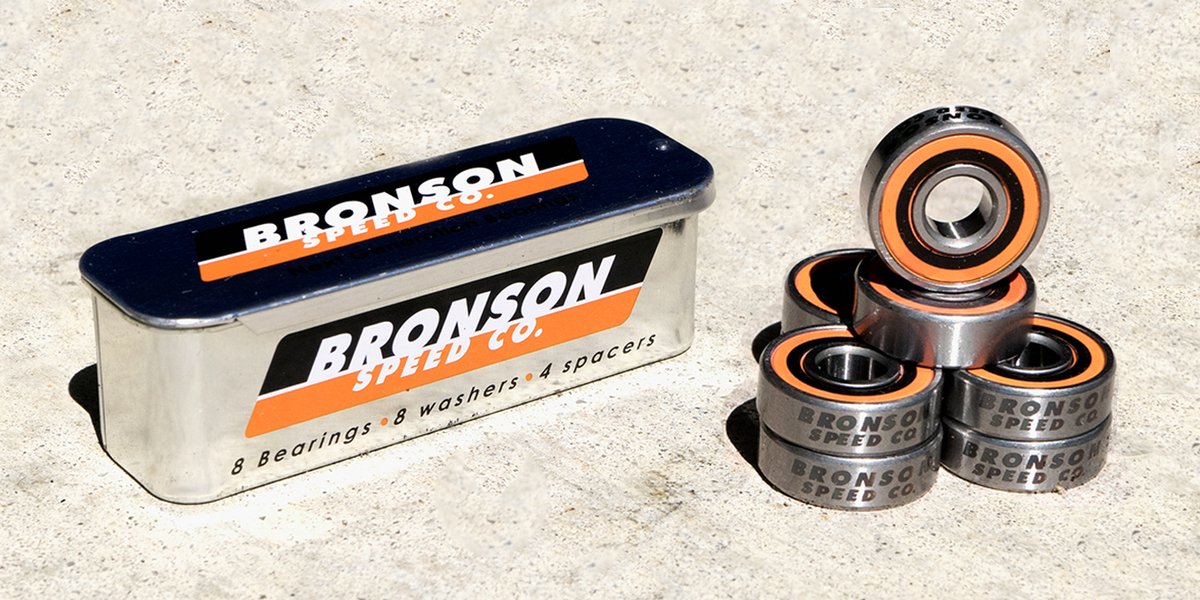
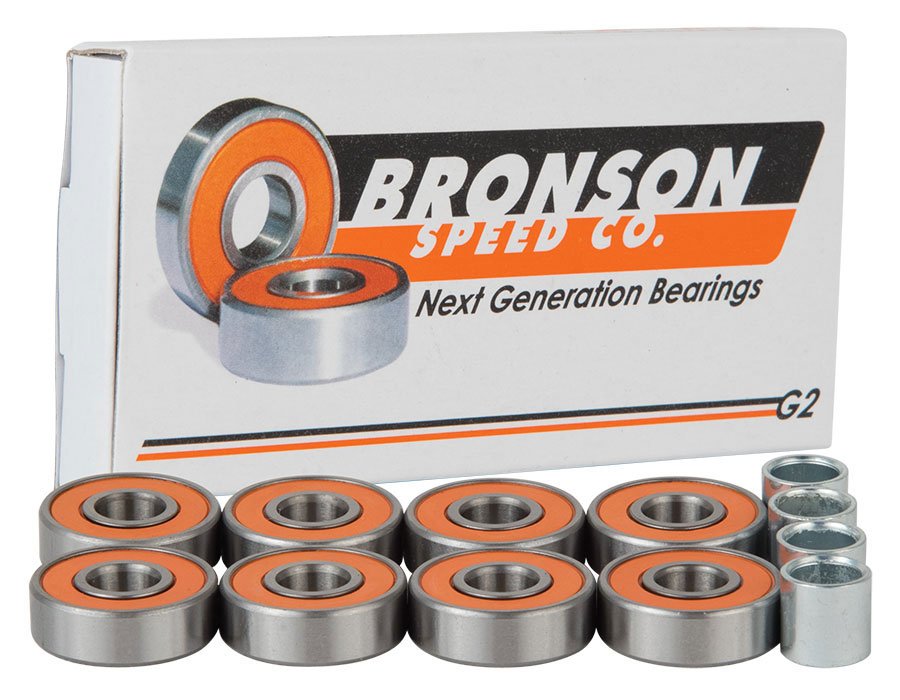
| G2 | deep raceway grooves (Deep Groove Raceways) to prevent damage from side impacts, straight-cut, low-friction shields designed not to pop out, High Speed Ceramic Oil |
| G3 | like G2, plus micro-grooved raceways for a better oil film, fiberglass-reinforced nylon cage (Max Impact Cage), removable non-contact rubber shields. Install with the ball side facing outward, cage side facing inward |
| Raw | no shields or shield grooves at all, tungsten-coated raceways for dry lubrication. Spins very freely and is deliberately loud |
| Ceramic | silicon nitride balls, deep and micro-grooved raceways, Max Impact Cage. Also available with a box that serves as a cleaning container |
Information according to Bronson. Bronson says it packs the bearings under nitrogen to keep the oil fresh until opening.
Other brands
- Independent: offers the GP-B, GP-R and GP-S lines under «Genuine Parts». The GP-S are in the entry-level price range.
- Ace: bearings from the truck brand Ace Trucks MFG. Well made and a good choice for anyone who already rides Ace trucks and wants their setup from a single brand.
- Spitfire: offers an affordable bearing with the Cheapshots.
#Spacers and speed rings
Spacers (distance sleeves) are small metal tubes that sit inside the wheel between the two bearings on the axle. For skateboard wheels, they are approximately 10 mm long (0.400") and have an 8 mm bore. Speed rings (speed washers) are thin washers. Each wheel needs two: one between the axle shoulder and the inner bearing, and one between the outer bearing and the nut. They are usually supplied with the trucks.
What spacers are for
- They support the inner races against each other. The bearings stay parallel even when lateral forces act on them.
- You can tighten the axle nut firmly without putting the bearings under strain. The inner race, spacer, inner race and speed rings form a solid block, but the wheel still spins freely.
- Without a spacer, every turn and slide pushes the bearings at an angle in their seats. This costs speed, lets the wheel move sideways during a slide and shortens its service life.
- In soft wheels without a core, they prevent you from pushing the bearings into the urethane when tightening the nut.
What speed rings are for
The washers ensure that only the inner race contacts the axle shoulder and nut. Without them, the nut rubs against the shield or the outer race and slows the wheel down. Speed rings are not an upgrade, they should always be installed. If one is missing, you will notice that a wheel spins less freely than the others.
| Situation | Speed rings | Spacers |
|---|---|---|
| normal street and park setup with hard wheels | yes | recommended, many skate without them |
| lots of powerslides and slide tricks | yes | yes |
| soft wheels without a core (cruiser, filmer) | yes | yes |
| high speed, downhill, bowl | yes | yes |
| bearings with built-in spacer (e.g. Bones Race Reds) | no, already built in | no, already built in |
#Installation and removal
You only need a skate tool or a 1/2" wrench. A bearing puller or bearing press is convenient, but not necessary. The truck itself is your tool.
Removal
- Loosen the wheel
Remove the axle nut and outer speed ring and set them aside.
- Pull the wheel halfway off
Pull the wheel off the axle until only the inner bearing remains on the end of the axle.
- Pry out the bearing
Tilt the wheel outward with gentle pressure while turning it slightly. The bearing comes out of its seat. Do not pry with a sudden motion, or it may become misaligned or the shield may bend.
- Second side
Remove the spacer, turn the wheel over and remove the second bearing in the same way.
Installation
- Place the first bearing on the axle
Place a bearing on the axle with the shield facing down. For bearings with one shield, the open side faces up, toward the center of the wheel once installed.
- Press the wheel on
Place the wheel straight on the bearing and press evenly with the heels of both hands until the bearing sits flush in its seat. Never press on the shield.
- Insert the spacer
Remove the wheel, place the second bearing on the axle, put the spacer on top of it and press the wheel on, empty side first.
- Mount
Speed ring, wheel, speed ring, nut. Tighten as described above and check that the wheel spins freely and smoothly.
For the complete assembly of a board, see Assembling a skateboard.
#Cleaning bearings: step by step
Cleaning is worthwhile if the bearings crunch, run rough, or after a dusty or damp session. A general guideline is three to six months. Removable shields are required. Work in a well-ventilated place and wear gloves.
- Cleaner
- Isopropyl alcohol (as pure as possible) or acetone
- Container
- Plastic or metal with a lid, no glass
- Tools
- Pin or fine blade, paper towels, skate tool
- Lubricant
- Bearing oil, 2 drops per steel bearing, 1 drop for ceramic
- Remove the bearings
Remove all eight bearings from the wheels and wipe the outside with a dry cloth.
- Remove the shields
Insert the pin under the edge of the rubber shield at the inner ring and carefully pry it out. Do not bend or cut it. Do not put the shields in the solvent, rubber can swell in it. Just wipe them off.
- Soak and shake
Put the bearings in the container, cover them with cleaner, close the lid and shake vigorously. If the liquid changes color, replace it and repeat the process until it stays clear.
- Dry immediately
Remove the bearings, tap them out on paper towels and let them dry completely. Compressed air speeds this up. Do not leave the bearings wet, bare steel rusts quickly.
- Check
Turn each bearing by hand. It should run freely without scratching. If it still scratches, repeat the cleaning. If that does not help, the bearing is damaged.
- Oil
Apply 2 drops of bearing oil to the balls, or 1 drop for ceramic bearings. More does not help, it only slows the bearing down and attracts dust.
- Install the shields
Press the shields in all the way around with your thumb until they sit flat in the groove. Turn the bearings a few times to distribute the oil. A trace of oil on the outer surfaces protects against rust.
- Install
Press the bearings back into the wheels, and don't forget the spacers and speed rings.
Removing the cage is not necessary for normal cleaning and is best left to experienced people. If you do it, push it out, don't pry it out, or you will damage the ball pockets.
#Lifespan, water and rust
A good bearing lasts for years when used in dry conditions and occasionally maintained. Bearings are rarely ruined by mileage, but rather by water, fine dust and hard side impacts.
Water and rust
Bearing steel is not stainless. If water gets in, it displaces the lubricant, and rust forms on the exposed raceways within a short time. Even light surface rust makes the raceway rough. The bearing then runs noisily and slows down. Puddles, wet asphalt and rain are therefore off limits, and a board should not be washed with a garden hose.
- Got wet
Remove the bearings and take off the shields, preferably on the same day.
- Dry
Rinse with isopropanol, which displaces the water, and allow to dry completely.
- Re-oil
Apply fresh oil, insert the shields and reinstall. If you wait for days, you will usually find rust already.
When a bearing is finished
- it grinds or scrapes even after cleaning
- it stops abruptly or catches when turning
- visible rust on the balls or raceways
- noticeable play: the inner ring can be tilted against the outer ring
- broken cage, missing balls or a bent shield that rubs
#Frequently asked questions about bearings
Do all bearings fit all wheels?
Yes, as long as they are size 608 skateboard bearings (8 x 22 x 7 mm). That is the standard for skateboard and longboard wheels. Bearings with a 7 mm bore are available for some roller skate axles, but they do not fit skateboard axles.
What ABEC rating do I need?
No particular rating. The ABEC rating describes manufacturing tolerances and says nothing about durability, material or lubrication. Many skate brands no longer specify it at all. A branded bearing without an ABEC rating is generally a better choice than a no-name «ABEC 9» bearing.
Are ceramic bearings worth it?
Only if you skate a lot, maintain your bearings and do not mind the extra cost. Ceramic balls do not rust, are lighter and need less oil. The noticeable speed gain over a good steel bearing is small.
Do I need spacers?
They are recommended for hard Street wheels, but they are not essential. You should use them for soft wheels without a core, for frequent slides and for high speeds. Speed rings should be used in every case.
How often should I clean my bearings?
When they run rough or grind, immediately after they get wet, otherwise about every three to six months. If you only skate on clean, dry surfaces, you can clean them much less often.
My new bearings barely spin by hand. Are they defective?
No. Fresh lubricant slows down an unloaded bearing, especially grease. After a few kilometers, it has distributed itself. What matters is how the board rolls under load, not how long the wheel spins in the air.
Why does a wheel squeak or whistle?
Usually a bearing is running dry, or a shield is rubbing because it is bent or a speed ring is missing. Remove the bearing, check the shield, clean and oil the bearing. If the noise persists, replace the bearing.
Can I just keep skating after riding in the rain?
Your bearings will not forgive you. Remove them that same day, dry and oil them. Otherwise the raceways will rust, and rust cannot be cleaned off.
Sources (12)
- Bones Bearings: ABEC vs. Skate Rated
- Bones Bearings: Skate Rated
- Bones Bearings: Maintaining Your Bearings
- Bones Bearings: History
- Bones Bearings: Skateboard Bearings (Sortiment)
- Bones Bearings: Super Reds
- Bones Bearings: Big Balls Reds
- Bones Bearings: Race Reds
- Bones Bearings: Super Swiss 6
- Bones Bearings: Swiss Ceramics
- Bronson Speed Co.: Bearings
- Independent Trucks: Hardware
Something missing or wrong? Report an error